

“The limits of my language mean the limits of my world.” —Ludwig Wittgenstein
In 1964, audiences around the world were introduced to a word so absurdly long, whimsical, and seemingly meaningless that it instantly entered popular culture. Supercalifragilisticexpialidocious burst onto the screen through Mary Poppins, accompanied by singing, dancing, and a delightfully paradoxical explanation: it was something to say when you had nothing to say.
At first glance, it was pure entertainment, a playful linguistic acrobatics act designed to delight children and amuse adults. Yet beneath the charm lies a profound insight about the human condition. The word emerged not to describe something ordinary, but something extraordinary.
Most people remember the melody. Fewer remember the paradox.
For what is a word created for moments when words fail?
It appears to be nonsense. Yet history has a peculiar habit of hiding profound truths inside playful disguises.
Human civilization has always encountered experiences that transcended available language. Explorers sailed oceans for which there were no maps. Scientists observed phenomena that had no names. Entrepreneurs built businesses that do not fit into any category. Artists attempted to describe emotions that elude vocabulary.
Language has never been a complete representation of reality. It has always been a delayed reaction to reality.
Reality arrives first. Words arrive later.
The gap between the two is where uncertainty lives. That’s where innovation lives too. The history of human progress is, in many ways, the history of bridging that gap.
Before there was the word „electricity,” there were mysterious forces. Before there was „gravity,” there were falling objects. Before there was „burnout,” there were exhausted people. Before there was „digital transformation,” there were organizations struggling to adapt to technological change.
The phenomenon always precedes the label.Reality is the author. Language is merely the editor.
More than sixty years later, businesses face a remarkably similar discrepancy. The modern organization is surrounded by realities that seem to transcend language:
- AI is transforming work faster than executives can define it.
- New business models emerge before industries develop names for them.
- Customers experience products that blend software, services, communities, and algorithms in ways that traditional categories cannot capture.
- Leaders confront technological possibilities that did not exist when their strategic frameworks were written.
For perhaps the first time in modern history, the pace of technological progress has dramatically accelerated this phenomenon. AI, synthetic biology, spatial computing, autonomous systems, algorithmic creativity, and automated reasoning are not simply advancing existing industries, they are creating entirely new dimensions of possibility. New realities are emerging faster than businesses can name them, map them, or imagine their implications.
Ask ten executives to define AI, and one often receives ten different answers. Is it software? Infrastructure? A co-worker? An operating system for knowledge work? A strategic capability? A utility? The truth is that it is all of these and none of them.
We are living in a time when language is struggling to keep up with invention. And it is here that the lesson of Supercalifragilisticexpialidocious becomes unexpectedly relevant. The word reminds us that when existing language becomes insufficient, humanity does not stop progressing. Instead, it invents a new language.
Businesses that understand this principle gain a strategic advantage because they recognize that naming is not merely communication. Naming is creation.
For centuries, language has served as humanity’s map of reality. We name things to understand them. We classify them to manage them. We define them to communicate about them. Yet history repeatedly demonstrates that reality evolves faster than our dictionaries.
The challenge of modern business is no longer simply managing change. It is managing experiences, technologies, and possibilities that exceed available language.
But what does this really mean?
The tyranny of existing categories. The first opportunity lies in the deliberate use of what might be called strategic placeholder language.
Human beings possess a powerful cognitive instinct. Whenever we encounter something new, we immediately try to classify it: Is it a bird? Is it a machine? Is it software? Is it consulting? Is it average? Is it retail?
Categories provide comfort because they reduce uncertainty. A labeled object feels safer than an unlabeled one.
Businesses exhibit exactly the same behavior.
The moment an unfamiliar idea appears inside a boardroom, the first questions are rarely about potential. They are usually about classification.
Which department owns this? Which budget funds it? Which competitors resemble it? Which market category does it belong to?
The questions appear sensible.
Often, they are lethal.
Because truly transformative ideas almost never fit into existing categories.
History repeatedly demonstrates this pattern. A transportation platform emerges but owns no vehicles. An accommodation business emerges but owns no hotels. A media company grows without producing traditional media. A technology platform becomes one of the world’s largest employers without resembling an employer in any conventional sense.
In every case, observers initially struggled to describe what they were seeing. Investors misunderstood it. Regulators misunderstood it. Competitors misunderstood it…Sometimes even the founders misunderstood it.
The challenge is not operational. The challenge is linguistic. The existing vocabulary is too limited for the emerging reality.
Businesses frequently kill innovation because they force new ideas to be translated into an old language before they have had time to mature. A breakthrough concept is treated like a product when it is actually a platform. A platform is treated like software when it is actually a network. A network is treated like a service when it is actually an ecosystem. The wrong label creates the wrong strategy. And the wrong strategy eventually creates failure.
Therefore, one of the hidden responsibilities of leadership is to protect ambiguity long enough for understanding to emerge. The future often arrives wearing a name tag that says „Unknown.” The temptation is to replace it immediately. The wiser response might be to leave the label in place for a while.
A temporary placeholder, a conceptual „Supercalifragilistic”, creates room for exploration. It allows organizations to discuss possibilities before they are constrained by definitions. It acknowledges uncertainty not as a weakness but as an essential stage of discovery.
Remember, language follows reality, it doesn’t lead it. In this sense, innovation often begins not with answers, but with linguistic patience.
The strategic power of naming There is a subtle but important distinction between discovering a market and naming a market. The first creates opportunity. The second creates perception. And perception often determines who captures value.
Throughout the history of business, entire industries have been transformed by the introduction of a single phrase. Before the term „network effects” became common, network effects already existed. Before organizations talked about „technical debt,” engineers were already accumulating it. Before the „creative economy” entered the mainstream vocabulary, millions of people were already monetizing audiences.
And yet, the moment a useful term emerged, something changed:
- Invisible patterns become visible.
- Scattered observations become coherent concepts.
- Isolated discussions became strategic conversations.
Language did not merely describe reality. Language reorganized reality.
This insight carries profound implications for businesses operating in the age of AI. Many executives assume that innovation consists primarily of building new products. In reality, some of the most influential innovators in history have been builders of vocabulary.
They introduced concepts that changed the way people think. Once people think differently, they behave differently. Once they behave differently, markets change.
Inventing a useful term is often an act of strategic power. The company that names a phenomenon often becomes the company that defines it. And the company that defines it frequently becomes the company that leads it.
This suggests a fascinating opportunity for modern businesses. Instead of focusing exclusively on products, they should pay more attention to vocabulary.
What important realities exist inside the business that remain unnamed? What emerging customer behaviors lack definitions? What frustrations remain invisible because no language exists to describe them? What opportunities are hidden behind conceptual blind spots?
Words are more than communication tools. They are strategic assets and an architecture for thought. The search for answers may reveal that some of the most valuable innovation opportunities are linguistic before they are technological.
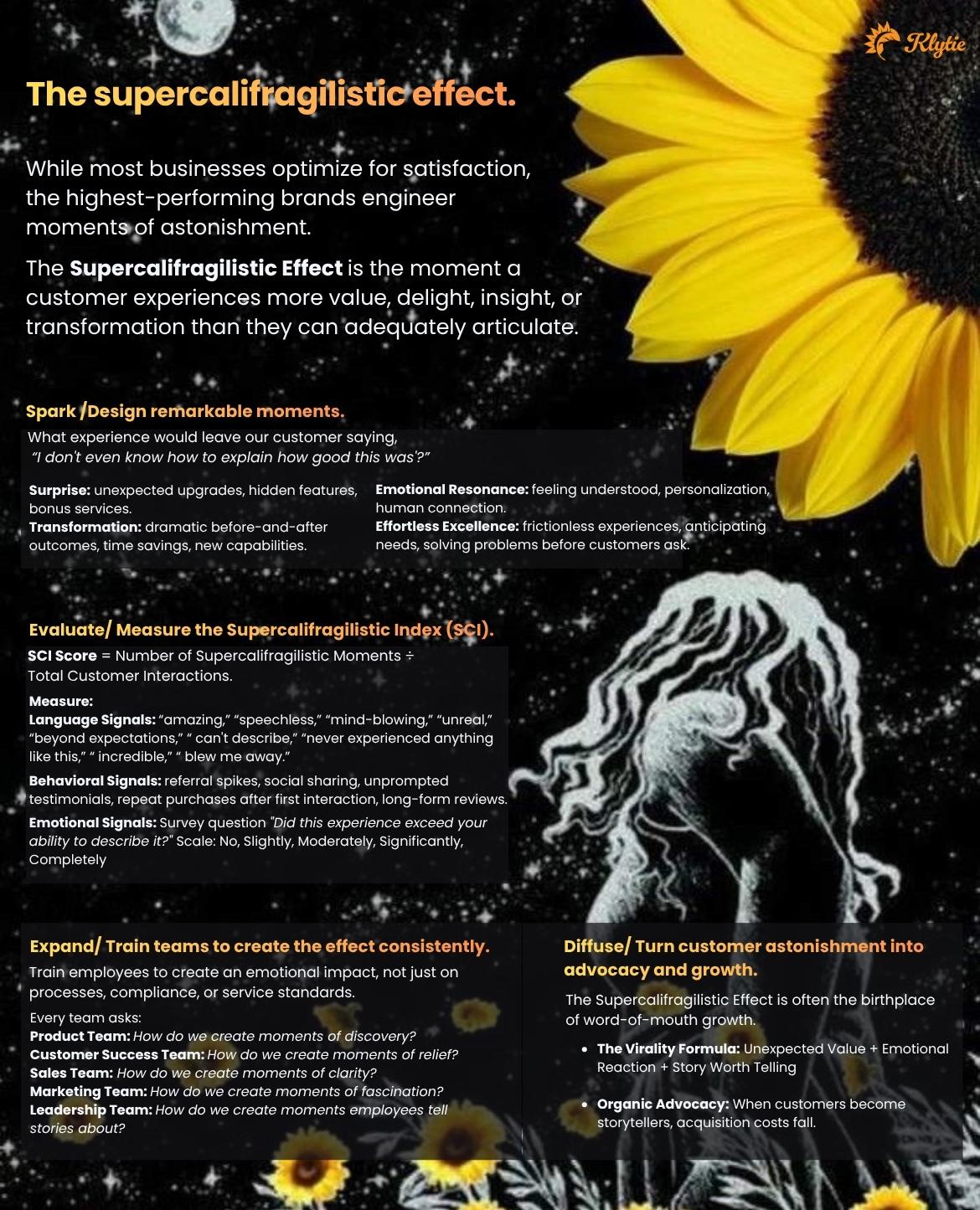
The Supercalifragilistic Effect. There exists a moment that every exceptional business secretly pursues. A moment when a customer encounters something so surprising, so elegant, so unexpectedly valuable that ordinary language becomes insufficient.
The customer pauses…Smiles….Searches for words…And fails.
The review reads: „I don’t know how to describe it.” „It was unbelievable.” „It felt like magic.” „You have to experience it yourself.”
Traditional business metrics struggle to capture these moments. Yet, these moments often represent the highest form of value creation.
The most successful products aren’t always the ones that solve problems most effectively. Often, they’re the ones that create emotional experiences that exceed expectations. Luxury brands understand this instinctively. Exceptional hospitality providers understand this. Great artists understand this. Increasingly, AI companies understand this.
The first time a person watches a machine produce an attentive response, generate sophisticated images, summarize months of research, or assist in complex reasoning, the reaction is often not analytical… It is emotional. For a brief moment, reality exceeds expectations and expectations exceed vocabulary. The client becomes, in effect, linguistically bankrupt. No existing expression seems adequate.
This is what might be called the Supercalifragilistic Effect. The point at which perceived value becomes larger than available language.
Businesses rarely measure this. Perhaps they should. Because word-of-mouth is born precisely at this limit. This inability to articulate an experience may indicate not confusion but transcendence. People don’t enthusiastically share ordinary experiences. They share experiences that challenge their assumptions about what is possible.
In a world saturated with products and services, businesses that create such moments not only satisfy customers, they become memorable. And memory is, increasingly, the rarest competitive advantage, and even more so in our AI era.
Historically, organizations measured efficiency. Then they measured engagement. More recently, they measured customer experience. The next frontier may involve measuring astonishment.
How often do customers become speechless? How often do they describe an interaction as unbelievable, magical, transformative, or impossible?
These words are not merely emotional reactions. They are indicators that a product has crossed a threshold from utility into significance.
While for decades, business strategy has focused on solving problems, increasingly, successful organizations will focus on creating moments that challenge existing mental models. AI is already generating such moments daily. People encounter capabilities that would have seemed like science fiction just a few years ago. They watch machines summarize, reason, generate, create, and converse. Their first reaction?. It is astonishment. And astonishment.is often the birthplace of new markets.
AI & the return of wonder. For much of the 20th century, business was dominated by a philosophy of optimization: improving efficiency, reducing costs, increasing production, eliminating friction. While these goals remain important, AI introduces a different strategic dimension, wonder.
For decades, technology become increasingly powerful, while simultaneously becoming increasingly predictable. A faster computer was impressive, but understandable. A larger database was useful, yet it was expected. ..AI is different, it reintroduces unpredictability into human-machine interaction.
People no longer see technology as just a tool. They increasingly experience it as a collaborator. This shift creates a vocabulary problem.
Businesses still use industrial-age language to discuss post-industrial realities.
- We speak of „tools” that behave like assistants.
- We discuss „software” that generates ideas.
- We refer to „automation” when what we are actually observing resembles augmentation.
The map is no longer keeping pace with the territory.
Language, once our most reliable tool for understanding change, struggles to capture the contours of this new landscape. We try to describe a digital renaissance in factory terminology.
This leaves today’s executives facing a fascinating paradox: How do you lead people through a transformation that cannot yet be fully named, measured, or even explained?
Perhaps the answer is not to eliminate uncertainty, but to become fluent in it.
The leaders who thrive in the age of AI may not be those with the most definitive answers. They may be those with the confidence to navigate questions for which the vocabulary itself is still being written.
Because every era has its defining skill. In times of stability, it is expertise. In times of disruption, it is adaptability. And in an age where technology evolves faster than language can describe it, the future increasingly belongs to those who can interpret ambiguity, translate possibility into action, and find clarity before consensus arrives.
The next generation of leadership will not be defined by certainty. It will be defined by the courage to lead where the words have yet to catch up.
The blank page economy. The original purpose of Supercalifragilisticexpialidocious was to provide something to say when one had nothing to say. Viewed through a contemporary lens, this is an unexpectedly accurate description of a vast economic opportunity.
Across every industry, professionals face blank pages:
- The consultant preparing a proposal.
- The entrepreneur writing a pitch.
- The manager drafting a strategy.
- The marketer creating a campaign.
- The researcher summarizing findings.
- The executive composing a difficult message.
The obstacle is rarely knowledge. The obstacle is articulation. People often know more than they can express. Their ideas exist in an unfinished state, half thought, half intuition, half possibility. Language becomes the bottleneck.
This is why generative AI has spread with such extraordinary speed. Its primary function is not replacing human intelligence. Its primary function is reducing the distance between thought and expression.
AI acts as a bridge between silence and expression. It turns ambiguity into articulation. It converts possibility into language. This could be one of the most significant business capabilities ever created. The blank page has always been expensive, AI dramatically lowers its cost.
Leadership at the edge of vocabulary. While stakeholders demand certainty and reality offers ambiguity, the modern executive occupies a difficult position.
The traditional response has been to disguise uncertainty beneath confident language. Strategic plans become full of impressive phrases. Presentations become populated with trendy terminology. Organizations become fluent in sounding certain.
Yet, sounding certain and being on point require entirely different skills.
Many of the greatest strategic failures in business history occurred not because leaders lacked intelligence, but because they relied too heavily on outdated language. They mistook familiar words for understanding. They assumed that because they could describe something, they understood it.
However, current reality no longer agrees with this. Future leaders may need a new discipline: linguistic humility. The willingness to admit, “We don’t yet have the right language for what we observe.” Such a statement is not an admission of weakness. It is an acknowledgment that understanding is still under construction and construction cannot begin until uncertainty is recognized.
When language becomes a cage rather than a tool, the willingness to acknowledge linguistic inadequacy creates space for genuine learning.
The competitive advantage of imagination. Modern businesses often become prisoners of seriousness. Processes become rigid. Terminology becomes sterile. Meetings become populated with interchangeable words like synergy, optimization, transformation… Ironically, the more polished the language becomes, the less memorable it often is.
Supercalifragilisticexpialidocious survives because it is impossible to ignore. It reminds us that imagination and memorability are not enemies of professionalism, they are often prerequisites for impact.
People rarely remember perfectly constructed corporate phrases. They remember stories. They remember symbols. They remember unusual ideas. They remember language that makes them feel something.
And so we arrive once more at the central question: What do we do when reality exceeds language?
The instinctive answer might be to search harder for words. However, history suggests another possibility. Sometimes we create them. Sometimes we invent new concepts, new metaphors, new categories, and new narratives that allow us to navigate previously unseen territories.
Every market breakthrough begins as something difficult to explain. Every transformative technology begins as something difficult to classify. Every great innovation begins as something that does not fit comfortably inside existing language.
For when reality expands, the vocabulary must expand with it. And perhaps that is the lingering business lesson hidden in a whimsical song from a children’s movie.
The future arrives speaking a language we do not yet understand. Our task is not merely to interpret it. Our task is to invent the words.
***
Where the map ends, we begin…
Reality always arrives first. Language, diligent but slightly out of breath, follows behind with a notebook, trying to catch up.
It is in that interval, that charged, wordless frontier, where the most meaningful collaboration begins. Beyond the last line of the dictionary, possibility waits patiently. Markets form there before they are named. Needs take shape before they are measured. Solutions stir before they are categorized.
If this frontier resonates, then the opportunity to explore it together could be a boon. Let’s give it structure. In time, perhaps even a name.
Until next time, keep it handy!
