

There was a time when the answer was simple.
A company existed to organize capital, coordinate labor, and convert inputs into outputs at scale. Its purpose was production. Its measure of success was efficiency. Its ambition was growth. The world rewarded organizations that could take something scarce and make it abundant.
That model worked because the world itself was constrained in familiar ways. Capital was scarce. Distribution was scarce. Manufacturing capacity was scarce. Even basic coordination at scale was scarce.
Today, a quiet shift is taking place in the architecture of business. It is easy to mistake it for another technology story. AI is certainly accelerating it, but the deeper transformation is organizational.
For more than a century, we designed companies around the problem of execution. If you could build it, calculate it, manufacture it, coordinate it, write it, code it or simply get it done, you possessed something of economic value. Much of what we called expertise was, in practice, the ability to execute. The great industrial enterprise was, above all, an extraordinary machine for turning resources into predictable outputs.
This model created the modern economy, until technological advances steadily changed this equation. Today the marginal cost of copying software is negligible, digital infrastructure can be deployed almost instantly, global collaboration has become routine, while platforms allow relatively small businesses to reach enormous markets.
Execution can increasingly be purchased, automated, outsourced, digitized or replicated while AI is pushing the frontier even further. And not only physical execution, but also cognitive execution: prediction, analysis, drafting, coding, designing, translating, researching and increasingly even forms of creative production.
The consequence is not that execution becomes irrelevant. Quite the opposite execution becomes abundant. And when something becomes abundant, its scarcity value declines.
A company can now build, analyze, market, program, simulate, and automate at breakneck speed. However, speed without direction is not progress, it’s merely a faster way to arrive somewhere you did not intend to go.
The bottleneck is no longer how fast we can move, it’s figuring out what’s actually worth moving towards. It’s about meaning. That’s why the core value is shifting from doing to deciding, from executing to directing, from producing answers to asking better questions, from having the ability to create something to knowing what’s worth making.
This creates a strategic inversion for businesses:
The old logic was: Capability → Advantage.
The emerging logic is: Capability + Comprehension → Advantage
In other words, the differentiator is no longer simply what an organization can build, automate, or process, but its ability to understand what is worth building, automating, and paying attention to.
The strategic questions therefore move upstream:
- From: Can we build it? To: Should we build it, and why?
- From: Can we automate it? To: Is this the right thing to automate, or are we simply automating the wrong process faster?
- From: Can we process more information? To: Which information actually deserves our attention?
The advantage increasingly lies not in having more capability, but in having the judgment to direct capability towards what matters. In a world where technology makes it easier to do almost anything, the scarce strategic asset becomes knowing what is worth doing at all.
This is the point at which the economics of business begin to intersect with the architecture of organizational intelligence, and where the way we create value begins to transform the way organizations think, learn, and evolve. Here’s how it unfolds:
We still tend to imagine organizations as machines. Inputs enter. Processes operated. Outputs emerge. But organizations do not live in factories. They live in reality, and reality is messy.
Customers do not behave according to PowerPoint diagrams. Competitors do not respect annual planning cycles. Technologies do not wait for budgets. Employees do not behave like cells in an organizational spreadsheet. Markets change meaning before they change metrics.
A company therefore performs a more fundamental function: it is an interface between a changing world and coordinated human action. The organization observes reality, filters it, interprets it and converts its interpretation into action.
Every representation is a compression. Every compression is also a choice. While something gets foregrounded, something gets simplified, and something quietly disappears. And, as is often the case, what disappears may matter even more than what remains.
This is precisely why the concept of absorptive capacity, developed by Wesley Cohen and Daniel Levinthal in their seminal 1990 paper, remains so useful. Organizations differ not simply in how much information they possess, but in their ability to recognize valuable knowledge outside themselves, make sense of it, assimilate it, and ultimately put it to work.
In other words, having access to information is one thing, knowing what is worth paying attention to is another, and knowing what to do with it is the real trick.
Later, Zahra, S. and George, G. (2002) refined this idea in their research, distinguishing between potential absorptive capacity (the ability to acquire and assimilate external knowledge) and realized absorptive capacity, which involves transforming and exploiting that knowledge. The distinction is important because organizations can be very good at collecting ideas while being remarkably bad at doing anything with them. Information may enter the organization, but whether it survives the journey from „this looks interesting” to „this actually changes what we do” is another matter entirely.
This is where the concept of dynamic capabilities becomes strategically relevant: „the firm’s ability to integrate, build, and reconfigure internal and external competencies to address rapidly changing environments” (developed by David J. Teece alongside Gary Pisano and Amy Shuen in 1997).
Their argument is that sustainable performance does not come simply from doing things well, but from being able to continuously adapt what „doing well” actually means. Organizations need capabilities for sensing emerging opportunities and threats, seizing them through timely decisions and investments, and reconfiguring resources and routines as circumstances change. These capabilities are supported by the less glamorous (but crucial) machinery of organizational skills, processes, structures, and decision rules.
In this sense, the source of competitive advantage shifts from a relatively straightforward question „Can we execute this?” to a much more uncomfortable one „Can we figure out what needs to be executed next?” The latter is a fundamentally different managerial problem, because the answer is rarely sitting neatly inside the organization waiting to be discovered.
Therefore, the quality of an organization can be viewed through these three perspectives:
- How well does it make sense? Does it detect weak signals? Does it hear customers before customers complain? Does it notice technological discontinuities before they become threats?
- How well does it interpret? Can it distinguish signal from noise? Can it combine information across silos? Can it challenge existing assumptions?
- How well does it adapt? Can it convert insight into action? Can it reconfigure resources? Can it abandon yesterday’s answer when tomorrow’s question has changed?
This is organizational intelligence in a deeper sense. Not merely the amount of information inside the company, but the quality of the company’s relationship with reality. After all, an organization can be an excellent engine of production while confidently producing the wrong thing.
What matters today is no longer whether you can deploy great software, world-class cloud infrastructure, powerful AI, or sophisticated automation, because, increasingly, everyone can. The questiion becomes: What can your business do that another business can’t learn, replicate, or automate quickly tomorrow? The answer increasingly lies in accumulated organizational intelligence. The difficult-to-copy asset is not necessarily the process, it’s the learning system that keeps improving the process.
Traditionally, we tend to define a company by what it sells. A bank sells financial services. A pharmaceutical company sells medicines. A software company sells software. A retailer sells products. But this description tells us what leaves the organization. It tells us much less about what the organization accumulates.
Every serious company accumulates something less visible and, in many cases, considerably more valuable: customer understanding, technical knowledge, institutional memory, relationships, proprietary data, operating routines, decision frameworks, market intuition, intellectual property, organizational capabilities and, above all, the ability to turn experience into better future action.
This is why Ikujiro Nonaka’s work remains remarkably relevant. In The Knowledge-Creating Company, he argues that in an uncertain economy, knowledge is a fundamental source of lasting competitive advantage and that successful companies continuously create, disseminate and embody new knowledge.
His deeper insight is even more important. Organizations do not simply process information. They create knowledge. And knowledge creation is not exclusively analytical. Nonaka emphasized the interaction between tacit and explicit knowledge: what people can articulate and what they know through experience, intuition and practice. His 1994 theory describes organizational knowledge creation as a continuous dialogue between tacit and explicit knowledge.
This changes our definition of the corporate product. The company sells products to the market, but internally, it is continuously producing something else: better understanding of reality. That understanding becomes tomorrow’s product, strategy, process, relationship and competitive advantage.
Seen this way, a company has always produced two outputs:
- External output: what it sells.
- Internal output: what it learns.
The first generates today’s revenue. The second determines the quality of the first.
That distinction becomes increasingly important as technological cycles shorten. In stable environments, a company can survive for years by exploiting what it already knows. In volatile environments, accumulated knowledge can become an asset or a liability depending on how quickly it is renewed.
A company that sells well but learns badly eventually becomes a museum of yesterday’s competence/ tomorrow’s blind spot. A company that learns exceptionally well can repeatedly reinvent what it sells.
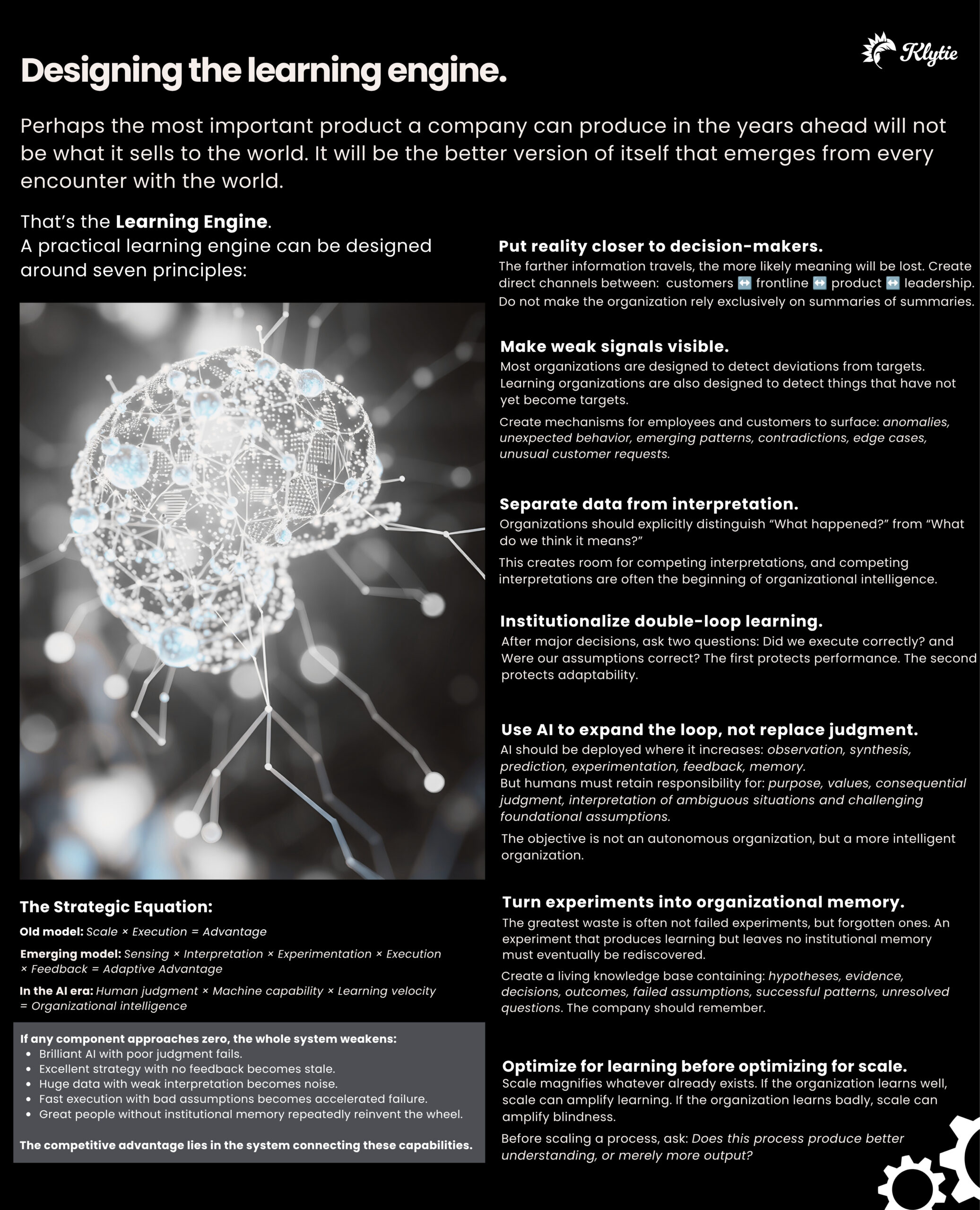
Today’s modern company is no longer primarily a factory. It is no longer primarily a software system. It is not even primarily a coordination mechanism. A modern company is best understood as a learning engine whose competitive advantage is determined by the quality, speed and fidelity of its learning loops.
While AI changes the economics of the loop by dramatically lowering the cost of observing, interpreting, experimenting and acting, organizational scale simultaneously creates compression, coordination and comprehension problems that can prevent the organization from converting capability into learning.
What ultimately matters is the ability of businesses to transform contact with reality into knowledge, knowledge into action, and action back into knowledge. Their deepest competitive advantage is the ability to continuously move through this cycle.
Everything else is secondary. Products are artifacts of judgment. Revenue is a byproduct of alignment. Efficiency is useful only when direction is correct. Automation is powerful only when understanding is stable. Scale is valuable only when learning does not degrade.
The purpose of a company, then, is not to produce outputs. It is to maintain a sufficiently tight loop between reality and interpretation that its actions remain meaningful as complexity increases.
Companies that close this loop quickly and intelligently can adapt before competitors do. Companies that interrupt, distort or compress the loop become increasingly disconnected from the reality they are supposed to navigate.
The challenge is that as businesses expand, the distance between reality and decision-making tends to increase, requiring more layers of information compression, interpretation and coordination. Unless the organization deliberately preserves high-fidelity feedback, scale can reduce its capacity to learn.
Consider the journey of a single customer experience:
- Customer: „This product no longer solves my problem.”
- That statement might become: conversation → ticket → category → dashboard → metric → management report → strategic discussion.
- And somewhere between slide three and slide seventeen, the customer disappears.
At some point, compression is unavoidable. A CEO cannot listen to every customer conversation. A board of directors cannot examine every operational decision. A global organization cannot coordinate without abstraction.
The strategic challenge is not to eliminate abstraction. Businesses need simplified representations because neither individuals nor institutions can process the full complexity of their environments. The challenge is to know when abstraction has become distortion.
A healthy organization must be able to zoom out without losing the ability to zoom back in. It needs the map, and yet occasionally, someone must still look at the landscape.
Let’s see how this could be achieved:
The learning loop. This is where the organization begins to reveal its deeper architecture. The fundamental unit of organizational advantage may not be the department, the process or even the individual capability. It may be the learning loop.
A simplified learning loop looks like this:
Reality: something happens in the external or internal environment → Observation: the organization detects it → Interpretation: people and systems determine what it might mean → Decision: the organization chooses how to respond → Action: resources are deployed → Feedback: consequences become visible → Learning: the organization updates its understanding → Adaptation: future behavior changes→ Back to reality.
As we can see, this is not a straight line. It’s a spiral. Each cycle should leave the organization slightly more capable than the previous one.
What matters is not merely whether the loop exists. Every organization has some form of feedback. What matters is its speed, fidelity and depth:
- A slow organization learns after the market has already moved.
- A noisy organization mistakes anecdote for signal.
- A politically constrained organization learns only what it is safe to say.
- A siloed organization learns locally but fails to learn collectively.
- A highly optimized organization may learn only how to optimize yesterday’s assumptions.
- A genuinely adaptive organization learns at multiple levels simultaneously. It learns about outcomes. It learns about processes. And, at its deepest level, it learns about its own assumptions.
This is the distinction captured by Chris Argyris’s concept of double-loop learning:
- Single-loop learning asks: Are we correcting the problem?
- Double-loop learning questions: Why did we define this as the problem in the first place?
The first keeps the machine running. The second asks whether the machine is still pointed in the right direction. This distinction is crucial.
Imagine sales are declining:
- Single-loop learning might produce: more promotions, more sales calls, more advertising, revised targets.
- Double-loop learning asks: Is the product still relevant?, Has the customer changed?, Has the category changed?, Are we measuring the wrong thing?, Are our assumptions about the market still valid?
Argyris illustrated the organizational consequences of this problem with an example in which people inside a large corporation knew about serious problems with a product years before top management acted on them. The lesson is devastatingly contemporary: organizations often possess the knowledge they need but lack the mechanisms, incentives or psychological safety to learn from it.
A learning engine therefore needs more than data. It needs the ability to question itself.
From the learning organization to the learning engine. Peter Senge’s learning organization (from his 1990 book, The Fifth Discipline) was never simply an organization that provided more training. Training can increase individual knowledge. Learning organizations increase the organization’s ability to change its behavior because of what it discovers. This is a much higher standard. His deeper proposition was systemic: organizations need to develop the capacity to understand relationships, question mental models, develop shared purpose and learn collectively.
The idea of a learning engine extends the traditional way by shifting the focus from the desired condition to the process that creates it.
- A learning organization describes a desirable organizational condition (one in which people and systems continuously learn, adapt, and improve).
- A learning engine, by contrast, describes the mechanism that produces and sustains that condition. It emphasizes the processes, feedback loops, practices, and structures that turn experience into knowledge and knowledge into better action.
A company can have: learning programs without organizational learning, data without insight, insight without action, action without reflection, reflection without institutional memory. Learning only becomes organizational when it changes what the organization is capable of doing next.
The distinction is useful because it shifts the conversation from aspiration to architecture: How does information enter? How is it interpreted? How are assumptions challenged? How are experiments conducted? How are consequences measured? How is knowledge retained? How does learning change resource allocation? How does it change behavior? How does it change the assumptions embedded in the system?
A company can fail ten times and learn nothing. Another can fail once and redesign itself. The difference is not the amount of experience. It is the quality of the loop. Experience is not learning, it becomes learning only when it changes future behavior.
AI & the expansion of the loop. AI introduces a remarkable possibility. It can expand the learning loop itself. Historically, organizations could observe only a fraction of the signals available to them. Human attention was the bottleneck.
- Interpretation was expensive.
- Analysis was expensive.
- Experimentation was expensive.
- Institutional memory was fragile.
- Feedback was often delayed.
AI changes each of these economies. It can observe more. It can compare more. It can synthesize more. It can simulate more. It can remember more. It can generate more hypotheses. It can monitor more continuously. It can help close the distance between an event and the organization’s understanding of that event.
The result could be a transition from the periodic organization to the continuous organization. The company no longer waits for the quarterly review to discover what the customer has been telling it for three months. It no longer waits for the annual planning cycle to recognize a structural shift. It no longer relies exclusively on a small number of analysts to interpret enormous quantities of information.
AI can potentially make the organization more permeable to reality. It can create the possibility of a much tighter learning loop.
The evolution is interesting: historically, organizations have often operated at the speed of meetings. Then at the speed of software. Increasingly, they can now operate at the speed of continuous learning. This is one of the most important strategic implications of artificial intelligence. AI is not just an execution layer, it can become a learning layer.
The human-machine knowledge spiral. This possibility extends naturally from Nonaka’s theory. If organizational knowledge is created through interaction between experience, articulation, combination and application, then AI introduces a new participant into the knowledge system.
Machines can now generate interpretations, hypotheses, summaries, simulations and recommendations that become inputs to human judgment. Humans can challenge those outputs, add context, correct them and redirect them.
The machine learns from interaction. The human learns from the machine. The organization learns from the interaction between both.
A recent 2026 paper by Aaron Chatterji, Daniel Rock and Eduard Talamas explicitly develops this idea through what they call a human-machine knowledge spiral, connecting AI to Nonaka’s theory of organizational knowledge creation.
This is a more interesting future than the familiar narrative of AI replacing workers.
The more consequential possibility is that AI changes how the organization thinks. The machine becomes neither employee nor tool in the traditional sense, it becomes part of the organization’s cognitive environment.
- Humans contribute: context, values, experience, judgment, intuition, purpose, responsibility.
- Machines contribute: scale, memory, pattern recognition, prediction, synthesis, simulation, speed.
The value emerges from the interaction. Not human versus machine. Not machine replacing human. But: human → machine → human → machine. A spiral. Every cycle potentially creates a richer shared understanding. The organization begins to think with machines. And, increasingly, machines begin to learn through the organization’s experience.
There is, however, an important paradox that we must consider. The same technology that can accelerate learning can accelerate mislearning. If AI expands the learning loop, it also expands the organization’s capacity to act on its assumptions. That is not automatically good.
A company with a bad mental model and excellent automation is not a learning organization. It is a highly efficient machine for reinforcing mistakes. This is why Argyris’s distinction between single-loop and double-loop learning becomes even more important in the AI era:
- AI can optimize the answer. But who is asking the question?
- AI can improve the forecast. But who is asking whether the forecast is the right thing to optimize?
- AI can identify correlations. But who determines whether the correlation matters?
- AI can generate ten thousand options. But who decides which reality is worth pursuing?
The greatest danger is not that AI will be wrong, humans are constantly wrong. The greater danger is that AI can make wrongness look organized. A sophisticated dashboard can disguise a poor question. A precise forecast can disguise deep uncertainty. An automated process can make an incorrect decision thousands of times before anyone notices.
This returns us to Argyris. The deeper question is not whether the organization is correcting errors. It is whether it is capable of questioning its own assumptions generating those errors. AI makes this more important, not less. The smarter the system becomes, the more important it becomes to ask whether it is becoming smarter about the right things.
From information architecture to learning architecture. For decades, businesses invested in information architecture. They built databases, ERP systems, CRMs, data lakes, warehouses, analytics platforms and dashboards.
These systems answer a valuable question: Where is the information? The next generation must answer a different question: How does the organization change because of what the information reveals?
That is the difference between information architecture and learning architecture. A learning architecture connects observation to interpretation, interpretation to experimentation, experimentation to evidence and evidence to institutional change.
It creates pathways through which knowledge can move. It protects weak signals from being drowned in hierarchy. It preserves institutional memory. It allows assumptions to be challenged. It makes experimentation economical. And it ensures that learning is not trapped inside the individual who happened to discover it.
A company may have a perfect dashboard and no learning loop. Another company may have imperfect information but an exceptional culture of experimentation, reflection and adaptation. The second may outperform the first.
Learning architecture therefore requires at least six components:
- Sensing: mechanisms for detecting changes in the environment.
- Interpretation: mechanisms for turning signals into hypotheses.
- Experimentation: ways to test hypotheses quickly and safely.
- Decision: clear mechanisms for converting learning into resource allocation.
- Memory: ways to retain what the organization has learned.
- Adaptation: mechanisms for changing behavior, structures and assumptions.
The objective is not to make the company know everything. It is to make the company better at becoming less wrong.
The living organization. There is a useful metaphor here: a machine is designed to repeat, a living system is capable of adaptation. The industrial organization was designed primarily to repeat successful behavior. The adaptive organization must know when successful behavior has become inappropriate.
This is the essential tension of modern management.
- Efficiency says: Do what works./ Learning says: Discover whether what works still works.
- Scale says: Standardize./ Adaptation says: Know what should not be standardized.
- Control says: Reduce variation./ Intelligence says: Understand which variation contains information.
The learning organization must somehow hold these contradictions together. It must be stable enough to function and fluid enough to evolve.
Senge’s systems thinking is valuable precisely because it shifts managerial attention from isolated events to understanding the feedback structures and relationships that generate these events.
That is why the metaphor of a living system is more than rhetorical: the organization has a metabolism. It consumes information. It processes experience. It stores memory. It responds to stimuli. It adapts its behavior. And, if it is healthy, it continuously renews its ability to survive in changing conditions.
That’s what makes a living system. The modern organization must do the same.
Learning velocity as a competitive advantage. If the learning loop becomes the fundamental unit of advantage, then a new strategic variable emerges: learning velocity.
Learning velocity is not the speed of decision-making. A company can make decisions extremely quickly and learn extremely slowly. It is the speed with which an organization can move from: signal to understanding, from understanding to experiment, from experiment to evidence, and from evidence to changed behavior.
A company can be operationally fast but strategically slow. It can launch products quickly while learning slowly. It can hold meetings efficiently while remaining intellectually stagnant.
Learning velocity asks a different question: How long does it take us to discover that our assumptions are wrong? And an even more important question follows: Once we discover it, how long does it take us to change?
These may become among the most meaningful measures of organizational health. Because the advantage of the future may belong to the company that does not need to predict the future perfectly, it may belong to the company that can correct itself faster than everyone else.
If the thesis is correct, then some traditional sources of advantage become less durable.
- Traditional advantage: scale, capital, physical assets, proprietary processes, labor arbitrage, distribution, information asymmetry.
- Emerging advantage: learning velocity, quality of sensing, interpretive capability, institutional memory, experimentation speed, cross-functional knowledge flow, human-machine collaboration, adaptive capacity.
This does not mean the old advantages disappear. It means their value increasingly depends on whether the organization can learn from and renew them.
A giant company with a slow learning loop may be less adaptive than a small company with a fast one. A company with enormous data but poor interpretation may be less intelligent than a company with modest data and excellent questions. A company with world-class technology but weak organizational learning may be outperformed by a company with ordinary technology and superior adaptation.
The durable advantage therefore lies not in any individual capability, but in the connections between capabilities: Sensing without interpretation produces noise.Interpretation without experimentation produces opinion. Experimentation without memory produces repetition.Execution without feedback produces inertia. AI without judgment produces scale without wisdom.The learning engine integrates them.
What should leaders measure? If organizations are learning engines, traditional KPIs are incomplete. Leaders should begin measuring the health of the learning system itself.
Sensing metrics: How quickly do emerging customer problems reach decision-makers? How many independent sources of market intelligence exist? How much frontline knowledge reaches senior leadership?
Interpretation metrics: How often are assumptions explicitly challenged? How often do cross-functional teams interpret the same signal differently? How much time is spent debating meaning rather than merely reviewing metrics?
Experimentation metrics: How quickly can the company test a new hypothesis? What percentage of experiments produce actionable learning? How much does the organization learn from failures?
Adaptation metrics: How quickly does validated learning change strategy? How quickly can resources move toward emerging opportunities? How often are obsolete processes retired?
Organizational memory: Can people find what the organization has already learned? Are decisions and their assumptions documented? Does institutional knowledge survive employee turnover?
AI-human learning: Which decisions are AI-assisted? Which remains human-owned? How is machine output validated? How does human feedback improve future machine performance? How does machine-generated insight change human understanding?
These measures begin to describe something traditional financial statements cannot: the organization’s capacity to become more intelligent over time. Why? Simply because an organization capable of asking these questions honestly has something rare: it has room to learn.
The winners of the next decade will not necessarily be the companies with the most models. They will be the companies where information flows on without losing its meaning, where front-line experience can influence strategic decisions, where experimentation is cheap enough to become a habit, where failure becomes organizational memory instead of organizational shame, where AI expands perception without replacing judgment, and where strategy is treated not as a fixed prediction of the future but as an evolving relationship with reality.
This is a different conception of the company.
The company is no longer merely a machine that produces. It is a system that perceives, interprets, acts and evolves.Its products are temporary expressions of what it currently knows. Its processes have hypotheses about how work should be done. Its strategy is a model of how the world might behave. Its culture is the social infrastructure through which knowledge travels. Its technology is the nervous system through which signals are captured and processed. And its competitive advantage is the quality of the learning loop connecting all of them.
From companies that work to companies that learn. The industrial age taught us to build organizations that could execute. The digital age taught us to connect them. The AI age may require us to teach them how to learn. This is not a minor refinement of management theory, but a completely different way of thinking about business.
For much of modern economic history, the dominant question was: How can we make the organization more efficient? The next question may be: How can we make the organization more intelligent? And intelligence, in this context, does not mean knowing more. It means being able to change what you do because you have learned something.
That is the distinction between information and intelligence. Between experience and learning. Between scale and wisdom. Between ability and understanding. Between an organization that performs and an organization that evolves.
AI makes this distinction unavoidable. It can dramatically expand the organization’s capacity to observe, interpret, predict, experiment, remember and act. And yet it cannot absolve organizational judgment. This responsibility remains human. This is why the future of business may not belong to the company defined simply by the intelligence of its machines, but to the intelligence of the system that connects people, machines, knowledge, decisions and reality.
The winning company will be the one that can sense earlier, understand more deeply, experiment more intelligently, remember more faithfully and adapt more quickly. And all of this not because it can predict the future better than anyone else, but because it can learn its way towards it.
***
Intelligence is often confused with knowledge. However, while knowledge tells us what we have, intelligence tells us what we can make of it.
That distinction points to an ambitious vision for the adaptive organization of the future — one that can sense like a network, remember like an institution, reason like a strategist, experiment like a startup, execute like a machine, and learn like a living system.
It’s a high bar. Conveniently, the environment seems to have stopped asking for lower ones.
If this sparks something for you, it could be a significant opportunity to explore what this could mean in practice for your business as it navigates and shapes this next chapter.
Either way, keep it handy!
