

There was a time when systems spoke to us.
A bridge groaned before it cracked. An engine vibrated before it failed. A seasoned physician sensed that something was wrong long before laboratory values confirmed it. Markets whispered through small anomalies before they screamed in crisis. Forests revealed imbalance through subtle changes in birdsong, insects, and soil long before entire ecosystems collapsed.
Change, in its earliest form, was rarely silent. It announced itself through friction.
Today, however, we inhabit a world increasingly designed to erase those announcements. We celebrate technologies that are frictionless, organizations that are seamless, supply chains that are optimized, software that is invisible, and AI that anticipates our needs before we express them. Across industries, „smoothness” has become synonymous with progress.
Yet there is a paradox at the heart of this pursuit.
The smoother a system becomes, the fewer opportunities it has to notice itself. In removing interruptions, we often remove observations. In eliminating inefficiencies, we frequently eliminate feedback. In optimizing away resistance, we may unknowingly optimize away awareness.
Smoothness is not merely an engineering achievement, it is also an epistemological trade-off. Every system that becomes exceptionally efficient at doing one thing inevitably becomes less sensitive to the things it no longer needs to observe. Optimization narrows attention. Standardization compresses diversity. Automation filters experience. Over time, a system can become remarkably capable while simultaneously becoming remarkably blind.
The danger is not that smooth systems fail more often. Many perform extraordinarily well, until they encounter conditions they were never designed to perceive.
History offers countless examples.
Financial markets collapsed not because transactions became difficult, but because they became effortless. Global supply chains did not struggle because they lacked efficiency, but because they possessed too little redundancy. Automated aircraft have occasionally confused experienced pilots precisely because automation concealed critical states until human intervention came too late. Digital platforms connect billions of people while obscuring the slow accumulation of misinformation, polarization, and systemic risk beneath apparently seamless interactions.
In each case, catastrophe did not emerge from visible disorder. It emerged from invisible order. The common assumption is that progress consists of making systems increasingly frictionless. We remove waiting times, automate decisions, simplify interfaces, standardize procedures, predict user behavior, and optimize performance metrics. Every reduction in friction is celebrated as evidence of innovation.
And often, it is. But, what if friction performs another function entirely? What if resistance is not merely an obstacle to efficiency, but one of the oldest measuring instruments humanity has ever possessed?
When a machine resists, it communicates. When an employee questions a procedure, the organization receives information. When customers hesitate before purchasing, the market reveals uncertainty. When a scientist encounters unexpected data, discovery begins. Even biological pain (a phenomenon we instinctively seek to eliminate) is not merely suffering, it is also information indispensable to survival.
Evolution itself progresses through environmental resistance. Biological systems are in constant dialogue with their surroundings. That dialogue occurs through feedback. Feedback occurs through difference. Difference creates friction. Without environmental resistance, adaptation becomes impossible.
Astronauts returning from prolonged periods in microgravity lose bone density not because their bodies malfunction, but because the absence of gravitational resistance deprives biological systems of essential information. Their bodies are no longer measuring the world. Without measurement, adaptation ceases.
Resistance exists because reality is communicating. It teaches us a simple lesson: Life does not become stronger by avoiding every form of resistance. Life becomes more intelligent by responding to it.
The challenge of the twenty-first century is that our technologies are becoming increasingly proficient at filtering those communications. Intelligent systems complete our sentences, navigate our journeys, recommend our decisions, optimize our schedules, and automate our judgments. Every layer of convenience introduces another layer between ourselves and the underlying complexity of the world.
As interfaces become smoother, reality becomes quieter. This phenomenon extends far beyond technology:
- Organizations increasingly measure performance through dashboards that compress rich human experience into a handful of numerical indicators.
- Cities optimize traffic flows while losing the informal interactions that once strengthened communities.
- Healthcare systems maximize throughput while reducing opportunities for physicians to notice subtle patterns that no algorithm has yet learned to recognize.
- Education optimizes standardized outcomes while overlooking curiosity, creativity, and intellectual exploration that resist quantification.
The more legible our systems become to machines, the less legible reality often becomes to us.
„The great advantage of such tunnel vision is that it brings into very sharp focus certain limited aspects of an otherwise far more complex and unwieldy reality. This very simplification, in turn, makes the phenomenon at the center of the field of vision far more legible and hence more susceptible to careful measurement and calculation. Combined with similar observations, an overall, aggregate, synoptic view of a selective reality is achieved, making possible a high degree of schematic knowledge, control, and manipulation.”
Political scientist James C. Scott observed that large institutions simplify reality in order to make it administratively manageable. Every map, every metric, every classification transforms an infinitely complex world into something that can be governed. And so, forests become timber inventories, citizens become tax records, communities become demographic statistics, land becomes cadastral maps…education becomes standardized scores, healthcare becomes clinical metrics…and so on.
The simplification is practical. Large systems cannot function without abstraction. Yet abstraction always compresses reality. A map allows us to navigate because it omits almost everything. It excludes every bird, every conversation, every scent, every texture, every memory attached to a place. Its usefulness depends upon its incompleteness.
The problem begins when institutions confuse the map with the territory. When metrics become reality rather than representations of reality, organizations gradually lose contact with the complexity they were designed to manage. The system remains administratively efficient, but operationally, it becomes increasingly detached from the world it governs.
Cyberneticist Ross Ashby proposed what remains one of the most profound principles in systems theory: „Only variety can absorb variety”. A system can only respond to differences it is capable of recognizing. Everything else is invisible.
In this sense, blindness is rarely a failure of intelligence. It is more often a consequence of selective attention. This insight carries enormous implications.
- If an organization simplifies customer behavior into five categories, it will only notice changes occurring within those five categories.
- If an AI model has never encountered a particular pattern, it cannot recognize its significance.
- If a hospital dashboard measures waiting times but not patient confusion, confusion effectively disappears from managerial awareness.
Reality has not changed, observation has. Every observer sees by not seeing something else. The world continues generating signals. The system simply lacks the capacity to perceive them.
AI now magnifies this principle. Machine learning systems discover patterns by compressing overwhelming complexity into representations that support rapid prediction. They become extraordinarily capable precisely because they ignore vast amounts of information deemed irrelevant to their objective. Their intelligence is inseparable from their selectivity.
And yet prediction is not perception. Compression always leaves something behind. Claude Shannon (author of Information Theory) demonstrated that communication depends upon distinguishing signal from noise. The challenge is that the boundary between signal and noise is rarely fixed.
Sometimes, today’s noise can become tomorrow’s most valuable insight. If we just think about a few of the following: the first smartphone looked like an oddity, the first internet browser seemed insignificant, the first signs of a financial crisis looked like isolated irregularities, and so the first evidence of climate change appeared in the form of scattered measurements, or the first unexpected laboratory result that leads to a scientific revolution usually seems like a mistake, and we can go on and on.
The engineer calls it an anomaly. The scientist calls it an unexpected result. The entrepreneur calls it an opportunity. The historian calls it a turning point. The machine simply calls it statistically insignificant. This is not a flaw in AI, it is a consequence of intelligence itself. Every intelligent system must decide what to ignore. The danger emerges when society forgets that those decisions are being made.
As AI increasingly mediates hiring, lending, diagnosis, education, logistics, governance, and scientific discovery, its filters become society’s filters. Its blind spots become institutional blind spots. Its confidence becomes institutional confidence. The question is no longer whether machines can see, it is whether they can recognize what they have never learned to notice.
This transformation represents more than automation, it represents the redistribution of cognition. Thinking itself is becoming increasingly distributed across networks of humans and machines. What appears as an extraordinary achievement is at the same time an extraordinary responsibility. Because whoever (or whatever) mediates perception inevitably shapes reality.
This is not an argument against efficiency, automation, or AI. Modern civilization depends upon them. Without optimization, complex societies could barely function. The question is not whether smoothness is valuable (it unquestionably is) but whether we have mistaken smoothness for completeness.
Efficiency solves the problems we already understand. Awareness prepares us for the problems we do not yet recognize. These have not identical capabilities.
The most resilient systems in nature are rarely the most optimized. Ecosystems thrive because they preserve redundancy, diversity, experimentation, and countless interactions that appear inefficient when viewed in isolation. Evolution itself progresses not through perfect execution, but through continuous variation, error, adaptation, and selection. Nature repeatedly demonstrates that resilience is born not from eliminating uncertainty, but from remaining sensitive to it.
Human civilization increasingly pursues the opposite ideal. We seek systems that operate with minimal interruption, minimal variation, minimal redundancy, and minimal human intervention. In doing so, we often remove the very mechanisms through which systems perceive their own limits.
Like a climber who gradually loses sensation in their fingertips, a civilization can become so effective at suppressing discomfort that it no longer notices when it has begun to lose its grip.
This is the collapse of edge awareness.
The „edge” is where assumptions meet reality. It is where expectations fail, where anomalies emerge, where weak signals first appear, and where adaptation begins. It is the boundary at which every system learns something new about itself. And friction is the language spoken at that boundary.
When we eliminate friction indiscriminately, we do not merely create smoother experiences, we silence the edge. The systems that appear to work most effortlessly are often those least capable of noticing when the world has begun to change.
Progress, therefore, should not be measured solely by how much friction we remove. It should also be measured by how much awareness we preserve.
Smooth systems are often blind systems. „The eye sees only what the mind is prepared to comprehend.” as Henri Bergson once said. The highest aspiration of every engineered system is deceptively simple: to disappear.
The perfect interface requires no instructions. The perfect workflow requires no intervention. The perfect supply chain delivers without delay. The perfect algorithm predicts before we ask. The perfect organization operates without meetings, exceptions, or surprises. Success, in modern design, is measured by the absence of interruption. And rightly so, up to a point.
Smooth systems reduce cost. They increase speed, lower cognitive burden, free human beings from repetitive labor and create extraordinary gains in productivity. Almost every technological revolution has been, in one form or another, a campaign against unnecessary friction. And yet there is another truth that receives far less attention: every reduction in friction is also a reduction in observation.
When a process no longer hesitates, fewer questions are asked. When decisions become automatic, fewer assumptions are examined. When anomalies disappear from view, fewer opportunities remain to discover that reality has changed. The system becomes faster, but it also becomes quieter. And one of the most dangerous assumptions in systems design is that the absence of alarms indicates the absence of problems.
History repeatedly disproves this belief. Financial crises often emerge during periods of apparent market stability. Infrastructure failures frequently occur after years of flawless operation. Cybersecurity breaches may remain undetected for months. Environmental degradation accumulates slowly before crossing irreversible thresholds. Pandemics spread quietly before overwhelming healthcare systems.
In each case, deterioration precedes detection. The system appears stable because the mechanisms designed to detect change are themselves optimized for familiar conditions. Silence, therefore, is an ambiguous signal. It may indicate health. Or it may indicate that the system has lost the ability to hear.
And so, smooth systems are not blind because they are poorly designed. They are blind because they have become extraordinarily good at ignoring everything that does not contribute to their immediate objective.
Empires rarely collapse because they lack power. Companies rarely go bankrupt because they lack efficiency. Technologies rarely become obsolete because they stop functioning. They decline because the world changes faster than they are able to perceive. Long before systems collapse, they stop seeing. And long before they stop seeing, they become perfectly smooth. Smoothness is not the opposite of complexity, it is complexity that has become invisible.
Smoothness is selective perception. Every system, whether biological, technological, economic, or organizational, survives by filtering reality. No organism can process every sound, every movement, every change in temperature, every chemical signal, or every visual stimulus simultaneously. Likewise, no company can monitor every market fluctuation, no government can account for every local condition, and no AI can model every possible future.
Perception is therefore an act of selection. To see something is necessarily to ignore something else. Herbert Simon referred to this as bounded rationality. Human beings do not make perfect decisions because the world contains far more information than any mind can process. We simplify. We prioritize. We construct mental models that reduce overwhelming complexity into something manageable.
Organizations do exactly the same thing. Dashboards replace conversations. KPIs replace lived experience. Forecasts replace uncertainty. Police replace judgment. Categories replace nuances.
The simplification is not a mistake, it is a necessity. But every simplification carries an invisible cost. Every model leaves something outside its frame. The moment a metric becomes the definition of success, everything that the metric cannot measure begins to fade from organizational attention. This is not merely Goodhart’s Law—that when a measure becomes a target, it ceases to be a good measure. It is something more fundamental. Optimization creates blindness by concentrating attention.
Imagine a lighthouse. Its beam is extraordinarily bright. Yet its brilliance comes from focusing light into a narrow direction. The brighter the beam becomes, the darker everything outside it appears.
Organizations operate in much the same way. The clearer their objectives become, the easier it becomes to overlook everything that falls beyond those objectives. Focus creates excellence. Focus also creates shadows.
Information dies first at the edges. Complex systems rarely fail at their center. They fail at their margins:
- Small suppliers begin struggling before multinational supply chains collapse.
- Junior engineers notice subtle irregularities before executives receive alarming reports.
- Customers quietly change their behavior before revenue declines.
- Tiny software bugs reveal architectural weaknesses before entire platforms fail.
- Ecologists sometimes describe ecosystems as losing biodiversity before losing productivity.
The edges weaken first. The center notices last. Why? Because information always travels uphill through filters.
Each organizational layer summarizes, simplifies, categorizes, and prioritizes what the next layer should know. By the time information reaches decision-makers, uncertainty has often been polished into confidence. Exceptions become averages. Warnings become statistics Stories become charts. The organization becomes increasingly informed about what it already expects to see, and increasingly uninformed about everything else.
Smoothness accelerates this process. The smoother information flows become, the more relentlessly they are standardized. And the more standardized they become, the less room they leave for surprise, for the unexpected spark, the awkward detour, the strange idea that doesn’t quite fit the template. In polishing every rough edge, we risk sanding away the very texture that gives ideas their power.
After all, breakthroughs rarely arrive on a conveyor belt. They tend to emerge from the cracks in the pavement, where disorder interrupts the script and something genuinely new dares to appear.
Smooth systems create a seductive psychological effect. Because they are predictable, we begin to believe they are understood. Because they are efficient, we assume they are resilient. Because they operate without interruption, we infer that they require little attention.
This is an illusion. Order is not the same as understanding. Predictability is not the same as preparedness. Efficiency is not the same as resilience.
A frozen lake appears perfectly smooth. Its surface reflects the sky with remarkable precision. Yet its greatest danger lies precisely in how little it reveals about the ice beneath. The appearance of calm often conceals the accumulation of invisible stress.
So it is with organizations. So it is with economies. So it is with algorithms. So it is with civilizations.
Every system contains a model of reality. No system interacts directly with reality, it interacts with a model. A thermostat does not understand weather, it understands temperature. A GPS does not understand a city, it understands a map. A financial model does not understand an economy, it understands variables. An AI model does not understand language, it understands statistical relationships.
Likewise, organizations never operate on reality itself. They operate on assumptions about reality. Policies have assumptions. Processes have assumptions. Forecasts have assumptions. Algorithms have assumptions. Strategies have assumptions.
Every decision a system makes is based on an internal representation of how the world is expected to behave. As long as reality conforms to that representation, operations remain smooth. The moment reality begins to diverge, friction appears. That friction is not an obstacle, it is evidence. It tells us something important has changed.
Imagine pushing a shopping cart across a perfectly smooth floor. The effort is minimal. Now imagine pushing the same cart over gravel. Immediately, resistance increases. The resistance does not exist to frustrate you. It exists because the environment has changed.
The friction is information. Organizations experience precisely the same phenomenon. A customer suddenly asks questions that sales scripts cannot answer. An employee repeatedly bypasses an official workflow. A machine requires slightly more maintenance than expected. A supply chain experiences unusual delays. An AI system begins producing unexpected outputs.
Most organizations rush to extinguish these moments as if they were fires. The wiser ones treat them as instruments. Each one is a measurement, quietly revealing the widening gap between the world we imagined and the world as it actually is. Friction is not merely resistance; it is reality introducing itself.
History rarely announces its turning points with fanfare. It whispers through anomalies before it rewrites the rules.
Every great technological revolution has changed humanity’s relationship with reality. The telescope stretched our vision beyond the horizon and humbled our place in the cosmos. The microscope uncovered invisible worlds teeming beneath ordinary surfaces. Electricity collapsed distance into the flick of a switch. The internet dissolved geography, allowing ideas to travel faster than armies or empires ever could.
Each breakthrough handed us a more powerful lens, or a stronger lever with which to engage the world.
AI marks a different kind of threshold. It does not simply help us see farther, lift more, or communicate faster. It increasingly stands between us and reality itself, shaping what we notice, what we ignore, what we trust, and ultimately what we believe. If previous inventions expanded human capability, AI increasingly curates human perception. It is becoming less a tool in our hands and more a lens through which our hands decide where to reach.
Every civilization has ultimately been defined not by what it knew, but by what it chose to pay attention to. Attention has always been the rarest currency. Today AI is not just competing for it, it is becoming the architect of where it flows.
The faster we decide, the less we observe. The AI revolution promises unprecedented speed. While all of these capabilities unlock immense value, speed quietly changes the nature of observation.
Consider a physician examining an X-ray. Before AI assistance, interpretation required careful inspection. The physician’s attention lingered, questions emerged, ambiguities invited deeper investigation. The very slowness of the process created opportunities to notice the unexpected.
Now imagine an AI system presenting a diagnosis with a confidence score of 99.2%. The physician still reviews the image, but not in the same way. Human attention has been redirected. The task subtly shifts from exploration to verification. The AI has not merely accelerated the decision, it has framed the search.
This phenomenon repeats across every profession. Lawyers review rather than draft. Programmers edit rather than construct. Researchers validate rather than investigate. Managers approve rather than deliberate. Writers refine rather than discover.
The acceleration is real. So is the narrowing of attention. Increasingly, AI performs an invisible act of triage on behalf of civilization. It decides what enters human awareness. And every decision to elevate one signal is simultaneously a decision to suppress another. This is not censorship, it is selection, and it shapes our reality. A society ultimately becomes attentive to whatever its systems repeatedly amplify. Everything else slowly disappears into statistical darkness.
Designing systems that can still see. „The measure of intelligence is the ability to change.” Isn’t that so? Every civilization builds systems to extend its capabilities. We build machines to amplify strength. We build institutions to coordinate action. We build technologies to expand perception. We build AI to augment thought.
Each generation inherits the systems created by the previous one and attempts to make them faster, cleaner, and more efficient. This is the natural direction of progress.
But progress contains a paradox: The systems we create to increase our power can gradually reduce our awareness. The tools designed to help us see can eventually decide what is worth seeing. The systems designed to remove difficulty can eliminate the very signals that tell us when difficulty is approaching. The technologies designed to create certainty can make uncertainty harder to recognize.
The pursuit of smoothness has given humanity extraordinary capabilities. Yet the future will not be determined by how smoothly our systems operate. It will be determined by whether they remain capable of noticing when smoothness becomes an illusion.
A perfectly optimized system is a beautiful achievement. It performs consistently. It minimizes waste. It reduces unnecessary effort. It creates predictable outcomes. Yet perfection has a hidden vulnerability, it assumes a stable environment.
Reality is never stable. Markets evolve. Societies transform. Technologies disrupt themselves. Human behavior changes. Unexpected events emerge. The world continuously creates situations that no previous model fully anticipated.
The greatest threat to a system is therefore not always failure. Sometimes it is successful. Success reinforces assumptions. Assumptions become processes. Processes become habits. Habits become blind spots.
The system becomes increasingly efficient at operating within a world that no longer exists. This is how organizations, industries, and civilizations lose their way. Not through incompetence, often through excessive confidence in yesterday’s solutions.
Adaptive systems, on the other hand, share certain characteristics. They preserve feedback. They value anomalies. They encourage disagreement. They maintain curiosity. They allow reality to interrupt them. They understand that uncertainty is not a defect in the environment, but a permanent feature of the environment.
For centuries, friction has been treated as an enemy. The industrial mindset taught us to reduce it. The digital economy taught us to remove it. The AI revolution may tempt us to eliminate it entirely. However, friction has another identity. It is a messenger, a sensor, a measuring device. It is the point where our assumptions meet reality. The question is not whether friction exists. The question is whether we are intelligent enough to interpret it.
As machines become better at execution, the human role is not to be the fastest processor, it is to remain the most sensitive observer. Because every breakthrough begins with someone noticing something that doesn’t yet fit.
That’s a different philosophy. Conscious design asks different questions:
Not „How do we remove this obstacle?” but „What information does this obstacle contain?”
Not „How do we automate this decision?” but „When should human judgment remain involved?”
Not „How do we eliminate uncertainty?” but „How do we become better at navigating it?”
Contrary to appearances, this does not mean preserving inefficiency, but rather becoming smarter about efficiency. It means recognizing that some friction is waste, and some friction is wisdom.
In an increasingly automated world, the scarce resource will be precisely interpretation. The ability to distinguish signal from noise. The ability to recognize emerging patterns. The ability to question assumptions before they become failures. The ability to stay connected to reality.
In other words, awareness.
The smoothest systems may become the quietest, but the wisest systems will always leave room for a voice from the edge. Because at the edge, where assumptions meet uncertainty, where models meet reality, where friction becomes information, is where the future first appears.
***
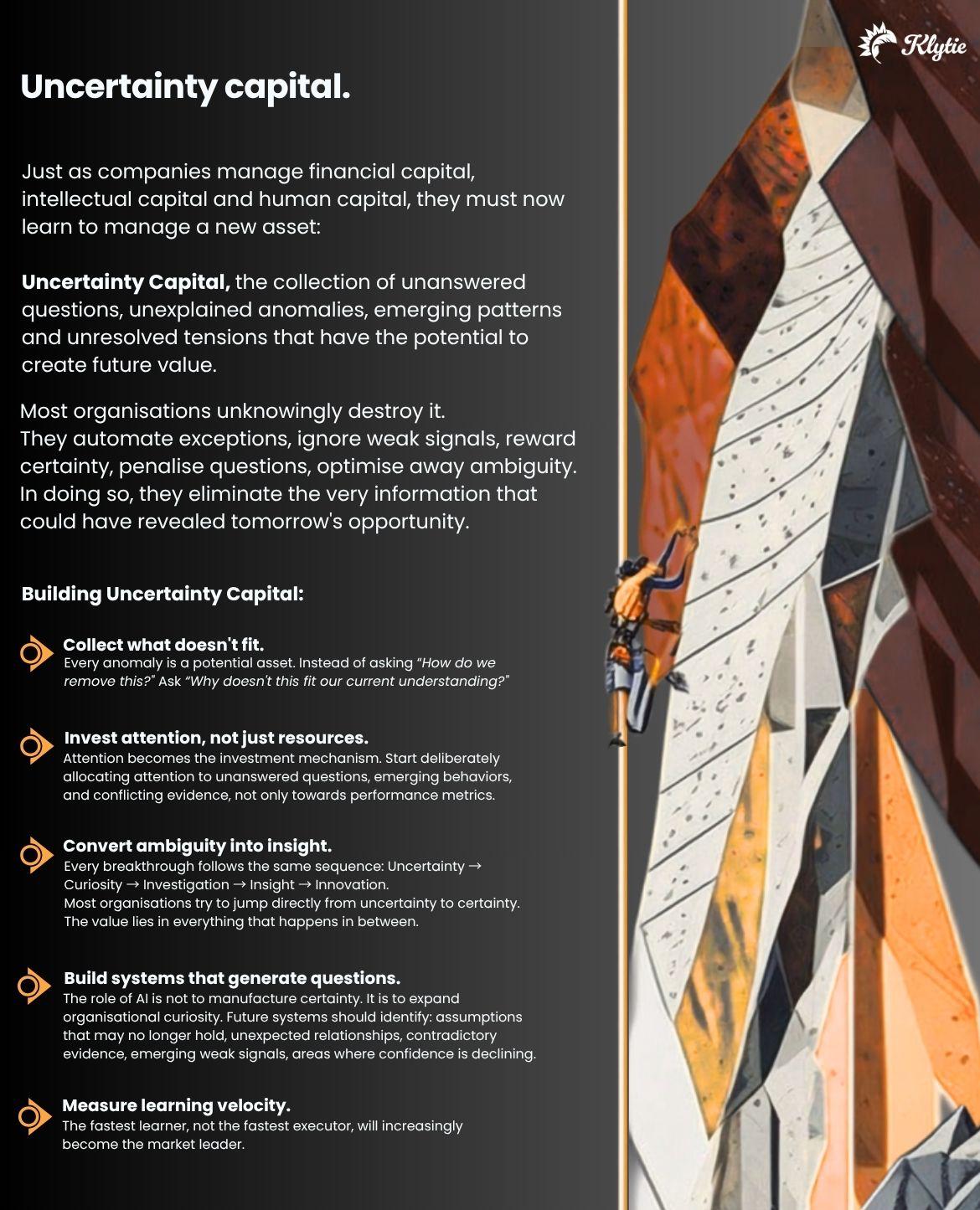
What if uncertainty isn’t the problem? What if it’s the asset?
We’ve spent decades trying to eliminate uncertainty through forecasts, dashboards, optimization and now AI. But as these tools become universal, certainty becomes commoditised. Efficient? Yes. Differentiating? Less and less.
The real advantage may lie elsewhere. After all, venture capital backs uncertainty. Science pursues it. Entrepreneurs embrace it. Markets depend on it. Innovation begins with it. Perhaps the winners of the next decade won’t be those who manage uncertainty best, but those who learn to harvest it.
If this perspective intrigues you, or challenges you, I’d be delighted to explore it together. Either way, until next time, keep it handy!
