

Every business wants to light a match.
A new idea. A new product. A new market. A new campaign. A new category. A new way of doing something that makes people stop, look and think: this might matter.
And sometimes the match catches beautifully.
There is attention. There is excitement. People are talking. The numbers rise. Traffic surges. Social media fills with mentions. The press notices. Customers arrive.
For a brief moment, everything feels as though it is accelerating. But a match is not a fire. It could be…but until it is, it’s simply the beginning of something that has yet to become extraordinary.
The most important question is what happens after the flame appears. Does it find fuel? Does it spread? Does it become self-sustaining? Does one person tell another? Does a first purchase become a second? Does curiosity become habit, and habit become loyalty?
This is where one of the most important distinctions in business emerges:
Broadcasting can light the match. Diffusion builds the fire.
It sounds simple, but it reaches surprisingly deep into how businesses understand growth.
Imagine a company preparing to introduce something important.
It spends €500,000 creating awareness. The launch generates: 2 million impressions, 100,000 website visits, 20,000 sign-ups, considerable social engagement, favorable media coverage.
On a presentation slide, this looks magnificent. The organization congratulates itself. But then the next question arrives:
How many of those 20,000 people actually used the product? How many found it valuable? How many remained active? How many returned? How much paid? How many recommended it? How many brought someone else with them?
Suppose only 2,000 became sustained users. The company created enormous exposure. It did not necessarily create enormous adoption. The match burned brightly. The fire did not take.
Conversely, another company can start relatively quietly and, through an excellent product, strong customer experience, recommendation and retention, create a much larger and more durable movement.
The first creates visibility. The second creates momentum. This distinction is not only semantic, it can be the difference between a successful communication exercise and a successful business.
Broadcasting and diffusion are different kinds of power. Broadcasting is powerful because it can create concentration. One message can reach millions. One advertisement can be shown to an enormous audience. One announcement can instantly put an idea into public consciousness. One influential person can introduce something to an entire network.
Broadcasting is therefore particularly useful at the beginning of a market journey. It creates the initial pool of people who could become adopters. But broadcasting has a natural limitation. The company is doing the broadcasting.
Diffusion becomes more interesting when the market begins participating in the process itself. A customer discovers the product. The customer tries it. The experience is positive. The customer returns. The customer tells a colleague. The colleague becomes curious. The colleague tries it. Another person observes that behavior. And gradually the product moves through a network.
At this point, the organization is no longer carrying the entire burden of growth. The customers have become part of the mechanism. That is the beginning of the fire.
Broadcasting transmits information. Diffusion can transform behaviour.
A person can hear about a product without changing anything. They can see an advertisement, scroll past it, remember it, even like it, and never buy. They can attend a presentation and remain unconvinced. They can become aware without becoming interested. They can become interested without trying. They can try without adopting. They can adopt without remaining loyal. And they can love a product without recommending it.
Every stage contains friction. This is why the journey from awareness to adoption is not a straight line. It is a sequence of behavioral decisions. And every one of those decisions represents a potential point at which the fire can either grow or disappear.
One of the most persistent mistakes in modern business is to treat visibility as if it were evidence of growth.
The logic often looks deceptively straightforward: big audience → awareness → adoption → growth. It feels intuitive. Reach enough people, and some will become customers. More reach should mean more customers. More customers should mean more growth.
But human behavior is rarely so linear. The actual journey is closer to: awareness → interest → trial → experience → satisfaction → adoption → recommendation → further adoption.
There is a difference in the underlying mechanism. The first model describes broadcasting. The second describes diffusion. The distinction becomes especially powerful when applied to communication.
Broadcasting is about sending (putting something into the market). Diffusion is about spreading (what happens to it once it enters the market). The strategic question is not just “How many people can we reach?” but “What will make the people we reach adopt, use, value and recommend what we have created?” The first is a communication question. The second is a business one.
In this sense, broadcasting is fundamentally an event logic: „We have something to say. Let us tell everyone.” Diffusion is a process logic: „We have created something valuable. Now let us understand how it moves through people, networks, habits and institutions.”
This is why the most successful businesses increasingly resemble learning systems rather than broadcasting machines. They do not simply communicate at customers. They observe customers, adapt to them, refine the product, improve the experience, create communities, generate referrals and build feedback loops.
The deeper principle is simple: an event can initiate change, only a process can sustain it. And in a business environment increasingly obsessed with launches, announcements, disruption, visibility and „big moments,” this distinction—between event-based thinking and process-based reality—is one of the most useful ways to understand growth in business, organizations, and society.
Let’s explore this in more detail:
The seduction of the event. Human beings naturally think in events. We remember the day a company was founded, the day a product was launched, the day a political movement emerged, the day a discovery was announced or the day an entrepreneur became famous.
Events are cognitively convenient. They have beginnings and endings. They can be photographed, announced, celebrated and measured.
Processes are less glamorous. Nobody takes a photograph of a company improving its customer onboarding by 7%. Nobody writes a headline about the eleventh consecutive month of slightly better retention. Nobody makes a documentary about the hundredth customer interview. Yet these seemingly insignificant repetitions are often what determine whether an organization survives.
This creates a fundamental analytical error: we confuse the visible starting condition with the mechanism responsible for the subsequent behavior:
- A rocket launch is spectacular. But the launch itself does not get the rocket to its destination.
- A seed being planted is an event. Growth happens afterwards.
- A patient receiving a diagnosis is an event. Recovery, if it occurs, is a process.
- A company announcing a product is an event. Adoption is a process.
- A government announcing a reform is an event. Institutional implementation is a process.
- A brand going viral is an event. Becoming culturally relevant is a process.
The event is often what attracts our attention precisely because it is unusual. The process is what determines the outcome precisely because it is repeated. That difference is easy to underestimate.
Growth is not a moment. The phrase „growth company” can be misleading because it makes growth sound like a property a company possesses. But growth is not really a state, it is a behavior.
A business does not „achieve growth” once and then keep it forever. It repeatedly performs the activities that generate growth. This is why the difference between a growth event and a growth process is so important.
Consider two companies:
- Company A launches spectacularly. It receives press coverage, attracts thousands of visitors and enjoys a surge of customers. Everyone declares the launch a success.
- Company B launches quietly. It attracts fewer customers but systematically studies why people buy, why they leave, where they struggle and what makes them recommend the product. Every month, the company improves acquisition, activation, retention and referral.
Six months later, Company A is asking how to recreate the excitement. Company B has built a machine that creates it. That is the difference. The first company experienced an event. The second built a process.
The remarkable thing about the event/process distinction is that it is not merely a business principle. It appears across almost every domain in which change occurs.
Field/ Event-based thinking/ Process-based reality:
- Business/ Big launch/ Continuous customer development
- Physics/ Initial impulses/ Sustained thrust
- Biology/ Birth/ Growth and adaptation
- Agriculture/ Planting/ Cultivation
- Epidemiology/ Exposure/ Transmission
- Sociology/ Announcement/ Diffusion
- Education/ Lesson/ Learning
- Leadership/ Speech/ Culture
- Innovation/ Invention/ Adoption
- Strategy/ Plan/ Execution and adaptation
The pattern is striking: the event establishes initial conditions, the process determines the trajectory. This distinction is particularly important because people often explain long-term outcomes by pointing backwards to a dramatic beginning.
A successful company has a famous launch, so we assume the launch caused the success. A successful leader gives an inspiring speech, so we assume the speech created the transformation. A product becomes popular after a major advertising campaign, so we assume advertising created the market.
Sometimes it did contribute significantly. But the deeper question is always: What happened after the event?
Physics offers a useful lesson: impulse is not momentum.
Business is similar. A large marketing campaign can generate initial impulses. A charismatic founder can create organizational momentum. A major investment round can provide resources. A product launch can create attention. But none of these automatically creates a durable growth engine.
The business must subsequently possess mechanisms that convert the initial impulse into continued movement.
This is why some companies can raise enormous amounts of capital and still fail, while others grow from modest beginnings. Capital can accelerate a process, it cannot substitute for one. A large budget applied to a broken mechanism merely allows the business to break things faster.
Perhaps the oldest illustration of this principle comes from agriculture.
Image of a farmer announcing: „I planted the field.” That is an event. It is also completely insufficient. The farmer must water, fertilize, protect, inspect, adjust, remove weeds, respond to weather and eventually harvest.
Planting establishes possibility. Cultivation converts possibility into reality.
Business is much the same. The initial idea matters. The founder matters. The product concept matters. The campaign matters. But the environment around the idea and (most importantly) the organization’s ability to cultivate it—matters enormously.
This is why sustainable growth often looks boring from the outside. It is customer interviews. Product improvements. Better onboarding. Faster response times. Cleaner operations. Better hiring. Smarter pricing. More reliable service. ….Hundreds of small decisions. None makes a particularly dramatic headline. Together, they create the harvest.
Startups provide an especially clear example. Entrepreneurs are frequently taught to launch quickly and rightly so. Perfection before market exposure is dangerous. But „launch fast” should never mean „launch and stop learning.” The real objective of an early launch is to begin a learning process.
The first version of a product is not supposed to prove that the entrepreneur was right. It is supposed to reveal where the entrepreneur was wrong. That is a profound difference:
- A process-oriented entrepreneur asks: Who actually uses this? Why do they use it? Why do they stop? What problem are they really solving? What behavior repeats? What makes customers recommend it? What prevents adoption? What can we improve this week?
- An event-oriented entrepreneur asks: How many people attended? How much press did we get? How many followers did we gain? How impressive was the launch?
The first set of questions produces learning. The second can produce vanity. This is why process thinking also changes what a business measures:
- A broadcasting mindset naturally gravitates towards: reach → impressions → views → media mentions → traffic. These numbers are not useless, they are simply incomplete.
- A diffusion mindset asks about: activation → usage → retention → repeat purchase → referrals → customer lifetime value.
The first group measures exposure. The second measures what exposure produced.
Vanity metrics often reward businesses for making noise rather than creating value. A million impressions can feel impressive, but a thousand customers who genuinely love a product may be economically and strategically more important.
A more thoughtful thinking process asks not only „How many people saw us?” but the far more revealing question „What happened because they saw us?” That is a harder question, certainly, but also a much better one. Attention is relatively easy to count, transformation is not.
Views are measurable. Clicks are measurable. Impressions are measurable. Followers are measurable. Launch attendance is measurable. But these metrics can conceal the real question: Did anything actually change?
And that is precisely the challenge for modern businesses: moving beyond measuring visibility to understanding impact. Because being seen is not the same as being remembered, and being remembered is certainly not the same as making a difference.
A campaign can generate enormous attention without changing behaviour. A company can become famous without becoming useful. A product can trend without becoming habitual. A CEO can dominate the news cycle without improving the organization.
Attention is often an event. Adoption is a process. This is why sophisticated businesses increasingly care about metrics such as retention, repeat purchase, customer lifetime value, engagement quality, referral rates and cohort behavior.
These metrics are less glamorous because they are fundamentally temporal. They ask not: „Did people respond?” but: „Did the response persist?”
That is the question that separates fireworks from a flywheel.
Fireworks are spectacular because all their energy is concentrated into a moment. A flywheel is almost unimpressive at first. It requires effort. Then more effort. Then more. But eventually momentum accumulates.
That is the essence of a durable growth engine: Customer satisfaction creates retention. Retention creates advocacy. Advocacy creates acquisition. Acquisition generates more customers. More customers create more data. More data improves the product. A better product increases satisfaction. And the cycle continues…
The objective is not merely to push harder. It is to build a mechanism in which yesterday’s effort makes tomorrow’s growth easier.
While events are often additive, processes can always be multiplicative. That is what makes a process powerful, it accumulates.
A company can spend €1 million on a campaign and receive €1 million worth of attention. That is an event. But a company that spends years improving customer retention may discover that every customer stays longer, buys more and refers more people. That is compounding.
The difference is profound. Event-based thinking asks: „What can we do now to create a result?” Process-based reality asks: „What can we build now that makes future results easier to produce?”
The second question is one of the great questions of strategy. It shifts management from activity to capability. Activity gets you through today, ability compounds. It turns one-off effort into a system, a habit, a tool, or an advantage that keeps paying dividends long after the original work is done. In other words, the best strategy is not just about running faster, it is about building a better track.
Broadcasting is necessary, but insufficient. None of this means that events, launches or broadcasting are unimportant. They matter enormously.
A great launch can create awareness. A powerful announcement can mobilize people. A compelling campaign can break through noise. A founder’s vision can attract talent. A dramatic product demonstration can change perceptions.
The mistake is not believing in events. The mistake is believing that the event explains the outcome. The event is the ignition system. The process is the engine.
There is also a moral dimension to process thinking. An announcement creates expectations. A promise creates obligations. A launch creates a responsibility to deliver. And so, the event becomes the beginning of accountability. This is especially important in an age where companies can communicate instantly and globally. It has never been easier to make an announcement, rarely has it been harder to maintain credibility.
The modern customer has learned to distinguish between what companies say and what they consistently do. Trust is therefore one of the ultimate examples of process-generated value. It is not created by one statement: „You can trust us.” It is created by thousands of small experiences in which the organization behaves consistently. Trust is accumulated. And, unfortunately, it is also accumulated negatively: one broken promise becomes part of the process too.
The practical implication is not that leaders should stop thinking in terms of „events.” They should think about what comes next before celebrating the event itself:
- Before releasing a product, ask: What is the adoption mechanism?
- Before launching a campaign, ask: What happens after attention?
- Before announcing a strategy, ask: What behaviors must change?
- Before acquiring customers, ask: What will make them stay?
- Before achieving a breakthrough, ask: What system will reproduce it?
- Before celebrating growth, ask: What produced the growth?
And perhaps the most important questions: If we stopped pushing today, what would continue moving tomorrow? Would customers still return? Would they still recommend? Would existing users generate new users? Would the product continue improving through feedback? Would the brand continue to create trust? Would the sales pipeline replenish itself? Would customers remain because of value rather than promotion?
The answers reveal the difference between momentum created by force and momentum created by a system. A business that must constantly push everything forward may have activity. A business whose customers, product and organization increasingly help push one another forward has a growth engine.
Virality is seductive because it appears to compress years of growth into days, and yet a viral moment is only valuable if the organization has a mechanism capable of converting attention into durable value. Otherwise, virality becomes a strange form of digital tourism: millions of people arrive, look around and leave.
A viral event without a diffusion mechanism is like lighting a match in a rainstorm. The flame is real. It simply doesn’t last.
Diffusion, the invisible architecture of growth. Diffusion is more complicated than broadcasting because it depends on networks.
A message spreads when people find it relevant enough to pass on. A product spreads when users find enough value to adopt and recommend it. A cultural practice spreads when individuals observe others adopting it. A management philosophy spreads when behaviors reinforce it throughout the organization.
A business grows when value moves repeatedly from one customer to another, from one interaction to another and from one learning cycle to the next.
This creates a powerful idea: sustainable growth is not simply expansion, it is the creation of mechanisms that reproduce value. That is why word-of-mouth is so powerful. The company does not have to perform the entire act of communication every time. Customers begin participating in the diffusion process.
The organization’s role changes from broadcaster to system designer. It creates conditions under which value can travel. The deeper business principle can therefore be expressed as a series of conversions:
Attention must become interest. Interest must become trial. Trial must become valuable. Value must become adoption. Adoption must become retention. Retention can become recommendation. Recommendation can become diffusion.
This is growth as a process. Each stage depends on the previous one, but it also introduces something new:
- Attention is psychological.
- Trial is behavioral.
- Experience is experiential.
- Adoption is usual.
- Recommendation is social.
- Diffusion is networked.
A successful business understands these transitions rather than treating the customer as a single conversion event.
Culture is the ultimate process. The event/process distinction is particularly useful when thinking about organizational culture. Companies often attempt to create culture through events: a values presentation, an off-site, a leadership speech, a new mission statement, branded posters, a company-wide announcement.
These things can matter, but culture is not what the organization says once. Culture is what the organization repeats.
If a company announces that it values innovation but punishes intelligent failure, employees learn the real rule. If it says customers come first but rewards employees only for internal targets, employees learn the real priority. If leadership announces transparency but information remains concentrated at the top, the announcement becomes theatre.
The profound implication of the famous observation „Culture eats strategy for breakfast” is precisely that culture is itself a process. It is produced through repeated decisions, incentives, rituals, stories, promotions, punishments and everyday behaviors.
The speech is the broadcast. The behavior is the diffusion. A great leader can change the emotional state of a group in minutes. History is full of speeches that mobilized people. But speeches alone rarely create enduring organizations.
Leadership becomes durable when inspiration is translated into: priorities, structures, incentives, habits, standards, decision-making principles, talent development, accountability.
In other words, the leader must convert emotion into repetition. A speech can make people feel differently. A system makes them behave differently tomorrow morning. And ultimately, organizations are shaped more by what happens repeatedly than by what happens dramatically.
Big business has the same problem. It is tempting to associate process thinking with startups and entrepreneurship, but large organizations may need it even more.
A multinational corporation can launch a new strategy with thousands of employees simultaneously. It can spend millions on communication. It can produce elegant presentations and impressive town halls.
Yet strategy does not become real because employees have heard about it. It becomes real when their decisions change. That requires processes. New incentives. New workflows. New capabilities. New reporting systems. New customer feedback loops. New management behaviours. New definitions of success.
The larger the organization, the more difficult this becomes because every strategic intention must travel through layers of interpretation. This is why large companies often struggle with transformation. They announce transformation as an event. Employees experience it as a process. And if those two realities diverge, the announcement eventually loses credibility.
Process does not mean slow. There is a common misunderstanding here. If events are associated with speed and process with repetition, one might conclude that process thinking is conservative. It is not.
A process can be extremely fast. A startup can run experiments weekly. A software company can deploy improvements daily. A sales organization can test messaging continuously. An e-commerce company can adjust pricing and merchandising in real time. A scientific organization can run hundreds of experiments.
The defining characteristic of a process is not slowness. It is continuity. A process-oriented company can move faster than an event-oriented one because it does not need to reinvent momentum every time.
Light the match, but build the fire.
Every transformation begins somewhere.
There is always a moment when the first customer arrives, the first product ships, the first message is broadcast, the first employee joins, the first field is planted. We should not underestimate the importance of that moment. But neither should we mistake it for the transformation itself.
The launch is not the business. The announcement is not the culture. The invention is not the innovation. The exposure is not the epidemic. The planting is not the harvest. The match is not the fire.
The deepest lesson of the event vs. process principle is therefore beautifully simple: events create attention, processes create outcomes.
In a world increasingly optimized for visibility, the temptation is to manufacture bigger moments: louder launches, larger campaigns, more spectacular announcements, more dramatic narratives. But sustainable success rarely belongs to the organization that can make the loudest noise once. It belongs to the organization that can keep creating value quietly, repeatedly and intelligently.
Broadcasting lights the match. Diffusion keeps the fire alive. And perhaps the real mark of strategic intelligence is knowing that the match is not the achievement. The achievement is building a fire that knows how to keep burning.
***
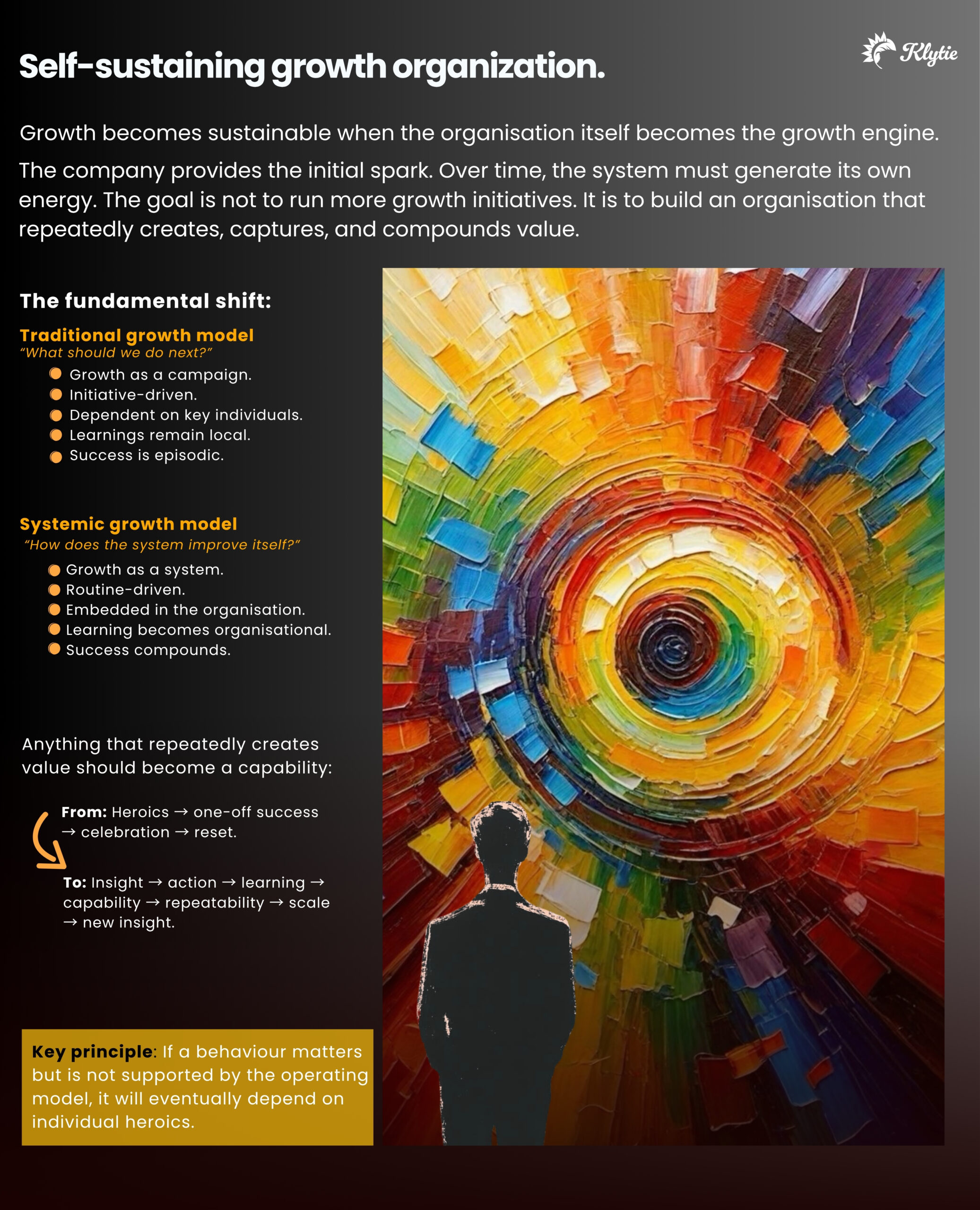
Jim Collins once wrote, “No matter how dramatic the end results, good-to-great transformations never happen in one fell swoop.” The same principle applies to growth. The best businesses build fires that feed themselves. The ambition is not perpetual broadcasting, but progressive, self-sustaining growth.
So perhaps the most interesting opportunity today is not simply to create another spark, but to build the machinery that keeps the fire alive.
If this resonates with you, let’s do this together! Keep it handy!
