

There is a question being asked in boardrooms, sales meetings and strategy sessions everywhere: „How can we use AI to sell more?”
It’s a perfectly reasonable question. It could also increasingly be the wrong one.
Not because AI cannot help companies sell more. It clearly can. It can find prospects, research accounts, analyze conversations, personalize outreach, draft proposals, identify buying signals, automate follow-ups and help salespeople spend less time on administrative work.
And yet, if every competitor can access broadly similar capabilities, these advantages will not remain advantages for very long.
The more interesting question is one level deeper: „What do we know about our customers, our market and our economics that is genuinely true, commercially valuable and difficult for competitors to replicate—and how can AI help us turn that knowledge into a compounding advantage?”
Well… that’s a completely different question. It shifts the conversation from AI as a productivity tool to AI as a force multiplier for proprietary knowledge and, in doing so, opens the door to something much more consequential: a fundamental shift in the economics of business.
If AI can not only accelerate how we work, but also amplify what a company uniquely knows, then the real competitive advantage may no longer be AI itself, but the proprietary knowledge, context, and judgment we teach it to compound.
That seems like a much more interesting direction to explore.
The first wave of business AI is largely about automation. Automated administration. Automated research. Automated reporting. Automated content. Automatic qualification. Automatic follow-up. Automatic analysis…This produces real efficiency.
But efficiency and competitive advantage are not the same thing. If everyone becomes 30% more efficient, nobody necessarily gains a lasting advantage. The cost base falls across the industry. The speed of execution increases across the industry. The quality of execution may improve across the industry. The competitive equilibrium simply moves.
The second wave of AI will therefore be more strategic. It will concern the intelligence of the organization itself:
- Which customers are economically attractive?
- Which signals predict buying behavior?
- Which problems create urgency?
- Which propositions consistently resonate?
- Which objections indicate genuine product weakness?
- Which objections have merely negotiating tactics?
- Which prospects consume resources without producing adequate returns?
- Which customers expand?
- Which customers churn?
- Which messages change behaviour?
- Which assumptions about the market are actually false?
These are not primarily automation questions. They are questions of knowledge, judgment and causality. AI can generate answers at extraordinary scale, it cannot, (on its own), confer hard-won experience, credibility, or context.
The premium shifts to something much harder: knowing what should be said, to whom, why, when, and under what circumstances it will actually change behavior. Distinguishing between information and genuinely earned knowledge may well become one of the defining strategic questions of the decade ahead.
Let’s delve deeper:
The great commoditisation of execution. Every major technological revolution changes the economics of labor by making certain capabilities cheaper.
The spreadsheet commoditised enormous amounts of arithmetic. The internet commoditised access to information. Cloud computing commoditized infrastructure. Software-as-a-service commoditized enterprise applications. And now, generative AI is beginning to commoditise a significant amount of cognitive execution.
It’s tempting to assume that because AI makes work cheaper, it automatically creates a competitive advantage. That’s not the case.
If everyone can do something more cheaply, faster or at greater volume, the economic value of that capability tends to decline. This is the uncomfortable logic of technological progress. Technology often creates advantage first and commoditization later:
The internet gave businesses extraordinary access to information. Eventually, everyone had access. Cloud computing transformed technology infrastructure. Eventually, everyone could buy it. Software made sophisticated capabilities available to almost every business. Eventually, software became ubiquitous.
AI is likely to follow a similar trajectory. The ability to generate content, conduct research, analyze information and automate routine cognitive work will increasingly become infrastructure. Powerful infrastructure. Important infrastructure. But infrastructure nonetheless.
There’s an uncomfortable implication for businesses here: if your competitive advantage is built primarily on work that AI can increasingly reproduce, you may not have much of a competitive advantage left, or at least not one that is particularly durable.
Consider two companies selling essentially the same product.
Both have access to the same large language models. Both can automate prospect research. Both can generate personalized outbound messages. Both can summarize calls. Both can create proposals. Both can analyze customer data. Both can automate follow-ups. Both can build sophisticated sales workflows.
What happens? The technological advantage rapidly disappears.
The two companies now possess roughly the same machinery. And when everyone possesses similar machinery, the question becomes: Who knows how to use it better? But even that is only the second-order question. The first-order question is: Who knows what is worth doing?
Who understands the customer better? Who knows what the customer will actually pay for? Who understands why they buy? Who understands why they don’t buy? Who knows which problem is genuinely painful? Who knows which message cuts through? Who knows which objections are real? Who knows which objections have excuses? Who knows which customers are profitable? Who knows which customers should never be pursued? Who knows what signals indicate that a prospect is about to buy? Who knows what causes an existing customer to expand? Who knows what causes one to leave?
This knowledge is much harder to commoditise. This is where first-principles knowledge enters the picture.
First principles begin where the dashboard ends. A first principle is something more fundamental than a rule, habit, assumption or received wisdom.
Businesses accumulate assumptions remarkably quickly:
- „Our customers want lower prices.”
- „Enterprise customers need more features.”
- „This market is highly competitive.”
- „We need more leads.”
- „Customers don’t understand our product.”
- „Buyers always need several meetings.”
- „This segment has a long sales cycle.”
- „Our competitors are cheaper.”
Some of these statements may be true. Many may be partially true. Some may simply be organizational folklore. First-principles thinking asks us to go deeper:
Why do customers want lower prices? What does „more features” actually accomplish? What makes the market competitive? Do we really need more leads, or better customers? Do customers misunderstand the product, or do they understand it perfectly and simply do not value it enough? Why does the sales cycle take six months? Who is delaying the decision? What risk are they trying to manage? What happens if they do nothing? What alternatives are they really comparing us against?
The point is not philosophical sophistication. The point is economic accuracy.
It’s about going underneath statements such as: „Our customers want faster delivery.” and asking: Why? „Faster delivery” because their own customers are impatient? Because inventory costs are high? Because delays create operational risk? Because procurement rewards speed? Because the buyer personally wants fewer headaches? Because a competitor has reset expectations? Or perhaps because „faster delivery” is simply the language customers use to describe a completely different underlying problem.
See the difference? Bad assumptions are expensive. They distort product development. They distort pricing. They distort marketing. They distort sales compensation. They distort forecasting. They distort resource allocation.
They lead companies to build the wrong products, pursue the wrong customers, price incorrectly, hire unnecessarily and optimize processes that should never have existed. And AI can make a bad assumption more dangerous because it can execute it at an extraordinary scale. Automation magnifies whatever you give it (including mistakes).
The machine becomes a multiplier. But the multiplier is only as valuable as the thing being multiplied. A salesperson can collect hundreds of customer statements and still misunderstand the customer. Data is not automatically knowledge and knowledge is not automatically understanding.
First-principles thinking asks: What is actually happening here? What causes it? What must be true for this behavior to occur? What would make the customer change? What would make them pay? What would make them refuse? What would make them switch? These questions are particularly powerful in sales because sales sits at the point where a company’s assumptions encounter economic reality.
Marketing may believe a message is compelling. Product may believe a feature is valuable. Strategy may believe a market is attractive. Finance may believe the price is justified…. The customer gets to decide. And the customer decides not through PowerPoint, but through behavior:
- They buy. They don’t buy.
- They renew. They leave.
- They expand. They negotiate.
- They ignore you. They refer you.
- They complain. They pay.
That is reality speaking.
From this perspective, sales is much more than a revenue-generation function. Done right, it is one of the most important knowledge-acquisition functions of the company. And this is perhaps one of the most underappreciated strategic roles of sales.
A great salesperson does not merely ask, „Can I close this deal?” They are constantly observing the market at close range:
- They hear objections before they appear in research reports.
- They discover competitors before they appear in strategy presentations.
- They notice changes in customer priorities.
- They hear the language customers actually use.
- They discover what budgets exist.
- They learn which decision-makers influence purchases.
- They see where deals stall.
- They learn what customers say privately that they would never put in a survey.
- And, critically, they discover the difference between what customers say and what customers do.
Those observations are extraordinarily valuable. The tragedy is that organizations often fail to capture them.
Customer conversations can and should be recorded. As well as: patterns can be identified, successful proposals can be recorded, failed approaches can be analyzed, objections can be categorized, buying signals can be documented, pricing lessons can be preserved and customer characteristics can be connected to outcomes.
In this way, over time, the organization can begin to develop something like a commercial nervous system. The company remembers what it has learned. More importantly, it can make that knowledge available to everyone.
The salesperson no longer starts every customer conversation from scratch. The organization carries its accumulated experience into the next conversation. That is potentially a profound competitive advantage.
Imagine a company selling enterprise software. Its customers say they want „better analytics.” The product team dutifully builds better analytics. Sales continue to struggle. Eventually someone discovers that customers were not actually buying analytics. They were buying confidence:
- The CFO wanted to be able to defend a decision.
- The operations director wanted to know where problems were emerging before they became expensive.
- The CEO wanted visibility without another six-month transformation project.
The software feature was analytics. The economic value was certain. The message changes. The product may barely change. The sales conversation changes completely.
This is why customer understanding is not a nice-to-have. It is the foundation upon which positioning, pricing, product development, marketing and sales all rest. And this is precisely where AI can move beyond utility and realize its deeper transformative potential.
AI can listen across enormous numbers of conversations:
- It can identify recurring language.
- It can compare successful and unsuccessful deals. It can detect changes in objections.
- It can identify patterns invisible to individual salespeople.
- It can surface emerging customer concerns.
- It can connect behavior across segments.
- It can turn scattered experiences into structured organizational knowledge.
However, there is an important caveat. AI does not automatically create truth. It can discover patterns, but people need to determine whether those patterns have meaning.
A correlation is not a commercial principle. A frequently repeated customer statement is not necessarily a customer need. And what customers say they want is not necessarily what they will pay for. Behavior is the ultimate observable test of understanding, and humans are still better than machines at genuinely understanding and interpreting it.
The customer is the laboratory. The best organizations therefore treat every customer interaction as an experiment. They form hypotheses. They test them. They observe behavior. They refine them.
For example:
- We believe this customer segment has a strong need for our solution. Test it.
- We believe this particular problem creates urgency. Test it.
- We believe this message resonates with the economic buyer. Test it.
- We believe customers will pay more when the proposition is framed around risk reduction rather than efficiency. Test it.
- We believe customers with these characteristics are more likely to expand. Test it.
This creates a flywheel: more conversations → more learning → better knowledge → better sales → better data → better AI → better decisions → more effective conversations.
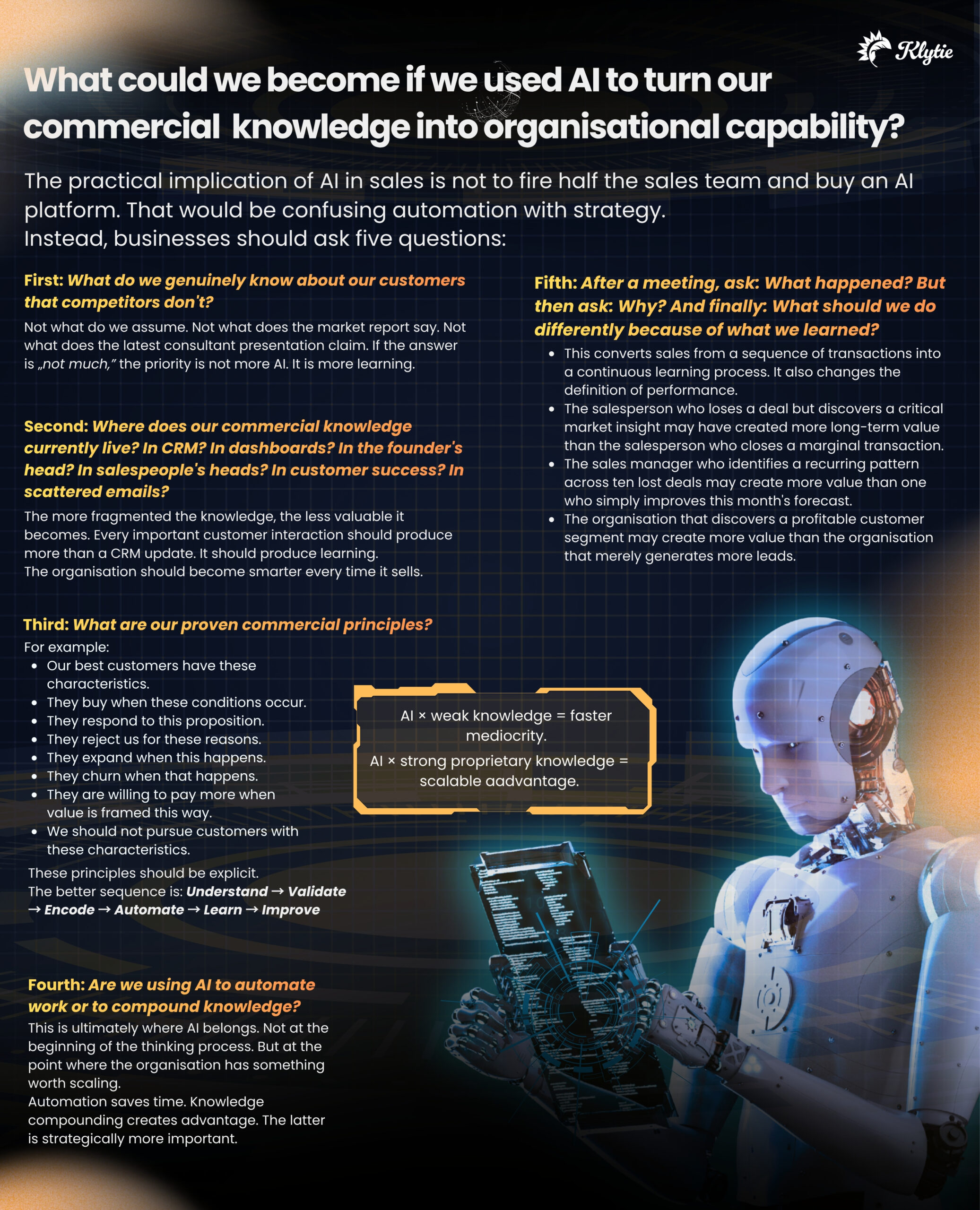
The strategic opportunity for businesses is therefore not simply to „implement AI in sales.” That is too small a vision. The objective should be to build a commercial learning system.
That is considerably more powerful than simply automating sales administration. The first-principles knowledge cannot simply be purchased as software. It must be discovered. And here is another reason this matters: customers are not always reliable narrators of their own purchasing behavior:
- They may say they want more features. What they may actually want is confidence.
- They may say they want a lower price. What they may actually want is an easier internal approval process.
- They may say they need more information. What they may actually need is less perceived risk.
- They may say they are interested. What they may actually mean is that they are being polite.
- They may say the price is too high. What they may actually mean is that the value is insufficiently clear.
What people say is information. What they repeatedly do is evidence. The commercial organization that can connect the two has an enormous advantage.
AI can scale a principle. It cannot invent one reliably. While AI can amplify knowledge, it does not make proprietary knowledge unnecessary. It makes proprietary knowledge more scalable, and that is a very different proposition.
Suppose a business has discovered (through years of sales conversations) something genuinely valuable: Customers with characteristics A, B and C are highly likely to buy when problem X becomes urgent, and they respond best when the proposition is framed around outcome Y.
That is a commercial principle. Now AI becomes incredibly powerful.
- It can search for companies exhibiting A, B and C. It can monitor signals indicating that X is becoming urgent.
- It can identify relevant decision-makers.
- It can personalize outreach around Y. It can analyze responses.
- It can recommend next actions.
- It can coach salespeople.
- It can update probability estimates.
- It can detect when the hypothesis stops working.
- It can help the organization continuously refine the principle.
This is where AI becomes a force multiplier. The AI did not create the underlying commercial truth. The organization discovered it. AI made it scalable. That’s why businesses should stop asking only: „How can we use AI?” and begin asking: „What do we know that is worth giving AI?” That is a much more strategic question.
Generic intelligence is becoming cheap. Specific intelligence is not. An AI system can tell you how to sell software (for example). It can tell you how to write an outbound sequence. It can explain the pricing strategy. It can generate a sales playbook. It can produce a market analysis.
But it does not automatically know the particular truths of your market:
- It does not automatically know that your best customers tend to buy three months after a particular organizational event.
- It does not automatically know that one objection is genuine while another is merely a polite rejection.
- It does not automatically know that your most profitable customers look unattractive at first glance.
- It does not automatically know that a particular phrase consistently increases conversion.
- It does not automatically know which prospects consume enormous amounts of sales effort and almost never close.
Those truths have to be learned. This creates a new hierarchy of value: data → information → insight → knowledge → judgment. The competitive advantage lies increasingly towards the right side of that spectrum. For example:
- Data: Customers in industry X have a 23% lower conversion rate.
- Information: The decline is concentrated among companies above a certain size.
- Insight: Larger customers require multiple internal stakeholders before purchasing.
- Knowledge: The sale fails when the operational champion is engaged without the financial buyer.
- Judgment: Do not pursue these accounts until an economic buyer has been identified.
The final statement is enormously more valuable than the first. It changes behavior. And this is where first-principles commercial knowledge becomes an asset.
Economic value appears at the moment an organization moves beyond knowing what happened to knowing what to do about it. Data creates awareness, insight creates direction, action is where value is realized.
We are entering an era in which businesses will have access to more information than ever before. That does not mean they will necessarily understand their markets better. In fact, there is a risk of the opposite. AI can produce convincing explanations at extraordinary speed. It can create polished analyzes from weak assumptions. It can generate plausible strategies before the organization has established whether the underlying premise is true.
The result can be an impressive form of corporate self-deception. A beautifully presented misunderstanding.
This is why first principles matter. The question is not: „Can AI give us an answer?” It almost certainly can. The question is: „Is this answer grounded in something we have actually learned about reality?”
Knowing who not to sell to. This may become one of the most valuable applications of first-principles sales knowledge.
Traditional sales culture often celebrates activity. More calls. More meetings. More leads. More opportunities. More pipeline. More territory. But an intelligent commercial organization should ask a more uncomfortable question: Which opportunities should we deliberately reject?
Not every customer is a good customer. Some consume disproportionate service resources. Some negotiate endlessly. Some churn quickly. Some require customization that destroys margins. Some have no genuine urgency. Some will never achieve the value necessary to justify your price. Some have simply the wrong fit. Others may initially look difficult but become extraordinarily profitable over time.
The ability to recognize these patterns can transform economics.
Imagine two companies with identical revenue.
- Company A pursues every plausible opportunity.
- Company B has learned that 30% of its market generates most of its profit, while another segment produces impressive revenue but chronically poor margins.
Company B deliberately says no to more prospects. It may therefore have a smaller pipeline. It may also have a much better business.
This is the subtle power of first-principles knowledge: it does not merely tell you where to go. It tells you where not to go. AI can make that knowledge executable at scale. But someone has to discover the principle first.
Pricing is where first-principles knowledge becomes money. Perhaps nowhere is this more obvious than pricing. Most businesses think they know their price. They know their competitors’ prices. They know their costs. They know their margins. They know what customers tell salespeople they are willing to pay. But willingness to pay is not the same as affordability. And affordability is not the same as value. The deeper question is: What economic outcome does the customer believe they are buying?
If a customer believes your product saves them €10,000, a €5,000 price feels expensive. If the same product prevents a €500,000 operational failure, €20,000 may suddenly feel cheap.
The product did not change. The customer’s perception of economic value did. This is why pricing is not simply a financial exercise, it is a knowledge exercise.
The best sales organizations discover:
- Which outcomes customers value most;
- Which problems are urgent;
- Which problems are politically important inside the customer;
- Who owns the budget;
- What alternatives customers compare you against;
- What happens if they do nothing;
- Which features genuinely influence purchase decisions;
- Which features merely sound impressive;
- Where price sensitivity disappears because value becomes obvious.
That is first-principles commercial knowledge. And once encoded into an AI-enabled sales system, it becomes extraordinarily powerful.
The organization that knows these things can price intelligently. The organization that does not tend to fall back on cost-plus pricing, competitor benchmarking or arbitrary discounting.
The message is also intellectual property. One of the most underrated assets a company can possess is a message that works. Not a slogan. Not a clever tagline. A proposition that causes the right customer to think: „That is exactly my problem.”
Finding that message can take years.
Most companies communicate from the inside out. „We have an innovative platform.” „We leverage advanced technology.” „We provide end-to-end solutions.” „We deliver world-class service.”
The customer is rarely lying awake at night worrying about whether your platform is “innovative.” They are worrying about something else. He missed the target. A costly delay. A difficult employee. A dissatisfied customer. A regulatory risk. A lost opportunity. A CEO asking uncomfortable questions. A competitor moving faster. A budget that has to be justified.
The strongest commercial messages connect the company’s capability to the customer’s economic reality. AI can generate thousands of messages. The question is: Which message is actually true? AI cannot reliably tell you which truth will matter before the market teaches you.
The answer must come from the market. You discover it by listening, testing, selling, measuring, learning, repeating. The message that consistently converts the right customers becomes an asset. And because AI can distribute it with extraordinary precision, its value increases.
The new salesperson is part seller, part scientist. This changes the profile of the best salesperson. The great salesperson of the future will not necessarily be measured by activity. They should be measured partly by learning velocity:
How quickly do they understand a new customer? How quickly do they identify the real problem? How quickly do they distinguish symptoms from causes? How well do they recognize buying signals? How effectively do they test assumptions? How accurately do they learn from lost deals? How effectively do they feed new knowledge back into the organization?
The best salesperson increasingly resembles a combination of: seller + analyst + psychologist + strategist + scientist. And this is a much more interesting profession, isn’t it?
From knowing more to knowing better. The AI era will not necessarily reward the company with the most information. Nor will it necessarily reward the company with the largest sales force. Nor the company that sends the most personalized emails. Nor the company with the most sophisticated technology stack.
It will increasingly reward the organization that can turn contact with the market into better knowledge faster than its competitors.
That is a different competitive game.
The winning company will listen better. It will learn faster. It will discard assumptions more readily. It will understand customers more deeply. It will know when to pursue an opportunity—and when to walk away. It will know what customers say, but more importantly, it will understand what their behavior reveals. And it will use AI not merely to do more work, but to multiply what the organization has learned.
Peter Drucker’s old question becomes newly relevant: What does the customer value? His broader argument was that this question cannot be safely answered from inside the company, management has to go to customers systematically to discover it.
That may be one of the great lessons of the AI age:
- When machines can generate almost anything, the scarce asset is no longer the ability to produce another answer. It is knowing which answer matters.
- When everyone can automate outreach, the advantage is not sending more messages. It is knowing which customer deserves a message in the first place.
- When everyone can generate a pitch, the advantage is knowing which truth about the customer’s business will make them care.
- When everyone has access to intelligence, the advantage becomes understanding.
- And when everyone has access to the same AI, the ultimate differentiator may be remarkably old-fashioned: knowing your customer better than anyone else.
That knowledge is not a prompt. It simply cannot be downloaded. It has to be earned (conversation by conversation, experiment by experiment, deal by deal).
AI can accelerate the process. It can magnify the insight. It can distribute the learning. It can turn individual experience into organizational capability. But first, a business has to discover something worth magnifying.
That is why the future of sales is not less human. It is, in an important sense, more intellectual.
- The salesperson’s job is moving from producing activity to producing understanding.
- The company’s job is moving from merely collecting data to building commercial intelligence.
- And the strategic challenge for leadership is no longer simply: „How can we use AI to sell more?” It is a much more consequential question: “What do we know about our market that is genuinely true, economically valuable and difficult for our competitors to replicate—and how can AI help us turn that knowledge into a compounding advantage?”
That is the question that sits upstream of sales. And increasingly, it may sit upstream of strategy itself. It changes everything. It changes the role of sales. It changes the role of customer conversations. It changes how companies think about CRM. It changes how founders transfer knowledge. It changes how pricing is developed. It changes how products are prioritized. It changes what should be measured. And it changes what AI investment should ultimately be for.
The new premium is redefined around: Not knowing more information. Knowing what is true. Not simply selling more. Understanding why people buy. Not merely using AI. Having something valuable enough for AI to amplify.
The businesses that understand this won’t use AI simply to make yesterday’s organization run faster. They’ll use it to build something fundamentally more valuable: an organization whose intelligence compounds. And in an economy where machines can increasingly perform the work, that may become the most important competitive advantage of all.
***
The AI advantage is therefore not “More AI.” A mediocre commercial understanding multiplied by AI simply produces mediocre decisions faster. A great commercial understanding multiplied by AI can produce extraordinary scale.
The difference is upstream. Scale becomes a consequence of clarity.
Before automation, there must be understanding. Before optimization, there must be something worth optimizing. Before personalisation, there must be a genuine understanding of what matters to the person. Before prediction, there must be an understanding of causality. And before AI can create a competitive advantage, a business needs to be clear about which advantage it is trying to create in the first place.
That understanding is not a software feature. It is not a prompt. And it certainly isn’t something you acquire by hiring a salesperson and asking them to „figure it out.”
It is the intellectual property of your business. And that is where I believe an interesting collaboration begins. Not with another AI implementation. With a deeper conversation about your business and the opportunity to build something better with the intelligence your business already has and the intelligence we can uncover together.
Until next time, keep it handy!
