

“I saw the angel in the marble and carved until I set him free.” Michelangelo’s words have endured because they speak to us of a timeless belief of humanity, greatness is revealed by the removal of all that does not belong.
It is a beautiful philosophy, until the context changes. In sculpture, subtraction reveals form, it creates perfection. In business, however, true power is not always found in what we subtract, it is often in what we choose to preserve. Remove the wrong things, and truth disappears, resilience fades, and fragility takes its place.
Modern organizations often inherit an aesthetic preference for cleanliness. Clean dashboards. Clean pipelines. Clean processes. Clean abstractions. Clean systems feel intelligent. They feel controlled. They feel modern. Above all, they feel safe.
Yet every act of cleaning comes with a hidden price.
Simplification is never just reduction, it is a decision about what deserves to endure. Every abstraction illuminates one truth while allowing another to fade into the background. And sometimes, the details we discard are the very ones that reality was quietly offering as its greatest lesson.
A perfectly smooth funnel hides the users who almost converted but didn’t. A perfectly optimized onboarding flow hides the moment confusion briefly appeared. A perfectly structured dataset hides the ambiguity that could not be categorized.
The most dangerous organizations are rarely those overwhelmed by messy data. They are the ones surrounded by beautifully organized information that no longer contains the questions it once raised.
This tendency has become even more pronounced today. AI excels at compressing complexity into coherence. It summarizes conversations, categorizes uncertainty, identifies patterns, and transforms thousands of observations into a handful of elegant conclusions. The efficiency is remarkable, and undeniably valuable.
Yet every summary is also a subtraction.
Why read ten customer support conversations when an AI can summarize them? Why observe users struggling through onboarding when a model can identify friction points in seconds? Why spend hours listening to customer interviews when transcripts can be analyzed instantly?
These are certainly sensitive questions while quietly, almost imperceptibly, a subtle exchange begins: organizations trade experience for representation. The map becomes more convenient than the territory.
History has seen this pattern before.
Every transformative technology introduces a new layer of abstraction, a lens that promises to make complexity manageable. As the tools grow more sophisticated and the interfaces more seamless, the distance between reality and its representation narrows until it becomes almost invisible. And that is precisely when the illusion takes hold: because something can be measured, visualized, or summarized, we assume it has been fully understood.
But representations are faithful servants and dangerous masters. They illuminate patterns while casting shadows. They compress meaning, and compression always comes at a cost.
Data becomes dashboards. Dashboards become decisions. Decisions become strategies. Each step is perfectly rational, elegantly efficient, and seemingly inevitable. Yet somewhere along that immaculate chain of logic, the messy, contradictory, deeply human texture of reality quietly slips through the cracks.
AI magnifies this illusion because its greatest strength is also its greatest sleight of hand.
AI can transform fragments of context into narratives that are coherent, persuasive, and often astonishingly insightful. It speaks with confidence, connects patterns at remarkable speed, and gives shape to complexity in ways that feel almost effortless. And yet there is an enduring truth that no algorithm can outgrow: coherence is not correctness, fluency is not understanding, and output is not judgment.
The true constraint of every intelligent system (human or artificial) is not computational power, processing speed, or the sophistication of its models. It is context. Context is the compass that separates signal from noise, wisdom from information, and meaningful progress from beautifully packaged assumptions.
What a system knows about the environment in which it operates determines everything it produces afterwards. A model with insufficient context rarely fails dramatically. It fails elegantly. It generates answers that sound convincing enough to discourage further questioning. That is what makes it dangerous. The biggest failure is rarely the wrong answer, but the disappearance of doubt.
Traditional software behaved according to code. Inputs produced predictable outputs through explicit, traceable logic. Modern AI systems behave differently. Their intelligence is shaped not only by algorithms, but by the often invisible environment surrounding every interaction.
That’s why two identical models can produce radically different conclusions depending on
- What the user previously said but did not state.
- What assumptions the system makes about the user’s intent.
- What historical patterns it has learned about similar situations.
- Which constraints remain implicit but not declared.
- Which edge cases it has (or has not) encountered before.
Intelligence, therefore, is no longer simply a function of capability, it is a function of situational awareness.
Context has become the invisible architecture of every intelligent system.It is the mechanism through which reality is represented inside machines. Unlike compute, storage, or capital, context cannot simply be purchased or scaled overnight. It must be accumulated patiently, refined continuously, and renewed through constant contact with reality.
The question worth exploring is: What if, in our attempt to eliminate the unnecessary, we started eliminating what matters most?
Today’s world is not a block of marble waiting to uncover a masterpiece. It is a living ecosystem, dynamic, interconnected, and relentlessly evolving. Success no longer belongs to those who simply cut away. It belongs to those who know what to preserve, what to refine, what to build upon, and what to add.
A summary tells us what happened, it rarely conveys how it felt, and in business, feeling is more informational than sentimental. Confusion, hesitation, frustration, surprise, silence…these are not imperfections to eliminate. They are signals that something in the relationship between a system and its users is misaligned.
When every interaction is mediated through summaries, organizations become fluent in patterns they have never directly encountered. They start making decisions based on second-order experience, a version of reality that is cleaner, smoother, and more internally consistent than reality itself. Too smooth, sometimes, to be accurate.
The greatest leaders are not sculptors of stone, they are architects of possibility. Sometimes wisdom lies in removing the unnecessary. Other times, it lies in recognizing that what appears unnecessary today becomes tomorrow’s competitive advantage.
True leaders know that excellence comes from discerning what to remove, what to reinforce, and what still needs to be imagined. They understand that value is rarely hidden beneath the surface waiting to be exposed. More often, it is created through collaboration, adaptation, curiosity, and the courage to embrace complexity rather than erase it. After all, progress has never been a simple act of reduction, but an act of intentional creation.
Nature rarely speaks through perfect symmetry. Doctors rarely make breakthroughs by studying only healthy patients. Detectives solve cases because something doesn’t fit the pattern. Reality has always whispered through its imperfections.
Yet in the age of AI, we are building organizations that increasingly hear only polished echoes of reality (summaries instead of conversations, dashboards instead of observations, confidence instead of curiosity). The real challenge today isn’t to eliminate everything that seems unnecessary. It’s to cultivate the wisdom to recognize the difference between noise and signal, simplicity and oversimplification, efficiency and true understanding.
So, let’s talk about this invisible ingredient that separates true intelligence from mere imitation, context. It is the messy, contradictory, and often incomplete fabric of reality, the subtle nuances, relationships, and circumstances that no summary, no matter how polished, can ever fully capture.
Context is earned, not stored. If there is a single misconception quietly eroding modern organizations, it is the belief that context can be accumulated like inventory. Collect enough logs. Archive enough documents. Index enough conversations. Embed enough vectors. Eventually, the system will know.
It is an alluring premise that understanding is simply what emerges when information reaches critical mass. But somewhere, between accumulation and comprehension, we mistake memory for meaning.
Context has never behaved like storage, it behaves more like circulation. Like the living memory of an organism rather than the archives of a library. It is sustained by relevance, sharpened by repetition, directed by attention, and renewed through proximity. It lives in motion, not in preservation.
Two organizations can possess precisely the same data and arrive at profoundly different conclusions. One has lived the circumstances that produced the data. The other merely inherited its residue. That distinction is almost invisible, until it matters. Stored context decays while circulated context compounds.
Many businesses are enamored with the language of „knowledge capture.” It sounds prudent, scalable. It sounds like progress. Yet what we often capture is not knowledge itself, but knowledge severed from the conditions that made it meaningful.
A meeting note without its tone, a support ticket without the customer’s frustration, a dataset without hesitation, or a transcript without silence..each remains factually accurate. Yet each has lost something essential, the invisible texture that made those facts intelligible in the first place.
We increasingly mistake beautifully organized maps for the landscape itself. Systems appear intelligent in demonstrations yet become erratic in the wild. They retrieve information flawlessly while missing significance entirely. They know what happened but remain strangely indifferent to why it mattered.
Nowhere is this tension more apparent than in AI-native organizations. Modern AI systems are trained not only on structured information but on progressively abstracted representations of human behavior. Every transformation (from experience to documentation, documentation to embedding, embedding to latent representation) adds another pane of glass between reality and its reflection.
While abstraction is indispensable, every layer extracts as much as it compresses. Eventually, a system can become remarkably fluent in symbols that no longer correspond cleanly to the world they were meant to describe. It speaks with confidence while drifting quietly away from experience.
Perhaps the deeper mistake is linguistic. We speak of context as though it were a noun, a thing to be stored, retrieved, transferred, and owned. But in operational systems, context is not a static object, it is a process. It is continuously generated through interaction between: users and products, systems and failures, decisions and consequences, intentions and misunderstandings.
Context exists only while these interactions are alive. The moment interaction stops, context begins to fade. Like water removed from its riverbed, it may remain visible for a while, but it no longer flows.
This explains why organizations built exclusively around stored knowledge often experience a slow, almost imperceptible contextual drift. Their documentation grows richer while their intuition grows poorer. Their databases expand while their understanding contracts.
Decision-makers begin to operate on summaries of summaries: product metrics instead of user behavior, quarterly reports instead of daily friction, synthesized research instead of direct observation, and AI-generated insights instead of first-hand experience.
Each layer improves efficiency. Each layer reduces fidelity. Eventually, the organization becomes structurally dependent on representations of reality that no longer match reality itself. They are no longer operating within context, they are adjacent to it.
This is entropy, the quiet force that erodes organizations not through failure, but through success. It is one of the least discussed, yet most consequential, risks facing modern companies.
As teams grow, products mature, and responsibilities multiply, something invaluable begins to dissipate and that is precisely context. Not because people are careless, but because progress inevitably creates distance between those who lived the decisions and those who inherited them. Every layer of scale adds efficiency, yet often subtracts shared understanding.
Context is not documentation. It is not a folder, a wiki, or an archive waiting to be searched. Context lives in conversations, in judgment, in the reasoning behind decisions, and in the subtle connections that rarely make it onto the page. Once those human links weaken, even the most meticulous records become fragments of a larger story.
As management thinker Peter Drucker observed, „The most important thing in communication is hearing what isn’t said.” Context is precisely that, the invisible thread that gives meaning to facts.
Organizations often obsess over preserving information while overlooking the harder challenge, preserving understanding. But information without context is like a map without a compass, technically complete, yet incapable of guiding the journey.
This is why organizational entropy is so deceptive. It does not announce itself with crises, it accumulates quietly, one missing conversation, one departed colleague, one undocumented assumption at a time. By the time its effects become visible, rebuilding shared understanding is exponentially more difficult than preserving it ever was.
Context, once lost, cannot simply be retrieved. It does not live in archives. It lives in contact, therefore it can only be recreated slowly, imperfectly, and at great cost.
The flywheel model. A more accurate way to think about context is as a flywheel. A system where value is not stored in a single moment of insight, but generated continuously through repeated cycles:
Contact with reality produces signals. Signals produce interpretation. Interpretation shapes action. Action reshapes reality. And the cycle begins again.
Each loop adds not just output, but understanding. But only if the loop remains intact. More often the danger in modern organizations is not lack of information, it is broken loops:
- Signals that never reach interpreters.
- Interpretations that never reach decision-makers.
- Decisions that never encounter real feedback.
- Feedback that never gets meaningfully processed.
When loops break, context stops circulating. And when context stops circulating, intelligence becomes static.
Today, AI introduces a strange dual effect on the context flywheel.
On one hand, it accelerates every stage of the loop: it can collect signals on a large scale, synthesize feedback instantly, generate interpretations quickly, and also propose actions in real time.
While the loop becomes faster, the speed is not the same as circulation. Because AI can also introduce a second effect, insulation. If systems begin to rely too heavily on generated summaries, synthetic interpretations, or automated decisions, they risk bypassing the very friction that once kept them grounded.
The flywheel spins faster, but with less contact with reality. Eventually, it becomes a simulation of learning rather than learning itself.
The difference between data flow and context flow. Most organizations believe they have „data pipelines.” But data flow is not the same as context flow.
Data flow moves information. Context flow preserves meaning.
- A data pipeline might tell you: what users clicked, how long they stayed, what percentage converted
- A context flow tells you: why they hesitated, what confused them, what expectations were violated, what mental model they were operating under
The first is scalable. The second is fragile. And yet, accumulated context becomes outdated, while circulated context stays alive. This is because meaning is not static, it evolves as systems evolve.
A feature that once caused confusion may later become intuitive. A workflow that once worked may become obsolete. A user behavior that once indicated success may later indicate misunderstanding.
If context is stored, it freezes at the moment of capture. If context is circulated, it continuously updates itself through interaction. This is why the most adaptive organizations are not those with the largest knowledge bases, but those with the fastest feedback circulation.
A useful metaphor is to think of context as a bloodstream. Signals has oxygen. Interpretation is metabolism. Action is movement.
When circulation is healthy, every part of the system remains informed by what is happening elsewhere. When circulation slows, parts of the system begin to act independently of each other’s reality. Eventually, the organization develops internal contradictions:
- Product builds features customers do not use.
- Marketing promotes value users do not perceive.
- Support solves problems engineering has already forgotten creating.
- Leadership makes decisions disconnected from operational truth.
The issue is that, over time, even the most capable systems can lose connection with the world they are meant to understand.
Static intelligence is intelligence that has stopped renewing itself, intelligence that no longer challenges its assumptions through contact with new experiences, changing conditions, and emerging realities. It can be deeply refined, highly efficient, and impressively optimized within the boundaries it knows. In controlled environments, it may even outperform systems that appear less structured.
In AI systems, this can appear as models trained on outdated assumptions, automated decisions that no longer reflect user intent recommendations optimized for behaviors that no longer exist, or summaries that flatten evolving complexity into outdated categories.
In organizations, it appears as strategy documents that no longer reflect market reality, metrics that optimize for past conditions, or even processes that persist long after their relevance has faded.
True intelligence is not defined only by how well it performs with what it already knows. Its greatest strength lies in its ability to learn, adapt, and evolve. The moment understanding becomes separated from experience, knowledge begins to lose its vitality. True intelligence requires circulation: a continuous exchange between ideas and reality, reflection and action, learning and change.
Growth comes from staying connected, from allowing new information, new perspectives, and new experiences to reshape what we think we know. The ability to adapt is not a weakness in intelligence, it is the very quality that keeps intelligence alive.
The flywheel breaks quietly. One of the most dangerous properties of context systems is that failure is gradual. The flywheel does not stop abruptly. It slows down.
Signals become less rich, interpretations become less grounded, actions become less informed, feedback becomes less meaningful…but each step still appears functional. Reports are still generated, systems are still operating, KPIs are still moving.
Only later does the organization realize that what it has been optimizing is no longer aligned with reality. By then, rebuilding context is expensive. Sometimes prohibitively so.
The solution is not more data, it is restored circulation. This often requires counterintuitive decisions:
- Reducing abstraction rather than increasing it.
- Increasing direct exposure to users rather than filtering it.
- Slowing certain feedback loops so they remain interpretable.
- Preserving human involvement at critical junctions of interpretation.
- Resisting premature compression of messy signals into clean metrics.
The goal is not to reject automation, it is to ensure that automation does not sever the flow of meaning. Because once meaning stops circulating, intelligence becomes decorative.
AI as a context amplifier, not a context replacement. A powerful misconception has begun to shape the conversation around AI, the belief that as AI systems become more capable, human context will become less important.
The opposite is more likely to happen.
AI won’t eliminate the need for context, but what it will do is expose its value. The future will not simply belong to those who possess the most advanced models, the largest datasets, or the greatest computational power, it will belong to those who understand their reality deeply enough to guide these tools with precision.
AI is not a substitute for understanding, it is an amplifier of understanding.
A useful metaphor is to think of AI as a lens. A high-quality lens does not create the landscape, it reveals it with greater clarity. But if the lens is pointed in the wrong direction, it only produces a sharper image of the wrong thing. The technology can enhance vision, but it cannot decide what is worth seeing.
The same principle applies to organizations.
A system built on rich, accurate, and continuously evolving context becomes extraordinarily powerful when combined with AI. It can make decisions faster, identify patterns earlier, and adapt with a level of speed and precision that was previously impossible.
But a system built on poor context creates a different outcome. AI can become a machine for accelerating confusion. It can produce convincing answers to poorly defined questions, amplify outdated assumptions, and transform uncertainty into false confidence.
The difference between these two realities is not the intelligence of the model, it is the quality of the environment surrounding it. As the saying often attributed to computer science goes, „Garbage in, garbage out.” In the age of AI, the principle becomes even more profound: weak context does not simply create weak outputs, it creates persuasive weaknesses. The danger is no longer that machines cannot answer. The danger is that they can answer too convincingly.
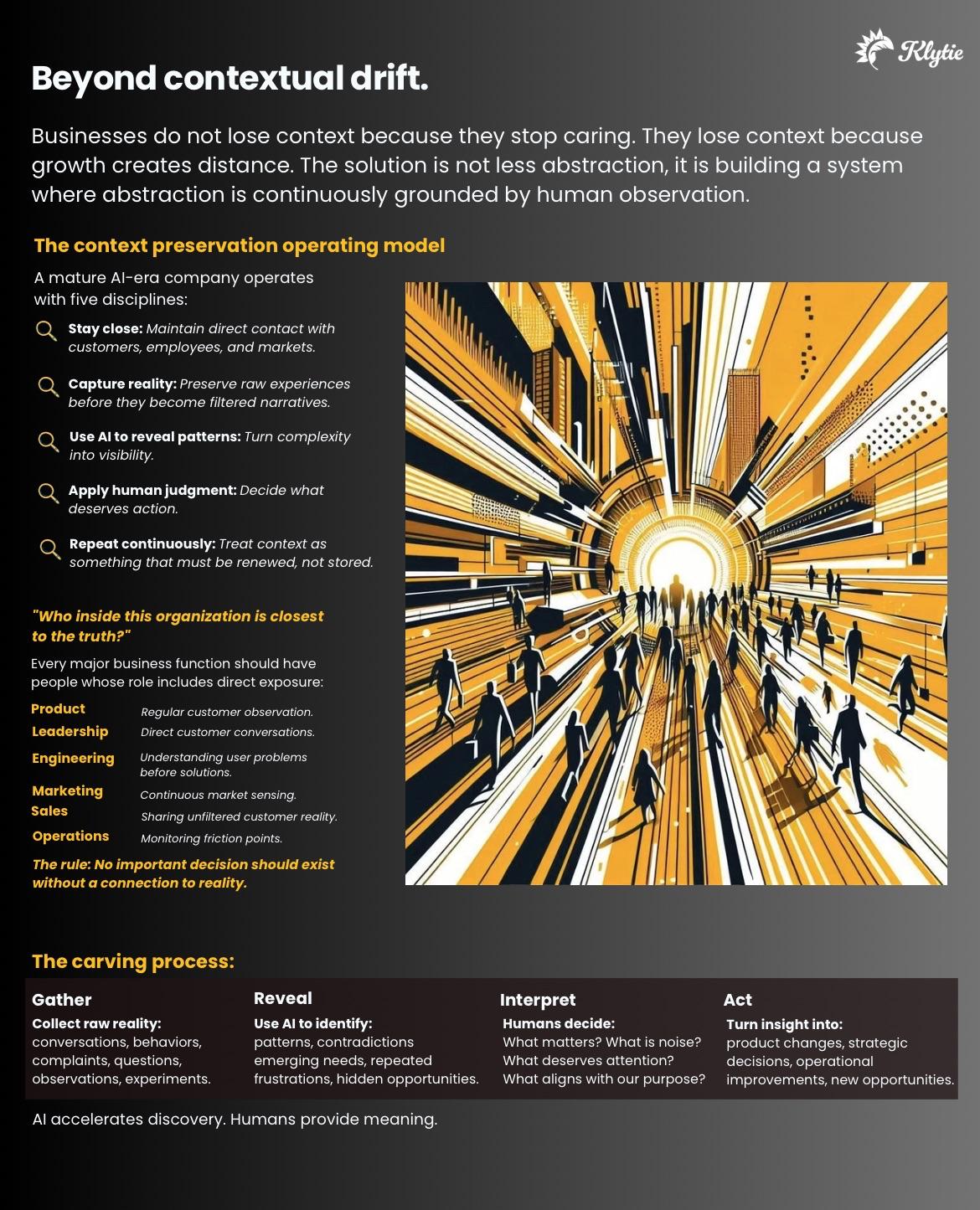
This is why context engineering may become one of the most important capabilities of the AI era. But context engineering is not primarily a technical discipline, it is an organizational discipline. It is built through proximity to reality:
- Teams staying close to users rather than relying only on reports.
- Organizations creating fast feedback loops instead of slow approval chains.
- Leaders challenging assumptions before they become institutional beliefs.
- Companies reducing ambiguity through learning rather than hiding it through complexity.
- Humans remaining involved long enough to recognize what machines cannot see.
These are not software challenges, but human ones. Technology can process information, but context is created through experience, judgment, relationships, and ongoing interaction with the real world. AI can accelerate intelligence. It cannot manufacture wisdom.
The new scarcity. Every technological era has been defined by a different form of scarcity. The industrial age was shaped by the scarcity of machines and physical production capacity. The software age was shaped by scarcity of distribution—who could reach users faster, scale more efficiently, and transform ideas into platforms.
The AI age may be defined by something far more subtle, the scarcity of meaningful context. Not the date, not computing power, and not even models. But context. Because information alone does not create intelligence. Context determines what information matters.
Defined context: which questions are worth asking, which signals should be ignored and which deserve attention, which outputs are useful and which are misleading, which risks matter, what success actually means, what „good” looks like in a specific environment. Without context, intelligence remains generic. With context, intelligence becomes situational, and only situational intelligence creates value.
Many organizations will have access to similar models, similar tools, and similar capabilities. The real advantage will come from something harder to replicate: deep, embedded understanding of a domain. The organizations that succeed will not win because they know everything. They will win because they know where they stand. They understand their customers, their constraints, their environment, their history, and the subtle signals that outsiders cannot see. They possess the invisible map that allows AI to navigate effectively.
The angel inside the marble. Michelangelo believed the angel was already inside the marble. His genius was not in creating it, but in recognizing what was worth revealing.
Today’s marble is different. It is made of overwhelming volumes of information, endless possibilities, competing signals, and growing complexity. Somewhere within it lies the next insight, the better question, the elegant solution.
The real question is no longer whether we have better tools. It is whether we remember who is holding the chisel. AI can expose patterns, suggest directions, and accelerate the work. But it cannot decide what is meaningful. It cannot recognize purpose before possibility. The sculptor still must.
So AI is less likely to replace human judgment, context, or imagination. If anything, it will amplify the value of those who bring them.
After all, the angel has always been in the marble. Technology may sharpen the chisel, but only people can recognize the masterpiece.
***
„Intentio operis is not revealed by the intentions of the author,” Umberto Eco once wrote in „The Limits of Interpretation.” Funny enough, decades later, many organizations still struggle with the opposite problem, they have more authors than ever, but no real story.
„How much data do we have?” has become a favorite boardroom question. The answer is usually, a lot. Mountains of it. Rivers of it. Enough dashboards, spreadsheets, and reports to make even the most enthusiastic analyst question their life choices. Data was never the scarce resource. Reality is. The harder question is perhaps „How close are we to where the truth actually happens?”
Every decision travels through a simple chain: Context distance → Reality exposure → Signal integrity → Decision confidence. The farther we move from the people, places, and moments where reality is created, the more our signal gets distorted. Eventually, we start optimizing a beautifully designed model of something that no longer exists. And no amount of AI can rescue an artificial understanding of reality.
If these ideas resonate with you—whether you’re leading AI initiatives, shaping strategy, building products, or rethinking how decisions are made—let’s challenge assumptions, exchange perspectives, and explore how we can build organizations that don’t simply become more intelligent, but more truthful in the way they learn, decide, and create value.
Until next time, keep it handy!
