

For most of modern business history, success followed a predictable trajectory. A company acquired capital, invested in machinery, hired people, expanded production, and eventually achieved the holy grail of economics, scale. Bigger factories produce cheaper goods. Larger sales teams reached more customers. More capital means more opportunity. Scale was not merely a strategy, it was the destination.
The Industrial Revolution did more than mechanize production, it taught us to worship distance. The successful executive became increasingly removed from the factory floor. Decisions ascended the hierarchy while work descended into specialized functions. Customers became data points. Employees became resources. Production became a process to optimize rather than a craft to understand.
For two centuries, this model worked remarkably well.
Then software happened. Software dismantled many of the assumptions that industrial businesses had taken for granted. Distribution became almost free. Copying a product costs virtually nothing. A startup of five engineers could challenge corporations employing fifty thousand. The capital required to build a meaningful business fell dramatically.
Now AI is dismantling another assumption. Execution itself is becoming abundant. Writing code, drafting documents, producing designs, analyzing spreadsheets, generating marketing campaigns, answering support requests tasks that once demanded specialized expertise can increasingly be performed by machines at negligible cost.
For the first time in economic history, intelligence is becoming scalable. This changes everything. When execution becomes abundant, it ceases to differentiate. When production becomes inexpensive, production ceases to be the bottleneck. When everyone has access to extraordinary tools, advantage migrates elsewhere.
The question is where.
Most organizations instinctively search for advantage by accelerating automation. They ask how quickly they can replace manual effort with algorithms, reduce human involvement, and eliminate friction from their operations.
It is an understandable instinct. It may also be the wrong one.
***
There is an older lesson, hidden inside the story of a small hardware startup called Meraki. Unable to afford a manufacturing run, the founders assembled their networking equipment by hand. Conventional business wisdom would describe this as inefficiency, a temporary hardship to overcome as quickly as possible.
Yet something unexpected happened. Building every router themselves did more than produce hardware, it produced understanding. From the very beginning, every screw tightened, every defective component discovered, every customer installation, every repair became information, part of a continuous learning process.
What looked like a manufacturing operation on the surface was, at its core, a feedback loop, a process of discovering reality. The factory’s real output was not hardware, but an increasingly accurate understanding of the market, the technology, and the constraints that defined both.
In this framing, the founder was not (and could not have been) a CEO in the conventional sense, but more a temporary instrument of observation. As one might put it: „You do not build the system. You discover what the system is by breaking it often enough to see its edges.”
This distinction appears subtle, but profound, because knowledge compounds. While factories depreciate, capital can be borrowed, technology can be licensed, software can be copied, knowledge earned through direct experience remains stubbornly difficult to imitate.
And that is the Meraki principle.
The word „Meraki” (pronounced may-rah-key) comes from modern Greek, where it carries an almost untranslatable tenderness. It means to do something with soul, creativity, or love. Linguistically, the word it evolved from the Turkish word „merak” (which comes from the Arabic „merāq“), originally meaning passion, curiosity, or taking a keen interest in something.
In other words, it describes the act of pouring your heart, passion, and essence into your work, leaving a piece of yourself in whatever you create. Not sentimentality, not decoration, but a kind of embedded presence. The kind that remains even after the maker is gone.
It is a word born outside the vocabulary of efficiency. And yet, paradoxically, it has become one of the most useful ways to think about technology companies in the age of AI. Because beneath its poetic surface, Meraki encodes a hard operational truth: when systems become cheap to build and easy to replicate, the only durable advantage is proximity to reality. Or more sharply: what cannot be automated is what must first be deeply understood.
This is where the original Meraki story becomes more than folklore. It’s not necessarily about hand-assembled routers or pieces built in apartments. These are superficial artifacts. The deeper pattern is architectural, in the earliest phase of a system, founders replace capital with intimacy, and scale with understanding. They don’t buy knowledge through infrastructure, they earn it through contact.
In the language of startups, Paul Graham once described this as „doing things that don’t scale.” But in today’s AI-shaped world, the framing has subtly evolved. It is no longer just about unscalable effort, but about something more precise, doing the things that must not be automated too early. Because automation, when applied prematurely, does not eliminate work. It eliminates learning.
And learning, has a peculiar requirement: distance slows it, proximity accelerates it. This is the paradox at the heart of modern business. The technologies promising infinite scale are making intimacy (not scale itself) the rarest and therefore the most valuable resource in the economy.
Let’s tackle them one by one.
Replace capital with intimacy. There is a quiet assumption embedded in most modern business thinking. It is rarely stated outright, yet it shapes nearly every strategic decision: that capital is the primary constraint on what a company can become.
If you have enough money, you can hire enough people. If you hire enough people, you can build enough product. If you build enough product, you can capture enough market. The logic feels almost mathematical in its certainty. It is also increasingly incomplete.
Capital still matters, of course. It always will. But in a world where software, infrastructure, and even intelligence are becoming widely available on demand, capital is no longer the rarest ingredient in the system. It is no longer even the most difficult one to deploy effectively.
A company can raise millions and still not understand its customer. It can hire hundreds and still not know what it is building. It can scale revenue and still not have clarity about why it exists. Something else, less visible and less easily purchased, is becoming the real constraint.
Call it intimacy. The word sounds almost misplaced in a business context. It belongs more naturally to art, to craftsmanship, to relationships. Yet it describes something increasingly central to competitive advantage: the degree to which a business remains close enough to its own reality that it can still perceive it clearly.
Intimacy, in this sense, is not emotional closeness in the personal sense, it is epistemic proximity. It is the distance between decision and consequence, between assumption and correction, and more often between belief and contact with reality.
Intimacy means remaining close enough to hear the customer’s hesitation before it becomes a churn metric. It also means writing the first support emails yourself, not because no one else can, but because confusion contains information. It means delaying automation until you understand precisely what deserves to be automated. It means viewing manual work not as operational inefficiency but as a sensor, a mechanism for gathering information that dashboards cannot measure.
Every organization obeys a kind of invisible physics. As it grows, three forces tend to increase simultaneously:
- First, the number of intermediaries between decision and consequence increases. No founder can personally observe every customer interaction once a company reaches scale. Representation replaces presence.
- Second, the time between action and feedback increases. What was once immediate becomes delayed through reporting cycles, analytics pipelines, and quarterly reviews.
- Third, the resolution of feedback decreases. Raw experiences are converted into summaries, which are converted into metrics, which are converted into dashboards.
Each transformation is rational. Each transformation removes detail. By the time information reaches the top of the organization, it is often structurally incapable of surprising anyone. And a system that is never surprised is a system that is no longer learning.
While distance is efficient, proximity is intelligent. Imagine attempting to understand a city solely through satellite photographs. You would see roads but not conversations. Buildings but not communities. Traffic but not purpose. You would possess information while lacking understanding.
Businesses often do the same. Executives monitor engagement metrics without watching customers struggle through onboarding. Product teams celebrate feature adoption without observing why users abandon workflows halfway through. AI systems analyze millions of interactions while no one notices the hesitation in a customer’s voice during a demonstration.
The closer an organization moves towards abstraction, the more it risks becoming statistically informed yet experientially blind. This is one of the defining dangers of digital transformation, technology allows us to see everything except what matters most.
Therefore, the question is not whether a company values closeness to customers, the question is whether it is structurally capable of maintaining it as it scales. A counter-organization is one that actively resists the natural tendency towards abstraction. It does not eliminate scales, it disciplines it. It builds mechanisms that force continued contact with reality even as distance grows.
In such organizations, senior leaders do not merely receive reports, they periodically re-enter the system they are governing. Founders do not merely set direction, they periodically experience the product as a confused new user would. Product teams do not merely analyze feedback, they directly observe behavior in real time. AI systems are not deployed to replace understanding, but to extend it, surfacing anomalies rather than hiding them.
The goal is not to remain small. The goal is to remain coherent.
This is also where capital reveals its limitation. Capital is powerful because it compresses time. It allows a company to do in months what might otherwise take years. It converts possibility into execution.
Yet capital has a blind spot, it accelerates whatever direction the organization is already moving in. It does not correct course, it does not interrogate assumptions, it does not ask whether the destination is meaningful. What it does, however, is simply increase speed.
Intimacy behaves differently. Instead of accelerating movement, it improves orientation.
- A founder answering support emails does not scale the company, but they may notice that users consistently misunderstand a core feature.
- A product manager watching live onboarding sessions does not increase revenue, but they may discover that customers abandon the product at a predictable moment of confusion.
- An engineer shadowing users does not reduce latency, but they may realize that the system they built solves the wrong problem entirely.
These moments do not appear in dashboards. They appear in lived experience, and they are often the difference between building the right thing quickly and building the wrong thing at scale.
Capital can scale operations, but it cannot guarantee understanding. It can fund activity, but it cannot ensure insight. It can accelerate execution, but it cannot compress the distance between perception and truth. Intimacy can. And that’s the reason many of the most successful companies started with what looked like inefficiency. They did not optimize for output, they optimized for understanding.
Today, AI can generate answers, while it cannot yet recognize which questions matter. It can optimize known processes, while it struggles to discover unknown ones. It scales decisions, but it rarely creates wisdom. Paradoxically, the more capable our machines become, the more valuable human closeness becomes.
Perhaps that is because every meaningful breakthrough begins long before the answer, it begins with paying attention to what deserves to be measured. We instinctively count what is tangible and celebrate what is visible, yet the forces that shape enduring organizations often live in quieter places: trust before transactions, curiosity before innovation, belonging before performance. What we choose to account for ultimately determines what we choose to build.
Businesses have understood this principle for centuries. Every organization maintains a set of financial accounts (revenue, costs, margin, burn, runway, capital allocation) carefully tracked, audited, and reviewed. Entire professions exist to ensure these numbers faithfully reflect reality, because leaders know that what gets measured gets managed.
And yet there is another balance sheet, almost never formalized, but constantly updated in practice. It tracks something harder to quantify: how close the company is to its customers, how quickly it learns from failure, how directly leaders observe reality, how often assumptions are tested against lived experience, how much of the organization has actually touched the work it claims to understand.
This is the balance sheet of experiential capital. It does not appear in financial statements, but it determines their future shape.
- A company with strong financial capital and weak experiential capital often appears successful in the short term. It can hire aggressively, expand rapidly, and produce impressive metrics. But over time, it begins to drift. Products lose coherence. Customers become harder to understand. Internal narratives replace external observation.
- A company with strong experiential capital but limited financial capital often appears fragile in the short term. It is slower, smaller, and more constrained. Yet it tends to possess something more valuable, clarity. It knows what matters, what works, and what doesn’t. When capital eventually arrives, it is deployed with unusual precision.
One spends money, the other learns where money should go. The distinction becomes decisive in environments where uncertainty is high. And there are few environments more uncertain today, than those shaped by AI.
If we extend this logic, we begin to see why the original framing—capital as the central constraint—may no longer hold. Financial capital can be raised. Experiential capital must be earned. Financial capital can be transferred. Experiential capital must be lived. Financial capital depreciates when misused. Experiential capital compounds when refined.
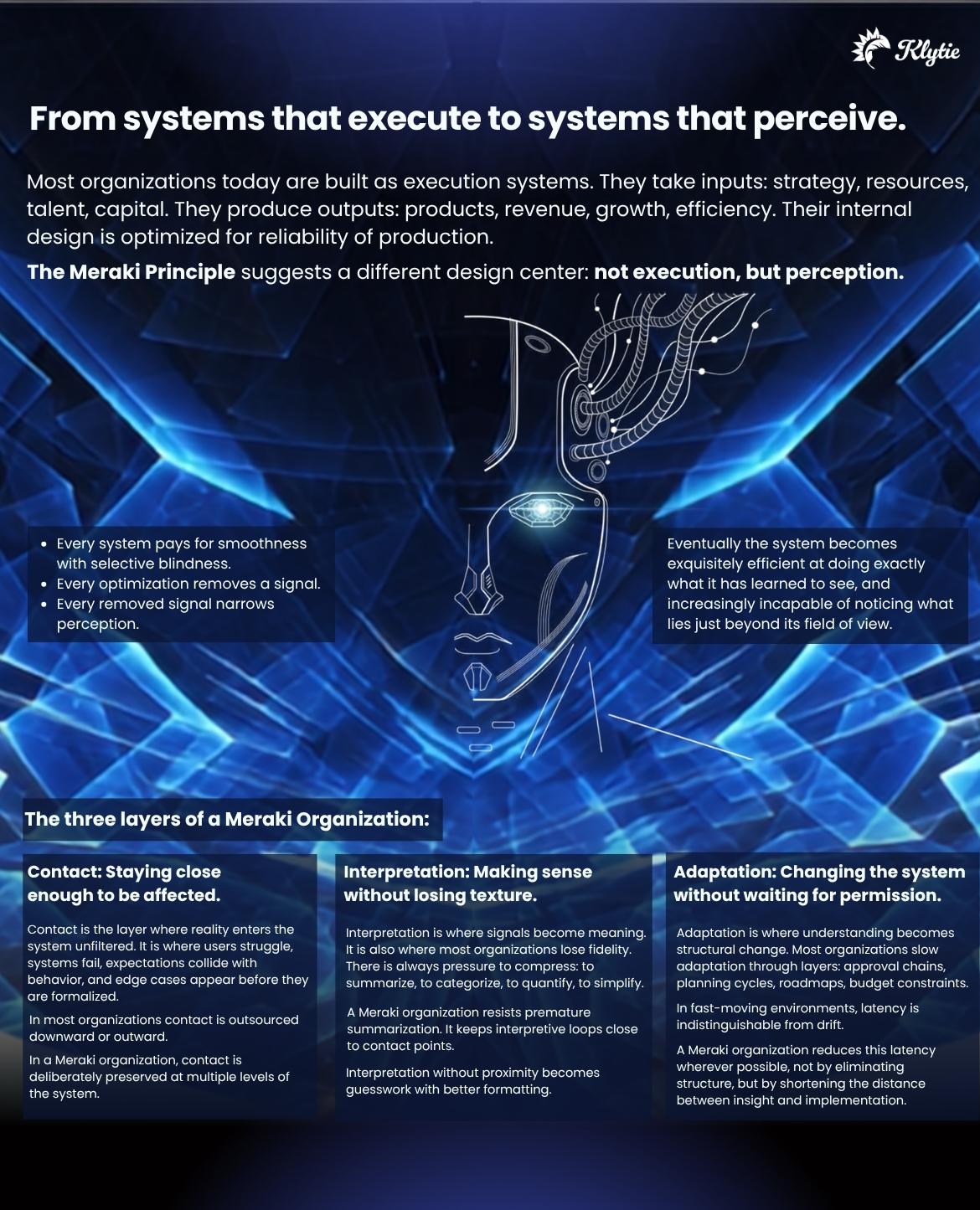
Most organizations optimize for the first while neglecting the second. The Meraki Principle suggests that this imbalance is becoming strategically dangerous. Because in a world where tools are abundant, judgment becomes the limiting factor, and judgment is never purchased, it is accumulated through proximity.
The reversal of scale thinking. For generations, business has worshiped at the altar of scale. We built organizations as one might build cathedrals, not to remain close to those inside them, but to become larger than life itself. Processes were standardized so they could replicate endlessly. Roles were fragmented so they could multiply without friction. Systems were abstracted so they could grow beyond the people who created them.
Growth became the destination; scale, the proof of success. Yet somewhere along that ascent, many organizations lost sight of the ground beneath them.
Scale, pursued without understanding, resembles constructing a taller tower while forgetting to deepen its foundations. Every additional floor magnifies not only strength but also the consequences of hidden cracks. Organizations become impressive in size yet fragile in character, efficient but disconnected, rich in data yet poor in insight, optimized for velocity while increasingly detached from reality.
The Meraki philosophy proposes a simple but profound reversal. Rather than asking the conventional question „How do we scale this?” it asks a more fundamental one: „What must we understand so deeply that scaling becomes safe?” It is a subtle inversion, but one that changes the entire architecture of decision-making. Understanding ceases to be the cost of growth, it becomes its prerequisite.
In the world of startups, this reversal also transforms the role of the founder. In the traditional scale-first paradigm, the founder gradually becomes a systems architect, designing from an ever-greater distance. Success is measured by how little direct involvement remains necessary.
The intimacy-first founder follows a different path. They do not merely design the organization, they continue to inhabit it. They remain in conversation with customers, immersed in products, attentive to anomalies and edge cases where assumptions quietly reveal themselves. Their advantage is not distance from execution, but proximity to truth.
Because reality whispers before it shouts.
Most scaling frameworks celebrate leverage. The Meraki inversion celebrates comprehension. Automation is delayed not because innovation is feared, but because complexity is respected. Understanding is treated not as an obstacle to efficiency but as the condition that makes efficiency trustworthy.
Premature scale is therefore more than an operational mistake, it is an epistemic one. Every process automated before it is understood, every workflow encoded before its boundaries are discovered, every AI agent deployed before its failures are mapped, hardens assumptions into infrastructure. And assumptions, once transformed into software, become remarkably expensive to question.
The tragedy is not that mistakes occur. The tragedy is that they become systematic. This is why the sequence matters.
- Most organizations unknowingly follow a dangerous path: Unknown → Machine → Confusion at scale.
- The Meraki discipline insists on another order: Unknown → Human → Known → Machine.
The distinction appears almost trivial until one observes its consequences. Automation should industrialize certainty, not uncertainty. The unknown is not inefficiency waiting to be eliminated; it is intelligence waiting to be discovered.
You can delegate the hands, but never the head. Execution follows instructions, judgment writes them. There is no shortcut, no app, no playbook that installs sound judgment overnight. It is accumulated the old-fashioned way, by colliding with reality often enough to stop arguing with it, as the old saying goes, „Good judgment depends mostly on experience and experience usually comes from poor judgment.”
This reveals one of scaling’s quiet paradoxes: the more friction we eliminate, the fewer signals we receive.
- When customer support becomes entirely automated, confusion disappears, not because it no longer exists, but because no one is close enough to witness it.
- When onboarding becomes perfectly self-service, hesitation leaves no trace.
- When AI agents execute workflows flawlessly, the human observer gradually vanishes from the very moments where learning once occurred.
The organization becomes faster. It also becomes less perceptive. Like a pilot who replaces the cockpit windows with larger instruments, the business gains cleaner dashboards while slowly losing sight of the horizon. Efficiency can polish the mirror so thoroughly that it reflects only itself.
This is why intimacy matters most in the earliest stages of growth. It preserves contact with reality long enough for meaning to emerge before systems fossilize assumptions into process. And if intimacy is to survive growth, it cannot rely on good intentions alone. It must become structural. The healthiest organizations deliberately shorten the distance between decisions and their consequences.
Leaders remain in direct conversation with customers instead of receiving reality through layers of interpretation. They preserve unfiltered channels where raw feedback arrives before it is translated into metrics. They treat manual work not as inefficiency to be eradicated but as calibration to be harvested. They design AI to amplify human perception rather than replace it.
The goal is never permanent manual effort. The goal is permanent contact with reality. Only then does automation become an extension of understanding instead of a substitute for it.
Scale, after all, is neither virtue nor vice. It is an amplifier. It magnifies whatever lies beneath it, clarity or confusion, wisdom or assumption, intimacy or distance. The real question is therefore not whether an organization can scale. It is whether its understanding can. Because acceleration without orientation is merely a faster way to get lost.
The illusion of knowledge at scale. Scale is a remarkable magician. The larger our systems become, the more convincing the illusion they perform: that seeing everything is the same as understanding everything.
Modern organizations can observe millions of interactions before breakfast. Dashboards glow with reassuring precision. Correlations line up like disciplined soldiers. Every click, purchase, abandonment, and delay is captured, categorized, and transformed into elegant charts. The enterprise begins to feel omniscient.
But there is an old cartographer’s lesson hidden beneath the pixels: the farther you zoom out, the less you notice the people walking the streets. While aggregation is an extraordinary tool for navigation, it is a terrible substitute for intimacy.
One of the most seductive arguments for automation is coverage. If a system can handle 90% of cases, why not extend it to 95%? Then 98%? Then 100%? The logic feels inevitable, but coverage is not the same as comprehension. The final percentage points in any system are rarely homogeneous with the first ninety. They are structurally different. They often contain the exceptions, the ambiguities, and the cases where assumptions break down.
These are precisely the cases that carry the highest informational value. They are also the hardest to automate correctly. And so, as coverage increases, the remaining unautomated cases become more important, not less. Yet organizations often treat them as residual inefficiency. Something to be eliminated. Something to be „completed.” But in many systems, those final edge cases are not residual, they are reality asserting itself.
What often happens is that as data accumulates, contradictions dissolve into averages, relabeled as variance, and confusion becomes statistical noise. The uncomfortable edges of reality are gently sanded down until the landscape appears smooth, predictable, and manageable.
But reality rarely lives in the average. It lives in the customer who abandons a workflow with only one final step remaining. In the support ticket that keeps resurfacing around a feature everyone insists is „self-explanatory.” In the enterprise client who refuses to adopt a flagship capability without being able to articulate precisely why.
Organizations often dismiss these moments with comforting vocabulary: edge case, low frequency, not statistically significant. History has a habit of calling them early warnings. The more knowledge an organization collects, the easier it becomes to mistake information for understanding. Because understanding is not born where everything behaves as expected. It emerges precisely where reality refuses to cooperate.
Intimacy refuses to outsource understanding to averages. It insists on meeting reality one conversation, one customer, one failed onboarding, one confused email at a time. It recognizes that every exception carries information the average cannot express. And so, the exception is not a flaw in the model, it is often the model trying to tell you it is incomplete.
When machines become too confident. Modern AI systems have this particular trait, they are rarely uncertain in a visible way. They produce answers even when the context is incomplete. They fill gaps, infer intent, and, most often, they maintain coherence even under conditions of ambiguity.
This makes them extraordinarily useful. It also makes them subtly misleading. Because human judgment is often calibrated through visible hesitation. We learn to trust uncertainty when it is expressed honestly. A human support agent might say: „I’m not sure yet, let me check.” A model rarely does it. Instead, it produces something that sounds complete, and completeness creates the illusion of correctness.
This is not a flaw in AI systems, it is a property of their design. But in organizational contexts, it creates a new risk: the disappearance of visible ignorance. And once ignorance becomes invisible, it becomes difficult to manage.
Traditional economics, teaches us to eliminate human labor wherever possible. It is expensive, slow, inconsistent, and difficult to scale. Automation, of course, appears as the pinnacle of progress. The conclusion is not wrong, it is simply incomplete. Before labor becomes inefficient, it is about discovery.
Every support request handled personally reveals vocabulary that no analytics platform could invent. Every implementation exposes constraints no specification anticipated. Every difficult conversation uncovers assumptions that no dashboard could ever average into existence. Human labor is not merely operational, but observational. It is the sensory nervous system of an organization learning how the world actually behaves.
When companies rush to automate every interaction, they often automate their own ignorance. They remove the very mechanism through which reality corrected their assumptions. What remains is an elegant machine optimized for a simplified world that exists only within its own models.
This explains why premature automation so often produces brittle systems. They are engineered for abstractions instead of experience. After all, you cannot automate what you do not truly understand, and you cannot truly understand what you have never been willing to do yourself.
What should remain human. There is a point in every technological transition where enthusiasm quietly outruns comprehension. A new capability appears (faster computation, cheaper software, more capable models) and the immediate instinct is to apply it everywhere at once. Not selectively, not cautiously, but comprehensively, as though hesitation itself were inefficiency.
AI is currently at that stage. It invites automation not merely as a tool, but as an ethic. If something can be automated, it feels almost irresponsible not to automate it. Human effort begins to resemble legacy overhead. Manual work begins to look like technical debt.
And yet, beneath this instinct lies a dangerous confusion: Not everything that can be automated should be understood as ready for automation. Some activities are stable. Some are mature. Some are well-defined, repeatable, and structurally predictable. Those are suitable for automation. Others are not.
If we accept this, then the question becomes more precise: Which kinds of work must remain human for epistemic reasons? Not sentimental reasons, not cultural reasons, only structural ones. The answer tends to cluster around a few categories:
- Work where the problem definition is still evolving.
- Work where customer intent is ambiguous or unstable.
- Work where edge cases dominate signal rather than noise.
- Work where failure modes are not yet well understood.
- Work where the organization is still learning what „good” looks like.
In these domains, automation does not simply improve efficiency, it locks interpretation into place, and locked interpretation is dangerous in systems that are still discovering themselves.
The great substitution error. Organizations often confuse two very different states: What is repetitive, and what is understood. These are not the same.
A task may appear repetitive while still being fundamentally misunderstood. Conversely, a task may appear messy while containing hidden regularities that only become visible through sustained engagement.
Automation works best when the structure of the task is stable. But uncertainty is, by definition, unstable structure. When organizations automate uncertainty, they do not eliminate complexity, they conceal it. The system continues to behave, but the organization loses the ability to see why it behaves that way.
Over time, this produces a different condition: Operational success combined with epistemic blindness. Everything appears to work, and no one fully understands why. And because nothing visibly breaks, there is no immediate trigger for correction. This is how fragility accumulates quietly inside systems that appear highly efficient.
There is a counterintuitive discipline embedded in the Meraki principle: Delay automation until understanding stabilizes. This requires a different organizational instinct than most companies currently possess. Instead of asking, „Can this be automated?” The first question becomes: ”What would we lose if we stopped doing this manually today?”
If the answer includes loss of insight, loss of feedback, or loss of proximity to confusion, then automation is not yet an optimization. It is a substitution of learning with execution. And those are not equivalent.
Today, AI is exceptionally strong at responding. It is not yet reliable as a replacement for interpretation in ambiguous environments. Which means that organizations that prematurely automate interpretive layers risk accelerating themselves into confusion at scale. They become very good at doing things, less good at knowing whether those things matter.
The true meaning of Meraki today. Meraki, is not a story about small companies doing heroic manual work. It is a constraint for building intelligence into systems that are otherwise tempted to skip the very phase where intelligence is formed. It is the discipline of staying close long enough to understand what you are actually building before you build it at scale.
Charlie Munger’s quote is equally insightful: “If a thing is not worth doing at all, it’s not worth doing well.” Not every task deserves our finest work, but every meaningful task does. If an activity repeatedly feels like busywork, Munger’s advice suggests asking a different question: Is the problem poor execution, or are we optimizing something that shouldn’t exist in the first place?
The same reversal logic applies to modern work: Do not scale what you do not yet understand, and do not automate what you have not yet felt. Before multiplying a process with people, capital, or software, first learn why it works, where it breaks, and what it actually demands.
Scaling confusion only creates greater confusion, and automating ignorance merely makes mistakes happen faster. Mastery should precede multiplication.
Staying intentionally small isn’t about thinking smaller. It’s about preserving the freedom to choose what deserves your care. Because Meraki isn’t about doing everything well, it’s about putting your soul into the things that are truly worth doing.
***
Perhaps one of the greatest paradoxes of our time is that the closer we get to seeing everything, the easier it becomes to overlook what matters most.
In a world where average can sketch the landscape but rarely reveal the whole story, where dashboards can point us in the right direction but can’t walk the journey for us, we risk mistaking the map for the territory.
The question for modern leaders is not whether we have enough information, it is whether we remain curious enough to understand them. How do we scale without becoming distant, automate without becoming detached, and build organizations where every number still has a human story behind it?
If you value thoughtful dialogue more than simple conclusions and believe that better questions are the beginning of better leadership, this may be the invitation for you. While knowledge may be scalable, understanding develops as conversation, observation, and human connection strengthen. So, keep it handy!
