

“The world of systems is primarily the world of the invisible.” — Donella Meadows
Every generation inherits a few ideas that quietly outlive the era in which they were born. They are not fashionable frameworks or management trends. They have intellectual lenses that become more powerful as the world grows more complex. Donella Meadows’ Leverage Points: Places to Intervene in a System is one of those rare works.
Written in 1999 (long before AI, cloud computing, digital platforms, or large language models), its central argument feels astonishingly contemporary. Meadows proposed something both deceptively simple and profoundly disruptive: in every complex system there are places where a small intervention can produce enormous change. Yet she also observed that paradoxically people consistently focus on the weakest leverage points while ignoring the strongest ones. The result is enormous effort spent producing only incremental improvements.
In business, we witness this pattern repeatedly.
When revenue declines, organizations hire more salespeople. When productivity stalls, they purchase new software. When customer satisfaction falls, they expand customer support. The interventions often produce results, at least for a while. Yet too often, they resemble treating symptoms rather than curing disease.
Managers review budgets. Executives redraw organizational charts. Governments introduce new regulations. Consultants redesign workflows. Everyone works harder, pulls faster, and reaches for the obvious controls. Yet beneath the surface, the system continues to produce precisely the outcomes it was built to produce.
Because the visible problem is seldom the real problem. As Albert Einstein wisely said: „The significant problems we have cannot be solved at the same level of thinking with which we created them.”
A doctor who prescribes painkillers without first asking why the pain exists may offer temporary relief, but the underlying illness quietly progresses. Businesses often make the same mistake. They become experts at silencing alarms instead of investigating what triggered them.
The greatest leverage in any organization rarely lies where the problem is most visible. It lies upstream, in the architecture of the system itself. Change the incentives, the information flows, the decision rules, and the feedback loops, and the symptoms begin to disappear not because they were managed better, but because the conditions that created them no longer exist.
Systems always tell the truth. They are the most honest mirrors we have. They do not respond to our intentions, our rhetoric, or our aspirations. They reveal only what our structures are designed to produce.
Every outcome we experience (whether success or failure, growth or stagnation) is evidence. It is the system speaking. And systems never misrepresent themselves. If the same results keep returning, it is because the architecture beneath them remains unchanged.
This is the profound insight Donella Meadows gave us. The greatest leverage in any system is rarely found in the numbers we optimize or the symptoms we correct. It lives higher upstream—in the goals we pursue, the rules we establish, the information we allow to flow, and the paradigms through which we make sense of the world. Change these, and everything else begins to reorganize around them.
Yes, that goes against human instincts. We are captivated by what is visible. We adjust metrics, redesign processes, replace people, and celebrate quick wins because these are tangible and immediate. But visible interventions often leave invisible assumptions untouched. A system changes only when its underlying logic changes. Until then, every apparent solution is simply another way of reproducing the same reality.
The deepest leverage is not found in pulling harder on existing levers, but in redefining the system that gave those levers their power in the first place. When we stop asking, „How do we improve this outcome?” and begin asking, „What kind of system could only have produced this outcome?” we move from managing consequences to shaping futures.
That’s where meaningful and lasting change begins.
Understanding the Donella Meadows’ twelve leverage points requires a subtle shift in perspective. It invites us to stop seeing organizations as collections of isolated functions and start seeing them as living systems (complex, adaptive, and profoundly shaped by relationships that often remain invisible).
In her seminal work, Donella Meadows ranked the places where one can intervene in a system from the weakest to the most transformative. At the lower end of the spectrum lie the interventions that dominate management conversations: taxes and budgets, prices and quotas, inventory levels, production capacity, physical infrastructure. These are concrete, measurable, and reassuringly tangible. They fit neatly into spreadsheets, dashboards, quarterly reviews, and executive scorecards. Because they are visible, they often create the comforting illusion that they are also the most important.
However, Meadows demonstrated precisely the opposite.
The deepest sources of transformation reside far above these operational mechanics. They emerge from information flows (who knows what, when, and why). They arise from incentives that quietly shape everyday decisions, from organizational rules that define what is possible, from the capacity for self-organization that allows systems to evolve, from the goals that silently guide collective behavior, and ultimately from the paradigms (the mental models and shared assumptions) through which people interpret reality itself.
These leverage points are elusive. They cannot be purchased with larger budgets or engineered through process optimization alone. They are often invisible to those operating within the system because they constitute the very lenses through which the organization sees itself.
And here is one of the curious paradoxes of modern management. For decades, management education has become remarkably sophisticated precisely in teaching leaders how to optimize these low-leverage interventions. Business schools produce experts in finance, accounting, operational excellence, budgeting, performance measurement, and resource allocation. Organizations have become extraordinarily capable of polishing the machinery.
Far less attention is devoted to redesigning the information architecture that determines how knowledge flows through an enterprise. Even less is invested in questioning the assumptions that define success, authority, value creation, or organizational purpose. We have become masters at improving the engine while rarely asking whether the compass points in the right direction.
The irony is profound, the success of almost every operational improvement ultimately depends on decisions made at these higher levels. A perfectly optimized process cannot compensate for flawed incentives. The most efficient organization cannot consistently outperform the paradigm through which it misunderstands its own reality.
As Meadows observed „The system, to a large extent, causes its own behavior! An outside event may unleash that behavior, but the same outside event applied to a different system is likely to produce a different result.”
The implication is both humbling and liberating. Problems rarely reside solely in people or isolated events. More often, they emerge from the architecture of the system itself (the structures, feedback loops, incentives, and assumptions) that quietly generate the outcomes we experience. Change the architecture, and behavior begins to change almost naturally.
This is precisely the current historical moment into which AI arrives.
Much of today’s conversation frames AI as a tool for automation (faster reports, cheaper operations, greater productivity, incremental efficiency, etc). Those capabilities are undeniably valuable, but they may ultimately prove to be the least consequential aspect of the technology. The more profound revolution lies elsewhere.
For the first time, organizations possess tools capable of observing themselves at a scale and depth previously unimaginable. AI can illuminate hidden patterns across millions of interactions, expose invisible feedback loops, reveal bottlenecks concealed beneath organizational charts, identify misaligned incentives, and surface assumptions that have silently governed decisions for years. It does not only accelerate work, it has the potential to make the invisible visible.
In many respects, AI represents an entirely new tool for systems thinking. It enables organizations to move beyond managing isolated events towards understanding the structures that continuously produce those events. Rather than asking, „How do we optimize this process?” leaders can begin asking the far more consequential question: „What characteristics of our system make this outcome inevitable?” That shift changes everything.
So AI’s greatest opportunity may have remarkably little to do with replacing human labor. Its real promise may be in helping human intelligence perceive the complexity that has always existed but remained beyond our cognitive reach. AI becomes less a machine for automation and more a microscope for organizational reality.
And that’s because every system is perfectly designed to produce the results it currently delivers, sustainable transformation doesn’t start by working harder within the existing system, but by understanding (and ultimately redesigning) the system itself.
Today, AI changes the economics of systems thinking. For most of modern management history, systems thinking has been less constrained by imagination than by visibility. Although leaders understood that organizations behaved as interconnected systems, they lacked the means to observe these systems in motion.
While executives received quarterly reports long after critical decisions had been made, managers monitored departmental dashboards that reflected only local performance and analysts worked with carefully selected data sets, each illuminating a single corner of a much larger landscape. Sound familiar? Each function optimized its own reality, while the organization itself remained largely invisible.
Like physicians attempting to understand the human body by studying individual organs in isolation, organizations learned to excel at analyzing the parts while struggling to understand the whole.
The challenge was never conceptual, it was economic. Building a comprehensive picture of a complex organization required enormous investments in data collection, integration, analysis, and interpretation. Even then, by the time understanding emerged, the system had already changed. Complexity evolved faster than our ability to observe it.
AI fundamentally alters this equation. Modern AI systems continuously synthesize signals that were once scattered across dozens of disconnected domains: CRM records, ERP platforms, financial reports, operational metrics, customer conversations, employee collaboration, supply-chain events, market dynamics, product telemetry, knowledge repositories, and countless other streams of organizational activity. What emerges is no longer a collection of reports, it is a living representation of the organization itself.
Instead of periodically taking snapshots of the organisation, today AI enables leaders to observe it as they observe a living ecosystem in real time, constantly adapting, continuously responding, perpetually reshaping itself through thousands of interactive feedback loops.
Consequently, the central management question begins to evolve from „What happened?” to a more consequential question „Why did the system behave this way?” This subtle shift in inquiry represents much more than better analytics. It signals a transition from managing events to understanding structures, from reacting to symptoms to understanding the architecture that continually generates those symptoms.
In many respects, this may represent one of the most significant advances in management since organizations first adopted enterprise software. While enterprise systems digitalize business processes, AI begins to illuminate the systems that those processes collectively create.
Building on this foundation, AI becomes a natural choice for identifying leverage points. Human cognition naturally simplifies complexity. Faced with thousands of interacting variables, we instinctively search for direct causes and straightforward explanations. This tendency has served humanity remarkably well throughout history, but it becomes increasingly limiting inside highly interconnected organizations.
Today, AI helps us approach the challenge differently. Instead of reducing complexity, we can navigate through it.
Consider a familiar situation: customer satisfaction begins to decline. Traditional analysis might conclude that customer support is responding too slowly. Additional agents are hired, response times improve, and performance dashboards celebrate success.
Yet the underlying problem often persists. A systemic analysis may reveal a very different story:
- Marketing campaigns create expectations that the product cannot consistently fulfill.
- The onboarding experience leaves customers uncertain about fundamental capabilities.
- Product updates outpace documentation.
- Customer education fails to keep pace with innovation.
Confusion accumulates long before a support ticket is ever submitted. Customer support, in this case, is simply where the system makes its distress visible while the true leverage point resides elsewhere.
Systems possess a remarkable ability to separate causes from effects, often by great organizational distance and significant periods of time. AI does not eliminate this complexity. It simply makes it observable. The leverage points have always existed. The feedback loops were always operating. The hidden dependencies, unintended consequences, reinforcing dynamics, and structural constraints have quietly shaped organizational behavior for decades. What was missing was visibility.
For generations, executives navigated their organizations much like sailors crossing an ocean beneath overcast skies. They relied on occasional landmarks (quarterly reports, annual surveys, departmental dashboards, financial statements) to estimate where they were and where they might be heading. Between those observations stretched vast intervals during which the organization evolved beyond anyone’s direct perception.
The living system remained largely invisible. Now AI changes this relationship. By continuously interpreting millions of interactions, AI enables organizations to perceive themselves as dynamic ecosystems rather than static organizational charts. It does not magically improve the organization, it illuminates the invisible relationships that have always governed its behavior.
The analogy is strikingly similar to the invention of the microscope. Microorganisms existed long before humanity discovered them. The microscope did not create bacteria. It simply revealed an invisible world that had always determined visible outcomes.
AI may ultimately play a comparable role for organizations. Its first revolution is epistemological before it is technological. It changes the nature of knowing before it changes the nature of doing. In that sense, AI is less a machine that replaces human judgment than an instrument that expands it. It allows leaders to perceive patterns too subtle for intuition, relationships too distributed for conventional analysis, and leverage points too deeply embedded to be discovered through observation alone.
As Donella Meadows wisely observed „We can’t control systems or figure them out. But we can dance with them.” Perhaps that is the deepest promise of AI. Not that it enables us to control organizations with greater precision, but that it helps us understand their rhythms, recognize their hidden structures, and intervene with greater wisdom.
The leverage points have not changed, our capacity to perceive them has.
From solving symptoms to redesigning systems. Most organizations are extraordinarily effective at optimizing first-order effects. A problem appears. A solution is implemented. Performance improves. The cycle repeats. AI makes it increasingly possible to pursue a different strategy altogether: optimizing second-order effects.
Coming back to the example of the organization seeking to reduce customer service costs, the conventional response is straightforward: automate support interactions, improve agent productivity, deploy chatbots, reduce handling time.
These are worthwhile improvements, and yet, AI could reveal a more interesting reality. Forty percent of customer inquiries originate from confusion during onboarding. The greatest leverage therefore does not lie within customer support, it lies in redesigning the onboarding journey. Or perhaps even earlier, in aligning marketing promises with product capabilities. Or earlier still, in simplifying pricing models that create unrealistic expectations before customers ever sign a contract.
Every layer removed from the symptom brings the organization closer to a genuine leverage point. The objective gradually shifts from making problems easier to manage towards making them less likely to emerge in the first place. This is systems thinking in action.
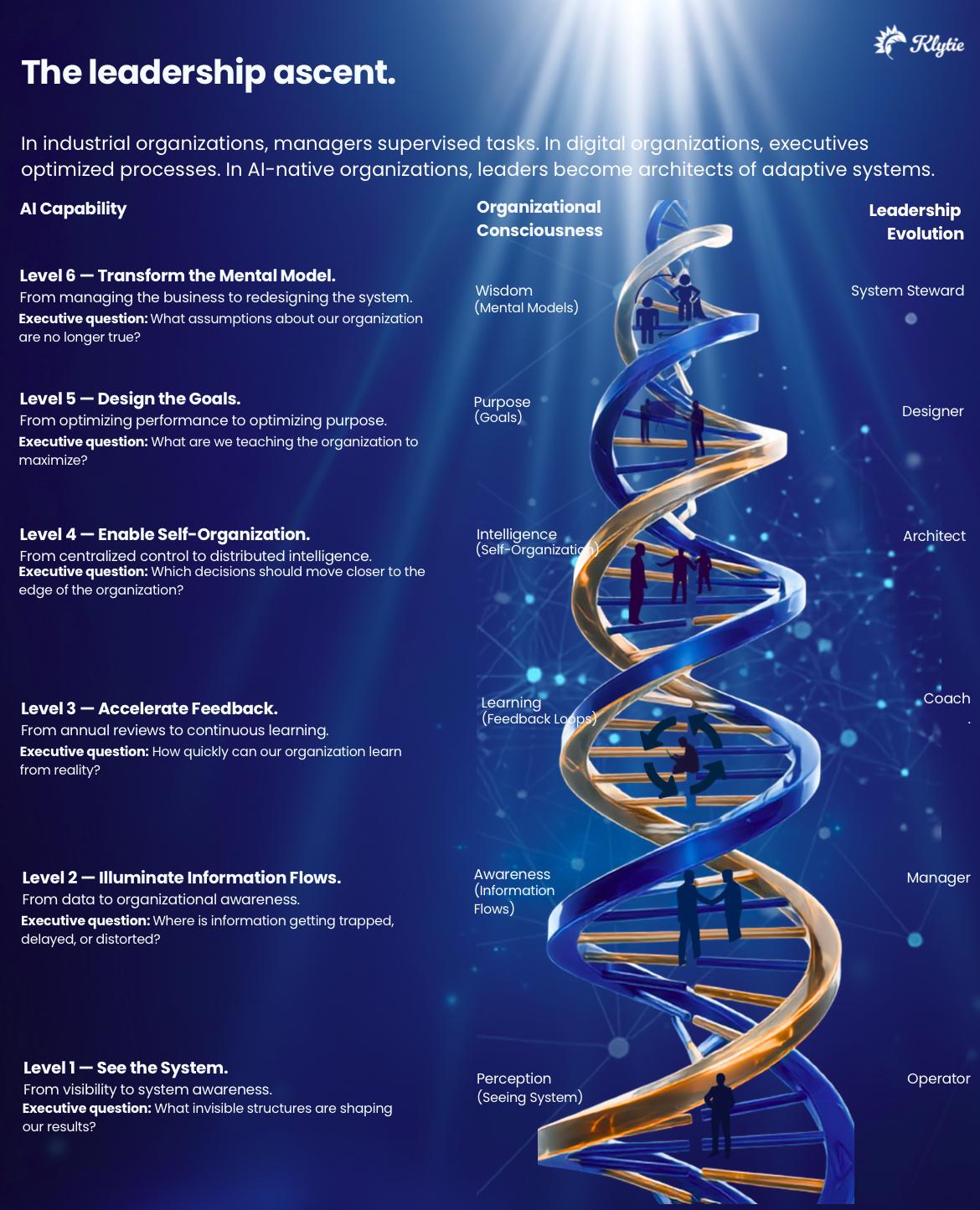
Among Meadows’ twelve leverage points, information flows occupy a remarkably influential position. Changing who knows what, when they know it, and how quickly information moves through a system can fundamentally alter the behavior of the entire system.
As she observed, „Many of the interconnections in systems operate through the flow of information. Information holds systems together and plays a great role in determining how they operate.”
Yet many organizations continue to operate with fragmented visibility. Sales teams rarely understand engineering priorities in real time. Engineers rarely hear customer frustrations directly. Executives often receive carefully filtered summaries rather than unfiltered reality. Customers repeat the same problems to different departments because organizational boundaries interrupt the natural flow of knowledge.
Information exists. It simply fails to flow. AI changes this relationship dramatically:
- LLMs can synthesize thousands of customer conversations into coherent themes.
- Knowledge graphs connect information that previously lived in disconnected repositories.
- Intelligent agents identify emerging patterns before they become visible through conventional reporting.
- Recommendation systems surface relevant insights precisely when decisions are being made instead of weeks or months later.
The result is not merely faster reporting. Information begins to circulate through the organization with greater coherence, context, and purpose. All this until another paradox of our times appears: although information has become abundant, almost infinitely abundant, organizations have never had more information, while understanding less of what really matters.
Information, by itself, possesses little value. Only when human attention transforms information into understanding can it influence decisions, reshape behavior, or alter the trajectory of a system.
Perhaps the greatest value of AI is not that it answers more questions, it is that it helps leaders discover which questions deserve asking in the first place. In an age overwhelmed by information, discernment becomes a greater competitive advantage than access.
Systems learn through feedback. Every organization contains countless feedback loops that quietly shape its evolution. Some reinforce growth, others stabilize performance by identifying deviations and encouraging corrective action before problems escalate.
Healthy organizations learn continuously because their feedback loops remain clear, timely, and trusted. Unhealthy organizations repeat the same mistakes because those loops are delayed, distorted, or ignored. As Meadows warned, „You can drive a system crazy by muddying its information streams.”
Today AI dramatically increases the speed, richness, and precision of organizational feedback.
- Marketing teams observe campaign performance almost as it unfolds.
- Product organizations continuously learn from user behavior rather than relying solely on periodic surveys.
- Manufacturing systems detect anomalies long before defects become failures.
- Financial forecasts adjust dynamically as conditions evolve.
- Customer success teams identify signals of dissatisfaction before cancellation becomes inevitable.
The cadence of learning changes. Instead of quarterly corrections, organizations begin making daily adjustments, sometimes hourly. The enterprise gradually becomes less reactive and more adaptive. This represents far more than operational efficiency. It is a transformation in organizational metabolism. The faster a system learns, the faster it evolves.
Meadows also reminds us that feedback loops possess extraordinary power precisely because they can reinforce either health or dysfunction. Positive feedback amplifies whatever it touches. As she observed, „According to the competitive exclusion principle, if a reinforcing feedback loop rewards the winner of a competition with the means to win further competitions, the result will be the elimination of all but a few competitors.”
When success is rewarded with the resources needed to achieve even greater success, advantages accumulate, competition diminishes, and various systems gradually consolidate around a dominant actor or a small group of winners, often summarized as „the rich get richer and the poor get poorer.”
Meadows’ broader insight is that reinforcing feedback is inherently neutral: it magnifies whatever it acts upon. The same dynamics that accelerate learning, innovation, and organizational resilience can also amplify bias, poor incentives, and dysfunctional behaviors.
This lesson extends well beyond markets. AI, as a powerful amplifier, can strengthen beneficial feedback loops, but it can equally reinforce harmful ones if leaders fail to understand the systems they are shaping. Acceleration, by itself, is never wisdom.
Higher still in Meadows’ hierarchy lies one of the most powerful leverage points of all, the capacity of a system to organize itself.
Traditional organizations were designed around centralized intelligence: while information flowed upward, decisions flowed downward, and coordination depended upon layers of supervision because no individual possessed sufficient visibility to make independent decisions with confidence.
Today AI begins to redistribute that intelligence throughout the organization.
- Employees gain immediate access to institutional knowledge.
- Teams receive localized recommendations tailored to their specific context.
- Intelligent agents coordinate routine work across functions.
- Knowledge becomes accessible without navigating organizational hierarchies.
- Decisions increasingly migrate towards the people closest to the work rather than those furthest removed from it.
The result is not the disappearance of leadership, it is the evolution of leadership. Leaders spend less time transmitting information and more time shaping purpose, principles, incentives, and the conditions under which intelligent systems (both human and artificial) can organize themselves effectively.
In this sense, AI does not replace hierarchy, it changes what hierarchy is for. Control gradually gives way to coordination. Supervision yields to enablement. Organizations become more resilient because intelligence is distributed rather than concentrated.
As Meadows beautifully reminded us, „A system is more than the sum of its parts. It may exhibit adaptive, dynamic, goal-seeking, self-preserving, and sometimes evolutionary behavior.” AI does not create these characteristics. Complex organizations have always possessed them. What AI changes is our ability to nurture them intentionally.
As we ascend Meadows’ hierarchy, the leverage points become increasingly intangible, and increasingly powerful. Structures influence behavior. Feedback shapes adaptation. Self-organization enables resilience. Yet above them all stands a force that quietly orchestrates everything beneath it, the goal of the system.
Meadows argued that changing a system’s goal transforms the behavior of every component within it. Alter the destination, and incentives, decisions, feedback loops, and organizational structures begin to realign almost automatically.
A company whose overriding objective is to maximize quarterly profit behaves very differently from one committed to maximizing lifetime customer value. Change the goal again—to maximize customer trust, innovation, societal impact, or ecosystem resilience, and the organization reorganizes itself once more (the strategy changes, the metrics change, the conversations change, even the definition of success changes).
As Meadows observed, „The most effective way of dealing with political resistance is to find a way of aligning the various goals of the subsystems, usually by providing an overarching goal that allows all actors to break out of their bounded rationality.”
Organizations often struggle not because people disagree, but because different parts of the system are optimizing different objectives. Sales pursues growth. Operations pursues efficiency. Finance pursues cost reduction. Customer success pursues satisfaction. Each department succeeds according to its own metrics while the organization as a whole struggles to achieve coherence.
AI cannot resolve this tension by deciding which goal is morally or strategically correct. That responsibility remains profoundly (and irreducibly), human. What AI can do is illuminate the consequences of our choices with unprecedented clarity.
Simulation models can estimate how changing incentives influence customer loyalty, employee engagement, innovation, operational resilience, and long-term financial performance. Leaders can explore alternative futures before committing scarce resources. Strategic conversations become less dependent upon intuition alone and increasingly informed by evidence, experimentation, and systemic understanding.
A useful shift in perspective is to view performance metrics not simply as measurement tools but as behavioral signals that influence how people make decisions.
Every metric is an invitation to behave in a particular way. Each dashboard quietly communicates what the organization values. Every target, incentive, and performance indicator becomes a signal that influences thousands of individual decisions, most of them made without conscious reflection.
Tell me what an organization measures, and I can often predict how it will behave.
- Reward sales volume, and discounts become more generous than relationships.
- Reward customer satisfaction, and support teams may resolve immediate concerns while overlooking the structural problems that created them.
- Reward speed, and quality gradually becomes negotiable.
- Reward efficiency, and experimentation begins to look like waste.
Every system organizes itself around the outcomes it has been designed (or incentivized) to achieve. The metric does not merely describe the organization, it becomes one of the forces that creates it: goals shape incentives, incentives shape decisions, decisions shape behavior. Over time, behavior becomes culture….And so, long before values appear in mission statements, they become visible in performance reviews.
Here, what AI does is amplify this dynamic. Organizations increasingly ask AI to optimize customer support costs, delivery speed, employee productivity, inventory turnover, sales conversion, or operational efficiency. In many cases, AI accomplishes these objectives with extraordinary precision.
Yet optimization is never neutral. Every objective pursued intensely alters the surrounding system. Reducing support costs may inadvertently erode customer trust. Maximizing productivity may leave little room for creativity or reflection. Accelerating delivery may increase defects that remain invisible until much later. Improving short-term profitability may weaken resilience, learning, or innovation over the long term.
The more capable AI becomes, the more visible this truth becomes as well: AI does not decide what should matter, it faithfully pursues what it is asked to optimize. In doing so, it exposes a fundamental reality that organizations have often preferred to overlook, there is no such thing as a neutral KPI.
Every metric creates an invisible organization. Every optimization embeds a philosophy of success. Each target privileges certain behaviors while quietly discouraging others. The implication for the age of AI is profound. Technology does not possess values, it only amplifies the values already embedded within the system.
- An AI instructed to maximize efficiency will become exceptionally efficient, even if trust declines, creativity diminishes, resilience weakens, or long-term learning is sacrificed along the way.
- An AI rewarded solely for growth will relentlessly pursue growth, regardless of whether that growth strengthens or ultimately undermines the organization.
In this sense, AI acts as an uncompromising mirror. It reflects organizational intent with extraordinary fidelity. If the objectives are wise, AI can accelerate meaningful progress. If the objectives are narrow, contradictory, or poorly conceived, AI will amplify those limitations just as effectively.
This is why the conversation surrounding AI is, at its heart, not primarily about technology. It is about purpose. Before organizations ask what AI should optimize, they must first answer a far more enduring question: What, ultimately, is the system for?
That is not a question algorithms can answer, it is a question of leadership, judgment, and values. And, as we already know, changing the goal of a system changes almost everything that follows.
Paradigms, the final leverage point. Above goals lie the highest leverage point of all, paradigms. These are the invisible assumptions through which organizations interpret reality itself. They define what leaders consider possible, desirable, rational, or even imaginable.
Every organizational structure, every incentive system, every performance metric, and every strategic decision ultimately rests upon a foundation of shared beliefs. Most organizations rarely notice their paradigms precisely because they experience them not as assumptions, but as reality.
Some believe growth solves every problem. Others elevate efficiency above all else. Some worship innovation. Others seek stability and control. None of these worldviews are embedded within AI. They are embedded within us. AI simply reflects them with extraordinary fidelity.
Ask an AI system to maximize shareholder returns, and it will recommend one set of actions. Ask it to maximize customer trust, and the recommendations begin to change. Ask it to maximize organizational learning or long-term resilience, and an entirely different organization starts to emerge. The technology has not changed, the worldview guiding it has.
This may explain why organizations adopting remarkably similar AI technologies often achieve profoundly different outcomes. The differentiator is rarely the algorithm, it is the philosophy directing the algorithm.
Much of today’s discussion suggests that AI transformation is primarily a technological challenge. Organizations invest in chatbots. They automate workflows, deploy copilots, modernize software platforms. These initiatives may improve efficiency. They do not necessarily transform the organization.
Replacing old tools while preserving old assumptions is not transformation, it is (at best) digitalization. The deeper question is far more unsettling: What if the organization itself was designed for a world in which intelligence was scarce?
For more than a century, management systems evolved around precisely that assumption. Expertise was concentrated, information moved slowly, decisions naturally accumulated at the top because few people possessed sufficient knowledge to make them confidently elsewhere.
Today AI fundamentally changes that landscape. Knowledge becomes continuously accessible, expertise becomes increasingly distributed, analysis becomes instantaneous. Every employee gains access to capabilities that were once available only through specialists.
When intelligence becomes abundant rather than scarce, the architecture of organizations inevitably begins to change (decision-making, leadership, learning, training, coordination…even the purpose of hierarchy itself). The most significant AI transformation may therefore have little to do with software, it may require reimagining the assumptions upon which modern organizations have been built.
If leadership values only efficiency, AI will faithfully optimize efficiency. If leadership values creativity, AI can amplify creativity. If leadership values trust, learning, resilience, or stewardship, AI can strengthen those qualities as well. Technology possesses no philosophy of its own, it amplifies the philosophy already embedded within the system.
This is precisely why Meadows placed paradigms above goals, rules, structures, and feedback loops. Every system ultimately becomes an expression of the beliefs from which it is designed. AI does not replace those beliefs, it reveals them.
“Whether you think you can, or you think you can’t—you’re right.”
Perhaps that is its greatest gift. Not that it thinks for us, but that it makes it increasingly difficult for us to avoid thinking about ourselves. The ultimate promise of AI is therefore not AI, it is augmented human wisdom.
For in the end, the organizations that flourish will not be those that merely automate more work, they will be those that learn to see more clearly, question more deeply, and redesign themselves with greater intention.
The highest leverage point has never been the technology. It has always been the way we choose to understand the systems we create.
***
One thing is certain, what got us here will not get us any further. Every system eventually reaches the limits of the logic that created it. Patterns that once brought growth can quietly become patterns that hold you back. Not because they are wrong, but because the world around them has changed.
Transformation doesn’t start with better answers. It starts with seeing and thinking differently. Today, AI offers more than speed or efficiency. It gives us new ways to observe ourselves.
But no system evolves in isolation. So bring your questions, your experiments, your unfinished thinking. There’s never been a better time… Together, let’s explore how your business can become more adaptive, more resilient, and more capable of responding to complexity, not just by simply deploying more intelligent tools, but by cultivating smarter systems.
A single spark can light a path. A shared fire can transform the journey. In any case, until next time, keep it handy!
