

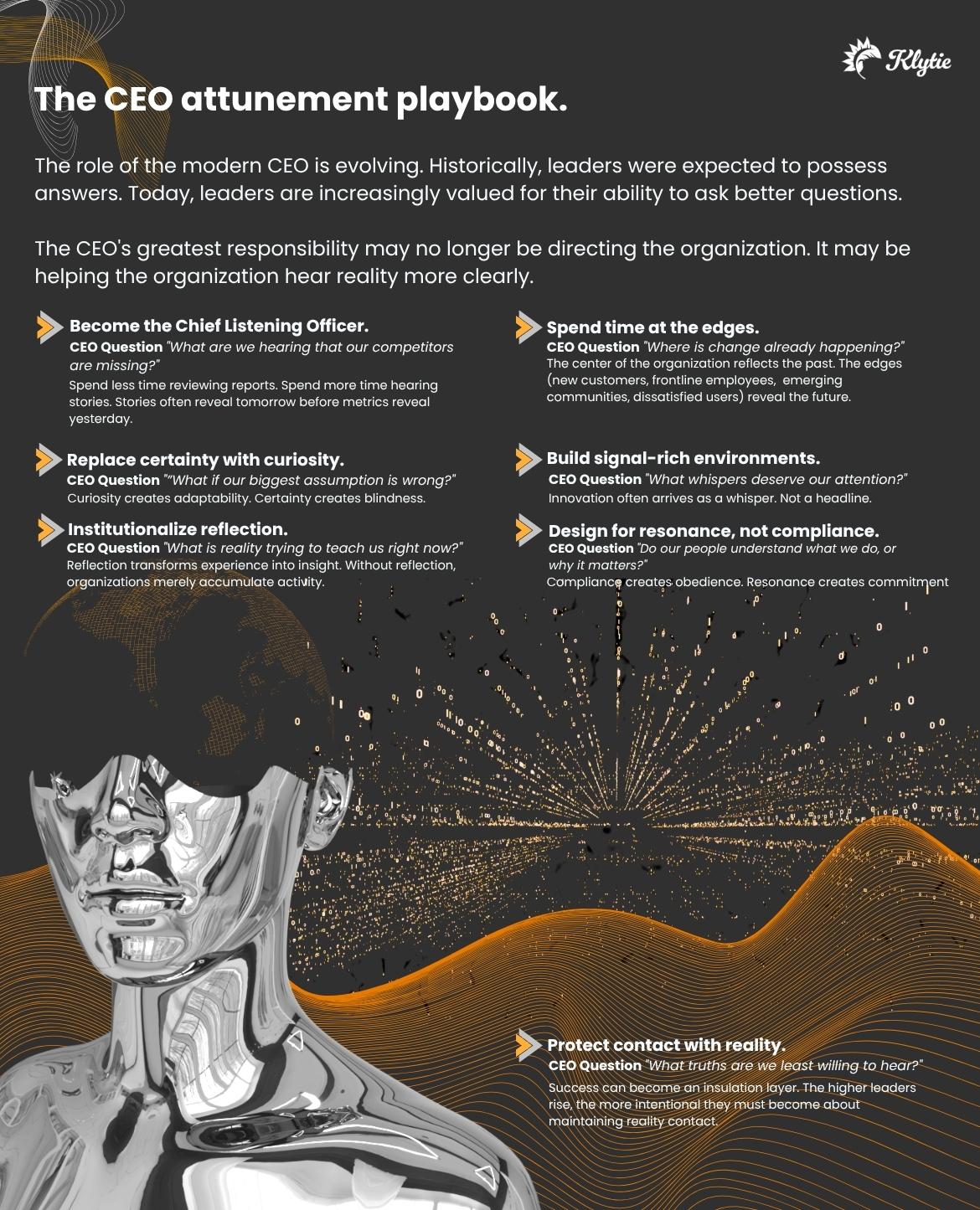
The defining challenge facing modern organizations is not that they are lost in the dark, but that they are blinded by the floodlights. We have moved from an era of information scarcity to one of cognitive saturation. Data pours in like rain, dashboards glow brighter by the day, yet clarity remains elusive.
The greatest danger today is no longer a lack of information, but the illusion that more light inevitably brings more clarity. In the glare of constant visibility, organizations risk mistaking motion for direction, activity for progress, and abundance of information for genuine understanding.
Despite unprecedented access to data, many businesses find themselves struggling to answer fundamental questions: What is really happening? What does it mean? How should we respond?
These questions cannot be answered through analytics alone. They require three interconnected capabilities:
- Empathy – the ability to understand human experience.
- Sensemaking – the ability to interpret signals and create meaning from complexity.
- Organizational awareness – the ability to perceive the dynamics, relationships, and realities within and around the organization.
Together, these capabilities form what is called attunement, the organizational capacity to remain connected to reality (human, operational, cultural, and strategic) as it evolves.
In a world overflowing with information, attunement becomes discernment. In a world overflowing with noise, attunement becomes signal. In a world obsessed with speaking, attunement becomes listening.
The challenge of our days is no longer finding needles in haystacks, it’s deciding whether it belongs in a compass, a scalpel, or a sewing kit. Many organizations possess talent, capital, technology, and strategy. Yet despite these assets, they struggle to create resonance with customers, employees, and markets. Why? Because success is not only the result of action, but the result of aligned action.
As management thinker Peter Drucker famously observed, „The greatest danger in times of turbulence is not the turbulence—it is to act with yesterday’s logic.” As technology democratizes information and AI commoditizes analysis, a new source of competitive advantage is emerging, not from knowing more, but from perceiving more accurately. Attunement is how organizations detect tomorrow’s logic while everyone else is still operating from yesterday’s assumptions.
Let’s take a closer look:
Beyond emotional intelligence, the empathy advantage. Empathy, often misunderstood as a soft interpersonal skill is in reality, a strategic capability. It responds to the strategic question: „What are people experiencing that our metrics cannot yet see?” It creates proximity to human reality, and proximity creates insight.
Before customers abandon products, they experience frustration. Before employees resign, they experience disengagement. Before markets shift, people change their expectations. Empathy allows organizations to perceive these realities before they appear in reports. It transforms business from a system of transactions into a system of understanding.
Sensemaking as strategic interpretation. Today, leaders are surrounded by market signals, customer feedback, economic uncertainty, technological disruption, competitive intelligence and many more. The difficulty lies not in gathering information. The difficulty lies in understanding what matters. This is the role of sensemaking.
Sensemaking is the process through which organizations transform signals into meaning.
- Data answers questions. Sensemaking determines which questions matter.
- Analytics explain patterns. Sensemaking explains significance.
In an uncertain world, sensemaking becomes a strategic compass. Without it, organizations become reactive, and with it, organizations become anticipatory. They begin to recognize patterns before competitors recognize trends and act long before certainty emerges.
Organizational awareness, the invisible dimension of performance. Many leaders still approach organizations as if they were engines to fine-tune, when in reality they are gardens to cultivate. While engines obey control, gardens thrive through understanding. The challenge is that too many are still applying yesterday’s mechanical logic to today’s living systems.
Organizational awareness is the ability to perceive the whole: cultural dynamics, informal networks, organizational energy, hidden tensions, cross-functional dependencies, and emerging risks, to better understand how the organization actually works, not merely how it appears on an organizational chart.
Many organizational failures originate not from poor strategy but from poor awareness. Leaders miss internal friction, communication breakdowns, cultural resistance, employee concerns, innovation bottlenecks. The organization gradually loses contact with itself, and eventually loses contact with the market.
Organizations with high awareness adapt faster, learn faster, collaborate more effectively, detect risks earlier, execute strategy more successfully. Awareness transforms complexity into coherence.
And so, the unexpected relationship between attunement and business is that we often think business success comes from influencing the market. In practice, the greatest successes often come from being influenced by the market more accurately than anyone else.
One way to think about this is:
- Empathy answers: „What are people experiencing?”
- Sensemaking answers: „What does it mean?”
- Organizational awareness answers: „How does it affect the system?”
- Attunement answers: „What should we do now?”
Attunement is an integrative capacity that allows organizations to stay in sync with reality and perceive it with higher resolution.
Not every benefit is self-evident. Here are some of the subtle ones, along with some inspiring analogies to reinforce the ideas:
Attunement, the faster form of intelligence. To borrow a metaphor from baseball: while everyone else was fixated on the scoreboard, Billy Beane looked deeper (into the quiet patterns unfolding beneath it) revealing value that traditional baseball had long overlooked, hidden in plain sight.
Billy Beane and the Oakland Athletics didn’t simply analyze more data, they fundamentally redefined how player value is calculated through the Moneyball philosophy. While competitors overpaid for traditional scouting metrics like home runs and batting averages, Beane recognized that on-base percentage (OBP) was the single most underpriced asset in the market (directly predicting run production and winning better than conventional wisdom ever suggested).
If traditional intelligence tells us what happened, attunement tells us what is emerging. Everyone had the same game. Few were looking for the right clues to exploit market inefficiencies.
Decision compression, the invisible multiplier. People often say Lionel Messi slows the game down. In reality, he compresses it, fundamentally redefining how space and time are manipulated on the pitch.
Because he reads the field before everyone else, he rarely needs extra touches. While others stop, look, and decide, he is already moving into space before it even exists. What appears to be raw physical speed is actually something far more valuable, the elimination of hesitation. In knockout football, that fraction of a second is often the difference between creating a chance and chasing the game.
Organizations work exactly the same way. They become less bureaucratic not because they remove processes, but because they reduce misunderstanding. When leaders are deeply attuned to customers, teams, and changing markets, the organization doesn’t need to rush, it simply hesitates less. Velocity is what clarity looks like in motion.
Attunement, the new scalability challenge. It’s similar to the story of the tailor and the factory. A tailor measures every person. A factory makes every shirt the same size.
For two centuries, business became extraordinarily good at becoming factories. Today’s customers increasingly expect to be treated as if every product had been tailored for them.
AI isn’t replacing the tailor. It’s trying to give the factory the memory and perception of one. And so, the challenge is no longer making a million shirts, it’s making a million people feel measured.
Profit as delayed attunement. Image shouting into a valley. The echo doesn’t tell you what you wanted to hear. It tells you what you actually said.
Markets behave the same way. Profit is an echo. It is yesterday’s understanding returning to you. It reflects how accurately an organization understood reality months or years earlier.
Attunement as strategic risk management. Think of air traffic controllers. They rarely prevent crashes through heroic actions, but rather by spotting small deviations while they are still only a few degrees off course.
A plane that’s one degree off its heading isn’t in danger at the moment. Leave it uncorrected, and it ends up hundreds of miles from where it was meant to be.
Organizations drift the same way. Every crisis whispers before it screams. They begin as tiny deviations, an overlooked complaint, a disengaged employee, a leadership assumption that no longer matches reality.Attunement is the radar that notices the drift before it becomes a disaster.
Attunement creates trust faster than expertise. Often, the best salesperson doesn’t have the perfect pitch. They ask the question that makes the customer stop and say, „Yes… that’s exactly my situation.” From that moment, the conversation changes. The customer is no longer evaluating a seller, they’re talking to someone who understands them.
While expertise explains, attunement recognizes. People trust those who understand them before they trust those who impress them.
Attunement, an antidote to AI saturation. An analogy that captures this is the one from the Gold Rush. Back then, the scarce thing wasn’t dirt, it was knowing where to dig.
Today AI is creating a gold rush of answers. Information becomes the dirt (everywhere, abundant, easy to move). Attunement is knowing where the gold actually is. As answers become cheaper, questions become more valuable.
Reality contact, the ultimate competitive advantage. That’s a bit like a scientist who never falls in love with a theory. Every experiment is an opportunity to prove it wrong. The moment evidence changes, the theory must change too.
Organizations often do the opposite. They defend yesterday’s assumptions against today’s reality. Attunement is the scientific mindset applied to business. It replaces certainty with observation and opinion with evidence. The companies that survive aren’t the ones with the strongest beliefs. They’re the ones willing to abandon them first.
Most organizations do not become highly attuned overnight. Attunement is not a binary state. It is a developmental journey. Like musicians learning to hear increasingly subtle harmonies, organizations evolve through distinct levels of awareness.
The Attunement Maturity Model is here to provide a framework to assess your organization currently stands and what capabilities are required to reach the next stage.
a.The Reactive Organization (responding only when reality knocks). The Reactive Organization moves through the world much like a ship navigating by looking only at the wake behind it. It responds when reality leaves no other choice.
Empathy is limited, awareness is narrow, and sensemaking remains underdeveloped. The organization does not anticipate change or detect disruption early, it only encounters it, and, even worse, reacts once the disruption has already arrived.
Operating largely through hindsight, leadership relies on historical reports, lagging indicators, and familiar assumptions to make decisions. The prevailing mindset is simple: „Show me the numbers first.” By the time the numbers appear, however, the story has often already unfolded. Customer complaints become the first signal that something is wrong. Rising employee turnover reveals cultural fractures that have been growing unnoticed for months or years. Market shifts arrive not as predictable trends but as unwelcome surprises.
In this environment, decision-making tends to be slow, filtered through layers of hierarchy, and constrained by the need for certainty. Feedback from customers is treated as a troubleshooting mechanism rather than a source of insight and innovation rarely emerges from curiosity or deep understanding of evolving needs, instead, it is triggered by competitors who have already moved first.
The greatest illusion at this stage is the belief that calm waters indicate mastery. What appears to be stability is often nothing more than insulation from reality. The organization mistakes the absence of alarms for the absence of risk. Yet the true danger is not what it knows, nor even what it does not know. The true danger lies in the signals it can no longer hear, the whispers of change that, ignored long enough, eventually return as crises impossible to overlook.
b. The Listening Organization (learning to hear the signals). The Listening Organization has taken an important step forward. No longer waiting for reality to force its hand, it begins to actively seek out the signals that surround it.
Empathy is growing, curiosity is emerging, and leadership starts to recognize that valuable insights often exist beyond spreadsheets and quarterly reports. The organization develops ears.
Customer research becomes more sophisticated, employee engagement surveys become more frequent, and market monitoring grows more intentional. Leaders begin asking a different question: „Let’s hear what people are saying.” The belief that feedback matters is no longer debated, it is increasingly embraced.
Yet listening and understanding are not the same thing.
At this stage, the organization gathers information from many directions but often struggles to transform observations into meaningful action. Feedback loops begin to emerge, cross-functional conversations become more common, and customer insights gain a seat at the table. Awareness of employee experience expands beyond anecdotal conversations and starts to enter strategic discussions. The organization hears more voices than ever before.
However, listening remains episodic rather than continuous. Signals are collected, catalogued, and discussed, but they are not always connected. Insights arrive as individual puzzle pieces without a clear picture emerging. Data accumulates faster than understanding. Reports multiply, dashboards expand, and surveys generate ever-growing streams of information, yet meaning remains elusive.
The challenge of the Listening Organization is not a lack of information, it is the ability to make sense of it. Like a radio receiving dozens of frequencies at once, the organization hears a constant flow of messages but struggles to distinguish noise from signal. The risk is not silence, it is overload. The danger lies in mistaking collection for comprehension and believing that awareness alone creates wisdom.
Listening is a critical milestone, and yet organizations at this level discover an important truth: hearing the signals is only the beginning, the real advantage belongs to those who can interpret what the signals are trying to say.
c. The Adaptive Organization (turning insight into motion). The Adaptive Organization has moved beyond merely hearing the signals, it has learned how to respond to them.
Empathy deepens, awareness sharpens, and learning becomes a continuous organizational capability rather than an occasional exercise. The organization no longer waits for change to happen around it, it evolves alongside it.
At this stage, feedback is no longer treated as a separate process or periodic event. It becomes woven into the fabric of everyday operations. Listening is embedded within strategy, product development, leadership practices, and organizational culture. Insights no longer sit in reports waiting to be reviewed; they flow directly into decisions, actions, and improvements. The organization develops not only ears, but muscles.
The leadership mindset shifts from gathering opinions to extracting meaning. The defining question becomes: „What is reality teaching us?” Leaders understand that markets, customers, employees, and partners are constantly providing lessons. Their role is not to defend assumptions but to learn faster than circumstances change.
As adaptation accelerates, the organization becomes increasingly agile and responsive. Experimentation replaces excessive deliberation, customer dialogue becomes continuous rather than transactional, and decision-making moves closer to where knowledge exists, reducing dependence on hierarchy and enabling faster responses. Transparency builds trust, while regular strategic recalibration ensures that direction remains aligned with an ever-evolving environment.
The Adaptive Organization resembles a skilled sailor who no longer fights the wind but learns to harness it. Every shift in conditions becomes information. Every challenge becomes feedback. Every success becomes a source of learning.
Yet adaptation carries its own risks. Organizations can become so focused on responding that they lose sight of where they are going. Without a clear sense of purpose, adaptation can slowly turn into drift. Constant adjustment may create movement without progress, flexibility without coherence, and responsiveness without identity. Listening, however sophisticated, cannot substitute for direction.
The challenge at this stage is not learning how to change, it is knowing what should remain constant while everything else evolves. The most successful Adaptive Organizations understand that true agility is not the ability to change course endlessly, it is the ability to change intelligently while remaining anchored to a clear purpose.
d. The Anticipatory Organization (seeing the future while it is still whispering). The Anticipatory Organization operates at the edge of emergence. It understands that the future rarely arrives as a sudden event, it begins as a faint signal, a subtle shift, a pattern barely visible beneath the noise of the present. While others react to trends and adapt to change, this organization develops the capacity to recognize what is taking shape before it becomes obvious.
At this stage, sensemaking becomes a core organizational strength. The company is no longer focused solely on understanding what is happening today but on interpreting what is beginning to happen tomorrow. It learns to identify weak signals, connect seemingly unrelated developments, and recognize patterns long before they become mainstream realities. Opportunities are not discovered after mature markets, they are sensed while markets are still forming.
The leadership mindset evolves once again. The defining question is no longer „What is reality teaching us?” but rather, „What is beginning that others cannot yet see?” Leaders understand that the goal is not to predict the future with certainty. The future is far too complex for that. Instead, they cultivate the ability to sense emerging possibilities, explore multiple scenarios, and remain attentive to early indicators of change.
This ability manifests through deliberate practices.
- Scenario planning becomes a strategic discipline rather than an occasional exercise.
- Strategic foresight expands the organization’s field of vision beyond immediate challenges.
- Deep customer immersion uncovers needs before customers themselves can fully articulate them.
- Ecosystem intelligence extends awareness beyond organizational boundaries, revealing shifts across industries, technologies, and societies.
- Innovation is no longer a project, it becomes a continuous pipeline fed by curiosity, experimentation, and disciplined observation.
The Anticipatory Organization resembles a seasoned navigator reading the horizon. While others focus on the waves directly ahead, it notices subtle changes in the wind, the currents, and the sky. It understands that major transformations rarely appear without warning. The clues are almost always present for those who know where and how to look.
Yet this level carries a unique danger. Success in anticipating change can breed overconfidence. Organizations may begin to mistake observation for prophecy and insight for infallibility. What started as disciplined sensing can evolve into the belief that they possess a special ability to foresee the future. The risk is not blindness but certainty.
The greatest Anticipatory Organizations remain humble in the face of uncertainty. They understand that their advantage comes not from being uniquely visionary, but from being exceptionally observant. They know that the future belongs neither to those who predict it nor to those who chase it, but to those who notice its first whispers and have the courage to act before the rest of the world hears them.
e. The Resonant Enterprise (becoming one with the rhythm of reality). The Resonant Enterprise represents the highest expression of organizational maturity. It is no longer defined by its ability to react, listen, adapt, or even anticipate. It transcends these capabilities by developing a profound and continuous relationship with reality itself.
Empathy, sensemaking, and awareness are no longer skills practiced by a few leaders or departments; they become deeply embedded cultural capabilities that shape how the entire organization thinks, learns, and acts.
At this stage, alignment with reality becomes continuous rather than occasional. The organization does not struggle to keep pace with change because it exists in constant dialogue with the forces that created it. Innovation, adaptability, and resilience are no longer strategic initiatives to be managed, they emerge naturally as the consequence of being deeply attuned to the world around it.
Attunement becomes part of the organization’s identity. The company no longer views change as something external to which it must respond. Instead, it becomes an active participant in shaping what comes next.
Customers feel genuinely understood because the organization recognizes not only what they say, but what they value, aspire to, and need. Employees feel heard because listening is woven into the culture rather than delegated to processes. Partners feel aligned because relationships are built on shared understanding rather than transactional exchanges.
The leadership mindset reaches its most evolved form: „How can we remain in continuous dialogue with reality?” Leaders understand that no strategy, no matter how brilliant, can replace ongoing learning. Their role is not to control the future but to remain connected to the conditions from which the future emerges. They cultivate environments where awareness flows freely, assumptions are regularly challenged, and learning never stops.
This is reflected in extraordinary levels of trust, remarkable adaptability, and a culture capable of innovating with consistency rather than occasional bursts of inspiration. Alignment exists not because everyone thinks alike, but because everyone remains connected to a shared understanding of what is true, what is changing, and what matters most. The organization develops a resilience that extends far beyond surviving disruption, it gains the capacity to thrive through uncertainty.
The Resonant Enterprise functions less like a machine and more like a living ecosystem. Mechanical organizations rely on control, predictability, and rigid structures. Living systems rely on awareness, connection, learning, and adaptation. One attempt to manage complexity. The others learn to dance with it.
From the outside, competitors often mistake this ability for intuition. They see an organization that consistently identifies opportunities early, adapts gracefully, innovates meaningfully, and remains resilient in turbulent environments. It can appear almost visionary. Yet its advantage is not intuition in the mystical sense, it is something far more powerful and far more practical.
The Resonant Enterprise has cultivated a superior relationship with reality itself. While others focus on managing information, predicting outcomes, or defending assumptions, it remains deeply connected to the signals, patterns, needs, and possibilities that shape the world as it unfolds. In the end, its greatest competitive advantage is not what it knows, it is how profoundly it listens, learns, and resonates with the reality from which the future is born.
The quiet superpower. In the end, advantage rarely announces itself with noise. It arrives quietly, as a kind of disciplined attention, an ability to stay in tune with what is actually happening rather than what is assumed to be happening.
To be attuned is not merely to observe reality, but to be corrected by it. It is a quiet surrender of illusion in favor of contact, a willingness to let the world revise one’s assumptions without resistance or delay.
In this sense, clarity becomes a discipline of presence, rather than just a tool of strategy. And perhaps this is the deeper reversal: the most successful organizations of the coming era will not be those that impose meaning on the world, but those that are still enough to receive it. They will act not out of excess interpretation, but out of the rare condition of seeing without interference.
In a landscape saturated with signals, clarity becomes an ethical stance towards reality itself. A refusal of distortion, a choice to meet the world as it is rather than as it appears through noise.
Attunement moves beyond advantage into alignment.
A quiet coherence with what is real, where perception sharpens and action follows the deeper structure of things rather than their surface volume, and direction emerges naturally from that clarity.
***
For me, this isn’t just an idea, it’s a practice I’ve grown into. Through both personal experience and professional work, I’ve discovered that the greatest shifts don’t come from constantly seeking more information, but from cultivating greater clarity and attunement. That subtle change transforms the quality of every decision, conversation, and opportunity.
This journey continues to shape the way I think, lead, and collaborate. I’m still learning what becomes possible when perception grows quieter, clearer, and more attentive to what others might overlook. Again and again, I’ve seen that meaningful progress begins not with having all the answers, but with developing the capacity to perceive what is already present yet often unseen.
It is this ongoing practice that allows me to guide others today, not from a place of certainty, but from lived experience, curiosity, and a commitment to helping people and organizations discover their own clarity, direction, and untapped possibilities.
If these perspectives resonate with you or your organization, I’d welcome the opportunity to explore what we might discover together. Until next time, keep it handy!
