

More than sixty years ago, sociologist William Bruce Cameron wrote a simple yet profound observation in his 1963 book Informal Sociology, “Not everything that counts can be counted, and not everything that can be counted counts.” Originally intended as a reflection on the limitations of statistics, Cameron’s insight challenged the assumption that what is measurable is necessarily what matters most. Although the quote is often attributed to Albert Einstein, its true significance lies not in its authorship but in its enduring relevance.
For generations, businesses have been built around measurement. Revenue, profit margins, productivity, market share, customer acquisition, and operational efficiency have become the dominant indicators of performance and success.
These metrics are valuable, necessary, and reassuring. They provide clarity in complex environments and offer leaders a sense of control over the future. Yet the factors that most profoundly shape an organization’s long-term success often exist beyond the reach of traditional measurement systems.
Trust between colleagues and customers. The knowledge accumulated through years of experience. The informal networks through which ideas flow. A culture that inspires innovation. The collective intelligence that emerges when people collaborate towards a common purpose. These assets rarely appear on financial statements, but they frequently determine whether an organization adapts, grows, and outperforms its competitors.
The question, then, is: What if your most valuable assets are hiding in plain sight? Not in your products, not in your quarterly reports, and certainly not on your balance sheet. What if the real engine of competitive advantage is everything your organization has quietly gathered beneath the surface (its knowledge, relationships, expertise, and collective experience), and what if AI is about to put a spotlight on it?
For much of modern business history, these intangible assets have remained difficult to identify, measure, and leverage systematically. They were acknowledged as important but often treated as secondary to the tangible resources that could be counted, tracked, and reported. Today, however, that distinction is beginning to disappear.
As AI transforms industries and redefines the nature of work, it is bringing unprecedented visibility to the assets that organizations have historically overlooked. AI can uncover patterns hidden within vast stores of information, connect expertise across organizational boundaries, and make institutional knowledge accessible at a scale previously unimaginable. What was once invisible is becoming visible. What was once intangible is becoming actionable.
We are entering an era in which competitive advantage will depend less on what organizations own and more on what they know, less on the resources they possess and more on how effectively they learn, adapt, and apply collective intelligence.
In a world where technology can automate processes, replicate capabilities, and generate information almost instantly, the organizations that thrive will be those that recognize the value of what has always counted (even when it could not be counted), and harness it as a strategic asset for the future.
Let’s shine a light on this so we can better understand it:
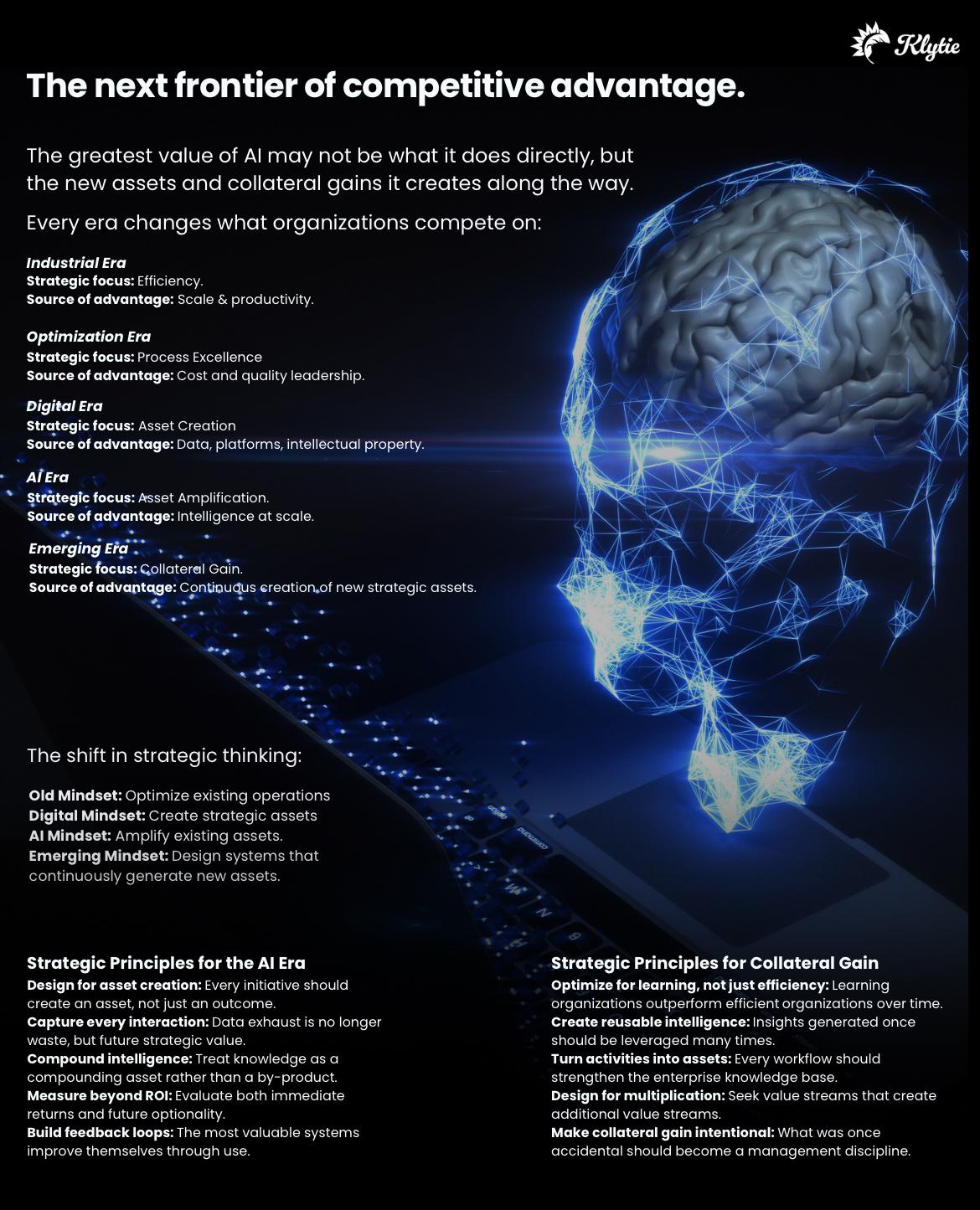
Strategic asset creation, the new imperative of business. For most of modern business history, strategy was fundamentally an exercise in extraction. Organizations sought to extract more productivity from labor, more efficiency from operations, more output from capital, and more revenue from markets.
The winners were those who optimized faster than everyone else. This logic fueled extraordinary growth. It built industrial giants, created global supply chains, and ultimately fueled decades of economic expansion.
Yet optimization contains a hidden flaw. It is a diminishing game.
A process can only become so efficient. A product can only become so refined. A market can only become so saturated. Eventually, every optimization approaches a ceiling, and that is precisely where many organizations find themselves today.
In a world where technologies evolve exponentially, business models emerge overnight, and competitive advantages disappear faster than ever, the central challenge facing leaders is no longer how to maximize value from existing activities. The challenge is how to continuously create new sources of value.
The most successful companies increasingly understand a profound truth: Products generate revenue, strategic assets generate possibilities. A product solves a problem. A strategic asset creates the ability to solve future problems. Revenue is consumed. Assets compound. While revenue reflects yesterday’s success, assets determine tomorrow’s success.
This perspective has deep roots in strategic management. More than three decades ago, Raphael Amit & Paul J. H. Schoemaker argued that enduring advantage comes not from products themselves but from the accumulation of „strategic assets,” resources and capabilities that are difficult to imitate, difficult to trade, and capable of generating sustained organizational rent.
A patent. A trusted brand. A proprietary dataset. A unique operating model. A culture of innovation. Deep customer relationships. Institutional knowledge. An ecosystem of partners. A highly specialized talent base…. Individually, each of these assets has value. Collectively, they become something far more powerful, the engines beneath the engine.
Amit and Schoemaker distinguished between two fundamental building blocks.
The first is resources. Resources are the things a company owns or controls (capital, patents, technology, brands, data, physical infrastructure).
The second is capabilities. Capabilities are the organization’s ability to deploy those resources effectively (its routines, its decision-making processes, its learning systems, its culture, its ability to coordinate action).
If resources tell us what an organization has, capabilities determine what it can do. The magic happens when the two become inseparable. When resources and capabilities reinforce each other over time, they evolve into strategic assets, and strategic assets are different.
They are not easily purchased. They cannot simply be copied. They cannot be replicated through a larger budget. They emerge through history, through learning, experimentation, relationships and through accumulated experience. They are products of time, and time is one of the few resources competitors cannot buy.
This is why some organizations consistently outperform their industries while others remain trapped in cycles of imitation. The difference is not always intelligence or capital, it is often asset asymmetry.
Strategic assets are unevenly distributed. Some firms own them. Others don’t. This asymmetry creates what economists call rent. Not rent as in real estate, but economic rent, the excess return generated when a firm possesses something uniquely valuable that competitors cannot easily duplicate. Amit and Schoemaker called this organizational rent, and it is one of the most important concepts in strategy. Because sustainable profitability is rarely the result of doing the same thing slightly better, it is usually the result of owning something others cannot replicate.
Think about the world’s most valuable organizations. Their success rarely stems from a single product. Products come and go, technologies become obsolete, market shifts…what persists are the underlying assets.
A trusted brand. A massive knowledge base. A network effect. A proprietary dataset. A developer ecosystem. A reputation for reliability. These assets continue generating value long after individual products have peaked. In fact, the most valuable assets often become more valuable over time. They compound.
Therefore, businesses don’t compete solely on what they sell. They compete on what they build beneath what they sell. The visible business is often only the tip of the iceberg. The real source of advantage lies beneath the surface.
Nowadays, AI is forcing executives to rediscover this insight.
AI is revealing that every organization possesses hidden reservoirs of value embedded within its knowledge, relationships, processes, data, expertise, and reputation. Assets that once appeared passive are becoming active. Assets that once seemed operational are becoming strategic.
To understand this transformation, it helps to borrow an idea from economics, the concept of collateral value.
The economics of collateral gain. Economists have long observed a subtle but powerful truth: an asset is often worth more than the cash flows it directly produces.
A building generates rent, but it can also secure a loan. Land yields crops, but it can also unlock credit. In economic theory, this additional source of value is often described as collateral value, pledgeability, or a collateral premium.
As one academic paper notes: “Collateral value … leads to commodity prices that are always at least as high as fundamental values and sometimes strictly higher.” In other words, assets can be worth more than their direct utility because they create opportunities beyond themselves.
This idea extends far beyond finance. In 1984, Birger Wernerfelt introduced what would become known as the Resource-Based View of the firm.
His argument was deceptively simple. Companies should not be understood merely as portfolios of products. They should be understood as portfolios of resources. „By analyzing the firm’s resource position rather than its product-market position, it is possible to plan a much richer set of strategies, especially for diversified firms.”
Products come and go. Resources endure.
This insight was later expanded by Jay Barney (Firm Resources and Sustained Competitive Advantage, 1991), who demonstrated that „Firm sustainable competitive advantage arises from resources that are valuable, rare, imperfectly imitable, and non-substitutable.”
Viewed through this lens, the most important question facing leaders changes dramatically. Instead of asking „What product should we build?” They begin asking: „What strategic assets should we create?”
The difference is subtle and it changes everything. One focuses on outcomes, the other focuses on capability. One optimizes the present, the other invests in the future.
Economists have observed that “…the reliance on collateral to secure loans and the particular collateral requirements chosen by the social planner or by the market have a profound impact on prices, allocations, market structure and the efficiency of market outcomes.” (John Geanakoplos and William R. Zame in their paper on Collateral equilibrium, 2013)
The same principle applies to businesses. What matters increasingly is not simply what an organization owns. What matters is what ownership allows it to do.
Consider two firms with identical revenues. The first has a collection of disconnected systems, fragmented knowledge, and undocumented expertise. The second possesses structured data, codified processes, and AI-accessible knowledge. Their present performance may look similar. Their future potential is not. The second company possesses greater collateral gain.
Every asset it owns can be recombined, analyzed, automated, extended, and monetized in multiple ways. It is like the difference between a warehouse and a library. Both contain information. Only one allows knowledge to be retrieved, connected, and multiplied.
One of the greatest opportunities created by AI is the transformation of businesses into living libraries of knowledge. How does it happen? More easily, and more quickly than most of us think. Imagine a company that spends years building a customer support operation. Traditionally, support is seen as a cost center. While its purpose is to resolve tickets, its value lies in customer satisfaction.
Yet AI sees something else. Every interaction becomes training data. Every complaint becomes market intelligence. Every resolution becomes institutional knowledge. Every conversation becomes a reusable asset.
What once generated a single outcome can now generate dozens. The support center has acquired collateral gain. Its value no longer resides solely in solving problems. Its value resides in the future capabilities it enables.
The same transformation is happening everywhere. What appears to be one asset is actually a chain reaction. AI simply makes the chain visible.
Consider a brand. Its primary value is obvious, it drives customer preference. But that is only the beginning. The brand accelerates trust. Trust reduces adoption friction. Faster adoption generates more customer interactions. Those interactions generated data. Data improves intelligence. Intelligence improves products. Better products strengthen the brand…..and so on …we can continue to consider countless examples.
The point is that the original asset begins to multiply itself. Its influence expands outward through the organization. Like a stone dropped into a pond, the ripples travel far beyond the point of impact. The asset becomes a platform for creating additional assets.
This is where extraordinary value creation begins. And this is what we might call collateral gain. Not the gain derived from using an asset, but the gain derived from what the asset enables.
AI, the great revealer of hidden assets. If previous generations of technology focused on automation, AI focuses on amplification. It functions as a strategic asset refinery.
For decades, organizations accumulated vast deposits of dormant value: customer conversations, technical documentation, research archives, operational records, expert knowledge, process histories, documents, emails…etc. These assets existed while they remained largely inaccessible. Like oil trapped beneath rock formations, they possess potential without productivity.
AI changes that. It transforms information into intelligence, memory into capability, knowledge into action. The result is extraordinary. Assets that once appeared secondary suddenly become strategic. Their collateral gain becomes visible.
A customer support archive becomes a training dataset. A project repository becomes an institutional memory system. A collection of emails becomes a map of organizational expertise. A manual process becomes an intelligent operating assistant.
Every competitor can buy similar AI models. Every competitor can access similar computing power. But no competitor can buy your history. No competitor can buy your relationships. No competitor can instantly acquire your culture. No competitor can replicate decades of accumulated expertise. No competitor can duplicate the trust embedded in your brand. All of these are strategic assets. The organization discovers it has been sitting on strategic capital all along, without realizing it.
In their landmark work on dynamic capabilities (1997), David J. Teece, Gary Pisano & Amy Shuen argued that competitive advantage increasingly depends on a firm’s ability to build, integrate, and reconfigure internal and external competencies in rapidly changing environments.
This idea feels remarkably prescient today. Because the modern economy rewards adaptability more than efficiency, the winners are no longer necessarily those with the best assets, they are those capable of continuously transforming assets into new capabilities.
For most of industrial history, businesses measured assets according to output. How many units does a factory produce? How many customers does a sales team acquire? How much revenue does a product generate?
The logic was linear. Input creates output. Investment creates return. Efficiency creates profit. Today, AI has an extraordinary ability:
- It can activate dormant assets.
- It can transform previously inaccessible knowledge into intelligence.
- It can turn scattered information into organizational capability.
- It can convert accumulated experience into scalable decision-making.
And, in doing so, AI completely changes the old, linear perception. Every dataset becomes reusable. Every workflow becomes reconfigurable. Every expertise repository becomes searchable. Every organizational memory becomes actionable.
Suddenly, assets that appeared passive become active. Assets that seemed operational become strategic. Assets that were hidden become visible. And assets that once generated incremental value begin generating exponential value.
The enterprise evolves from a machine into a living system. A system capable of learning, adapting, and creating collateral gain repeatedly and at scale.
The rise of the option-rich enterprise. Traditional management sought efficiency. The AI era rewards optionality. Efficiency asks „How can we extract more value from this asset?” Optionality asks „What else can this asset become?”
This distinction may define the next generation of competitive advantage. Researchers studying intangible asset accumulation observed that competitive advantages often arise from long-term processes that competitors cannot easily replicate.
In the current context, this observation could become especially relevant. If we just think about it: data cannot be copied overnight, trust cannot be bought instantly, culture cannot be downloaded, and institutional memory cannot be outsourced. These assets can only accumulate gradually. However, AI dramatically increases their utility. As a result, the strategic center of gravity within organizations is shifting. Physical assets remain important, but intangible assets increasingly determine competitive outcomes.
A customer database can become a recommendation engine. A recommendation engine can become a personalization platform. A personalization platform can become a predictive business. A predictive business can become a new market.
Each stage creates value. But more importantly, each stage creates additional possibilities. Collateral gain compounds. Like interest. Like trust. Like knowledge. Its power lies not in individual returns but in cumulative potential.
The modern balance sheet understates what matters most (knowledge, relationships, reputation, learning, context). These are becoming the infrastructure of future advantage. The organizations that thrive will be those that systematically identify hidden collateral within their assets and then use AI to unlock it
However, building strategic assets is extraordinarily difficult. Amit and Schoemaker emphasized that managers operate under three unavoidable constraints: uncertainty, complexity, and conflict.
Leaders must make decisions without knowing how markets will evolve, without fully understanding complex cause-and-effect relationships, and while navigating competing interests within their own organizations.
There are no perfect forecasts, no complete information, and definitely no flawless strategy models. This means strategic asset creation is ultimately an exercise in judgment. A bet on the future. A wager that certain capabilities will matter tomorrow more than they matter today.
A remarkable insight is that competitive advantage often emerges precisely because leaders are imperfect. If every executive possessed identical information and interpreted it identically, every company would pursue the same opportunities.
There would be no asymmetry, no uniqueness, and no rent. Advantage arises precisely because leaders see different futures. Most are wrong, a few are right. When a firm’s strategic assets align with the future before others recognize it, extraordinary value is created.
This is why strategic leadership is increasingly becoming less about optimization and more about asset architecture.
The role of leadership is not merely to manage resources. It is to design systems that continuously create strategic assets, to identify hidden reservoirs of value, to connect assets that reinforce one another, to build capabilities competitors cannot easily understand, as well as to cultivate trust, knowledge, relationships, data, culture, learning…. These are the assets that generate future options, future resilience, future innovation, and ultimately future rent.
The executive question of the AI era. For generations, executives evaluated investments through a familiar lens „What is the return on investment?” The AI era introduces a second question „What is the return on possibility?”
This question changes everything.
A knowledge-management initiative may create little immediate revenue. Yet it may unlock extraordinary future capabilities. A data platform may appear costly today. Yet it may become the foundation for future intelligence. A customer community may seem peripheral. Yet it may become a source of innovation, loyalty, and insight.
A project may generate modest direct revenue while creating extraordinary collateral gain. A dataset may have limited current use while enabling future AI capabilities. And so on… In an environment of accelerating change, possibility itself becomes an asset, and the organizations that systematically create possibility become extraordinarily resilient.
In the age of AI, secondary effects are becoming primary sources of value. Here are some examples:
- Customer Service AI (Original Investment)/ Faster support (Primary Outcome)/ Customer intelligence asset (Collateral Gain).
- Predictive Maintenance/ Reduced downtime/ Operational knowledge base.
- Sales AI Assistant/ Higher productivity/ Market trend intelligence.
- Enterprise Knowledge System/ Better access to information/ Organizational memory asset.
The collateral gain often becomes more valuable than the initial use case. The future belongs to organizations capable of recognizing this shift.
Seeing beyond the asset. The deepest lesson of collateral theory is that value is rarely confined to immediate utility. An asset is valuable not only because of what it produces, it is valuable because of what it enables.
Strategic management scholars spent decades extending this insight through theories of resources, strategic assets, dynamic capabilities, and intangible capital. AI now brings these ideas together. It exposes the hidden wealth embedded within organizations, it reveals dormant assets, it amplifies their collateral value, and it transforms possibility into a measurable strategic resource.
In doing so, it encourages leaders to see their organizations differently. Not as collections of resources, not even as collections of products, but as ecosystems of possibility.
The companies that will lead the next decade will not necessarily be those with the most technology, nor those with the largest datasets, nor even those with the most efficient operations. They will be those who understand the collateral gain embedded within them, and possess the imagination, systems, and intelligence to unlock it.
These assets are the engines beneath the engine. Yes, they are difficult to see, difficult to measure, often impossible to value accurately. Yet they determine who wins. And as AI unlocks new ways to activate, connect, and compound those assets, their importance will only increase.
The future belongs to organizations that stop asking how to extract more value from what they do today and start asking a far more powerful question: What strategic assets are we building that will create value tomorrow?
Because products create income, but strategic assets create futures.
***
And so, the good news is: AI is everywhere. The bad news is: So is everyone else.
The advantage comes from seeing what others overlook, imagining what your existing assets could become, and having the judgment to turn those possibilities into measurable value.
Asset Value × AI Capability = Exponential Return Potential.
The biggest opportunity isn’t replacing people, it’s uncovering value that’s already hiding in plain sight. Curious enough to explore it together?
Until next time, keep it handy!
