

We are living through one of the most remarkable periods in business history.
Every day, executives are presented with headlines announcing the next technological breakthrough. AI is transforming industries. Automation is redefining workflows. Algorithms are making decisions that once required entire departments. New tools are emerging so rapidly that by the time organizations learn one system, another is already knocking at the door.
The conversation in boardrooms has become almost singular in its focus: How fast can we adopt? How much can we automate? How much more efficient can we become?
While technology is changing rapidly, human nature is not.
People still want purpose.
People still want dignity.
People still want to feel like they matter. And perhaps most importantly, people still want a voice in shaping the environment in which they spend much of their lives.
And so, almost unnoticed, the questions that matter most begin to rise: “What kind of organization are we building while we are building all this technology?”
This brings us to a metaphor that I believe captures one of the defining leadership challenges of our age.
Imagine an organization as a house. I’m not talking about a building made of bricks and steel, but a living structure, composed of relationships, processes, ambitions, and shared goals. While leadership serves as the architect, technology provides the tools, and employees become the people who must live inside the finished structure.
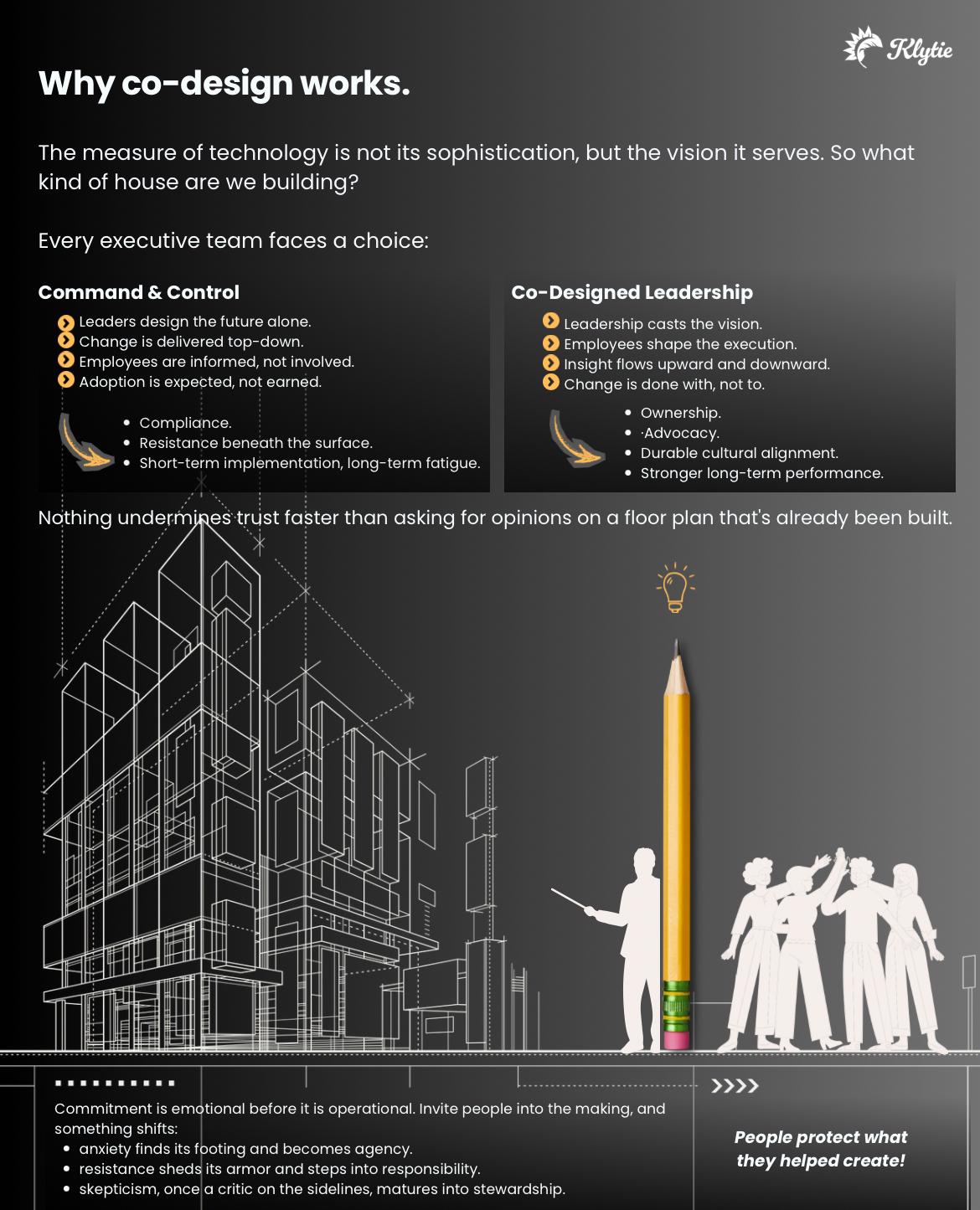
The question is simple: Are we building a house for people? Or are we building a house with people? The line between merely surviving and truly thriving in the years ahead will be drawn by how we answer this moment.
Every generation of business leaders inherits a defining challenge.
For the industrial age, it was scale. For the information age, it was connectivity. For our age, it is adaptation. AI, automation, and emerging technologies are reshaping industries with a speed that would have seemed unimaginable only a decade ago. Yet amid the excitement surrounding technological transformation, many organizations are forgetting a timeless truth: people may work in the house, but they also have to live in it.
This deserves a deeper look:
The great misunderstanding. There is a persistent misunderstanding in modern management. Many leaders assume employees want control over every decision. In reality, most do not.
Most employees do not aspire to become architects of corporate strategy. They do not expect to approve every investment, select every technology platform, or determine the direction of the organization.
What they seek is far simpler and far more human… They want to walk through the blueprint before the concrete is poured. They want to understand what is being built. They want the opportunity to point out where the windows should be larger, where the hallways may become crowded, and where a beautiful design on paper may become an everyday frustration in practice. And perhaps most of all, they want to know that the future of their work is not being discussed as if they are absent from the room.
When organizations fail to recognize this distinction, they often create the illusion of participation. Meetings are held. Surveys are distributed. Feedback sessions are organized. Employees are invited to „share their thoughts,” all while the blueprint has already been approved, the contractors have already been hired, the budget has already been allocated…
Too often, leaders treat technological change as an engineering challenge when it is fundamentally a human one. A new AI platform is purchased. Consultants are hired. Presentations are delivered. Then comes the familiar invitation to employees: „We welcome your feedback.” The problem is that the walls are already standing.
Employees may not always know every strategic detail, but they are remarkably skilled at recognizing the difference between genuine participation and ceremonial participation. They can tell when their perspectives are being sought to shape a decision and when they are being sought merely to legitimize one.
The consequences extend beyond disappointment. They strike at the foundation of organizational trust. Nothing erodes trust faster than asking people for their opinions about decisions that have already been made.
The trust gap. If the industrial age was defined by machinery, and the information age by data, then the technological age may ultimately be defined by trust. Trust has become the invisible infrastructure upon which transformation depends. It cannot be purchased, outsourced, or automated.
Without trust, every new system is viewed with suspicion. Without trust, every announcement becomes a source of anxiety. Without trust, every technological advance is interpreted as a threat rather than an opportunity.
Yet in many organizations pursuing digital transformation, trust is treated as a secondary consideration behind efficiency metrics and implementation timelines.
The philosopher Onora O’Neill argues that modern institutions often make a critical mistake, they focus on creating trust rather than demonstrating trustworthiness. As she observed: “Trustworthiness is the basis of trust.”
The implication is profound. Businesses cannot demand trust from employees during technological transformation. They must earn it through transparency, competence, honesty, and accountability long before new technologies are introduced.
Many organizations across every industry often announce AI-related initiatives with great enthusiasm. Leaders focus on what technology can do while overlooking how people will experience it. They present polished slides. They describe extraordinary possibilities. Then they ask employees for input. What employees frequently hear is something quite different: „We have already chosen the destination. We are now asking how you feel about the journey.”
The irony is profound. At the very moment when technology is becoming more sophisticated, organizational success is becoming increasingly dependent on deeply human factors such as trust, participation, and shared purpose.
This reality reveals one of the greatest misconceptions surrounding technological transformation: resistance is not always resistance to change, more often, it is resistance to exclusion.
Consider what happens when an organization introduces AI.
Leadership sees efficiency. Investors see productivity. Consultants see optimization. Employees often see uncertainty. Will my role change? Will my expertise still matter? Will the organization invest in my growth? Or am I witnessing the first chapter of my replacement?
These questions are rarely spoken aloud. Yet they occupy countless conversations in hallways, video calls, and lunchrooms. The challenge for leaders is not simply to answer these questions. It is to create an environment where employees believe the answers.
People are remarkably adaptable when they understand the purpose behind a change and feel they have helped shape it. They are much less adaptable when change comes as a blanket decree, accompanied by assurances that their voices matter after every significant decision has already been made.
As Peter Drucker once observed: “Management is doing things right, leadership is doing the right things.” In the technological era, doing the right thing increasingly requires building trust before deploying technology.
Not afterwards. Not during the rollout…Before.
Because trust is not a patch that can be applied after implementation. Trust is a foundation that must be poured beforehand. Just as no architect would begin construction on unstable ground, leaders should not deploy transformative technologies without first establishing the trust upon which adoption depends.
Technology moves at the speed of engineering. Trust moves at the speed of humanity. The companies that mistake one for the other often discover that transformation doesn’t stall in the server rooms, it stalls in the human hearts.
The wisdom hidden in the workforce. One of the most expensive mistakes organizations make is assuming that expertise flows exclusively downward. It does not. True insight lives everywhere. It grows in the daily work, in the hands of the people closest to the problems, in the voices that are often the quietest.
Technology may be designed from the top down, but it is lived, tested, and truly understood from the bottom up. The most successful organizations recognize this: innovation doesn’t flow downward, it rises. And so, they listen across levels. They build across perspectives. They lead with humility.
This principle sits at the heart of the Responsible Innovation movement developed by scholars such as Richard Owen, Phil Macnaghten, and René von Schomberg. Their research argues that organizations should not wait until technologies are complete before engaging those affected by them. Instead, innovation should be characterized by what they describe as anticipation, inclusion, reflexivity, and responsiveness.
In practical terms, this means inviting people into conversations while there is still time for their perspectives to influence outcomes.
Today, AI offers a perfect example.
A senior leadership team may identify a process that appears ideal for automation. The logic may be sound. The business case may be compelling. The technology may function exactly as intended.
Yet frontline employees often know something the boardroom doesn’t. They understand the exceptions. They understand the nuances. They understand the customer interactions that never show up in reports. They understand where human judgment creates value that metrics can’t capture.
While leaders often see the blueprint, employees see the terrain on which the house must stand. Both perspectives are essential.
An architect may envision a magnificent structure, but the future occupants know where rainwater collects, where sunlight enters, and where daily routines create friction. Ignoring either perspective increases the likelihood of constructing something impressive yet impractical.
The history of failed transformations is filled with initiatives that made perfect sense in theory and failed spectacularly in practice. Why? Because the blueprint was drawn by people who would never have to live inside the finished house.
The co-designed house solves this problem. It recognizes a simple truth: the people closest to the work are often closest to the knowledge required to improve it. Leadership still provides vision, and vision becomes stronger when informed by lived experience.
Businesses that truly involve employees in technological transformation often discover opportunities that leadership alone could never identify. In this sense, inclusion is not merely a cultural virtue, it is a strategic advantage.
The difference between compliance and commitment. Every leader eventually makes a fundamental choice. Do you want compliance? Or do you want commitment?
Compliance can be purchased. It can be mandated. It can be measured.
Commitment is different. Commitment must be earned.
The great scholar of innovation Everett Rogers spent decades studying why people adopt new ideas and technologies. His research demonstrated that adoption is rarely driven solely by technical superiority, it is heavily influenced by trust, communication, social networks, and perceived legitimacy.
“Thus we see that the diffusion of innovations is a social process, even more than a technical matter… An important factor regarding the adoption rate of an innovation is its compatibility with the values, beliefs, and past experiences of individuals in the social system.”
In other words, people do not embrace change simply because it is available. They embrace change when they believe it serves a meaningful purpose.
Likewise, employees comply when they must, they commit when they believe. The distinction becomes critical during periods of transformation.
- An employee who complies will follow instructions. An employee who commits will solve problems.
- An employee who complies will adapt reluctantly. An employee who commits will innovate enthusiastically.
- An employee who complies will do what is required. An employee who commits will do whatever is possible.
Technology alone cannot close that gap, leadership can, and the bridge is participation. This idea appears repeatedly across organizational psychology, implementation science, and technology governance research.
People support what they help create. That principle is as old as civilization itself. The co-designed house reminds us that ownership is not granted through authority, it is earned through involvement.
Many technology initiatives fail not because the technology is flawed, but because the conversation was. The system performs exactly as engineered. The implementation unfolds according to plan. The budget remains intact. On paper, it is a model of discipline and execution.
And yet, adoption stalls…while technology can be installed, commitment cannot.
This is where empathy becomes a strategic advantage, not merely a human virtue. Communication is most effective when people share common experiences, perspectives, or understanding. Individuals who can genuinely see the world through another person’s eyes create understanding even across diverse backgrounds. In that sense, empathy transforms difference into connection.
The result is more than better communication. It is shared understanding, shared purpose, and ultimately shared ownership. In line with Rogers’ homophily principle, effective communication promotes convergence between individuals, leading to greater homophily in knowledge, beliefs, attitudes, and overt behavior.
The lesson is simple: people rarely resist solutions they helped shape. When individuals are invited to contribute, they become invested. When they are heard, they become engaged. And when they see their fingerprints on the outcome, adoption becomes far less about compliance and far more about commitment.
Too often, organizations try to implement a new operating system in a culture that was never invited to help design it. They optimize workflows before understanding how they work. They configure features before building trust. And then wonder why the enthusiasm lags behind execution.
The result is not a technical failure. It is a human one. It is a beautifully constructed house (architecturally sound, meticulously finished) in which no one feels at home.
The competitive advantage nobody can copy. For centuries, organizations competed through capital. Then they competed through information. Today, many assume they will compete through AI
I would argue something different. AI will become increasingly available to everyone. Models will improve. Costs will fall. Capabilities that seem extraordinary today will become commonplace tomorrow. Like electricity, the internet, or cloud computing, AI itself will gradually cease to be a meaningful source of competitive advantage.
The real differentiator will not be access to AI. It will be the ability to create trust around its use. This distinction matters because trust is not the same as confidence.
Confidence exists when we rely on a system without seriously considering alternatives. We board airplanes, use currencies, and connect to the internet every day largely through confidence. These systems have become part of the background of modern life. We do not consciously evaluate them each time we engage with them.
Trust is different. Trust emerges when alternatives are available, uncertainty is visible, and a decision must be made despite the possibility of disappointment. Trust involves risk. It requires judgment. If the outcome proves harmful, we cannot simply blame the system, we must also reflect on our own choice to rely on it.
This is precisely the challenge facing organizations in the age of AI.
As AI becomes embedded in everyday workflows, society will develop confidence in the underlying technology. People will increasingly assume that AI is present everywhere, much as they assume the existence of electricity or software today. Confidence in AI infrastructure will become a prerequisite for participation in modern economic life.
And yet competitive advantage will arise elsewhere. Organizations will distinguish themselves through their ability to earn trust:
- trust that their AI systems are transparent when uncertainty exists,
- trust that human judgment remains accountable,
- trust that recommendations can be challenged,
- trust that decisions affecting people are not hidden behind opaque algorithms.
In a world where powerful AI is becoming universally accessible, technology is no longer the rarest resource. Trust is. This insight resonates with the work of sociologist Niklas Luhmann, who argued that trust functions more as a mechanism for navigating uncertainty, rather than simply as a moral virtue.
“Trust is a way of dealing with a future that cannot be fully known.” Without trust, every decision requires exhaustive verification, with trust, uncertainty becomes manageable, and action becomes possible. As uncertainty rises, trust does not become less important, it becomes indispensable.
AI is accelerating us into precisely such a world. „AI can generate answers. Trust determines whether people act on them.” While AI offers extraordinary opportunities, it also expands the landscape of uncertainty.
- Employees may not fully understand how algorithms reach conclusions.
- Customers may not know why a recommendation was made or a decision approved.
- Leaders may not foresee every downstream consequence of an automated action.
The more intelligent our systems become, the more vital it becomes that people can confidently navigate what they cannot fully see. Trust, therefore, is not the opposite of uncertainty. Trust is how we move through uncertainty. It is the bridge we build when the map ends.
Research on uncertainty and social identity suggests that when people face ambiguity, they seek structures, relationships, and communities that provide clarity, predictability, and confidence. In times of uncertainty, people do not simply look for better tools, they look for trustworthy guides.
The organizations that will thrive in the next decade will not necessarily be those with the most sophisticated AI models, but certainly those that create environments where the technology is transparent enough to be questioned, reliable enough to be trusted, and flexible enough to be challenged.
They will understand that trust is not a communication strategy, but an operational system, built through consistency rather than slogans, transparency rather than opacity, and accountability rather than blind faith.
Like a lighthouse in heavy fog, trust does not remove uncertainty, it provides enough orientation for people to move forward with confidence.
The house that endures.
Before we wrap up, let’s go back to the begining.
The technological era is presenting leaders with extraordinary opportunities. AI will reshape industries. Automation will transform work. New technologies will continue to challenge assumptions about how businesses operate. But amidst all this change, one truth remains remarkably constant.
People still want to matter.
People still want to contribute.
People still want to feel that they are helping shape the future rather than simply being subjected to it.
“The goal of leadership is not to create trust. The goal is to create trustworthiness.” One of the biggest mistakes businesses make is believing that technology is the house. It is not. Technology is merely a new set of tools, a more powerful hammer, a faster saw, a smarter blueprint.
Yet tools do not create great institutions any more than bricks create a home. The real structure is built from something far more enduring: the architecture of trust, the wiring of relationships, the load-bearing beams of culture, and the shared sense of purpose that gives meaning to every innovation. These are the foundations that determine whether an organization stands tall through storms or splinters under pressure.
Technology may accelerate progress, but trustworthiness sustains it. New tools can capture attention; only strong character can keep it. Long after today’s breakthrough becomes tomorrow’s commodity, people will remember whether an organization was reliable, principled, and worthy of their confidence.
The question facing today’s leaders is not whether to embrace technological change. History has already given its verdict on that debate. The real question is how we intend to build the future.
Will we build a fortress of command and control, a finished, revealed house with polished floors and predetermined rules, where employees are given keys and told to make themselves at home in rooms they had no part in designing?
Or will we build a co-designed house, one where leadership conveys the vision, where employees contribute insights from the grassroots, and where together they raise walls strong enough to withstand uncertainty?
The answer will shape much more than the fate of a single technology initiative. It will decide whether organizations become spaces people simply pass through or communities they are proud to help build.
In the end, enduring strength does not belong to the organizations armed with the most advanced tools. It belongs to those guided by a deeper wisdom: people invest their energy, loyalty, and imagination in what they help create.
That is the quiet, powerful truth at the heart of leadership in a technological age. The leaders who understand this do more than implement systems, they build places where people choose, wholeheartedly, to belong.
***
“The more we know about how to do something, the harder it is to learn how to do it differently,” as Everett M. Rogers wrote in „Diffusion of Innovations.”
It is a deceptively simple observation. The very expertise that allows us to build remarkable systems can, at times, make it difficult to imagine new ones.
Across industries, institutions, and societies, technology is advancing at an extraordinary pace today. Yet history reminds us that transformation is never assured by capabilities alone. The greatest breakthroughs are not just technical achievements, but collective acts of imagination, trust, and shared purpose.
Let’s design the future the way history likes its landmarks: principled enough to matter, advanced enough to inspire, and shared enough to belong to more than just a lucky few.
If this resonates with you, it might be an invitation to you, not as stakeholders who need to be informed, nor as end users who need to be trained, but as co-architects of what is to come.
Until next time, keep it handy!
