

For centuries, civilization has been defined by its persistent quest to transform uncertainty into order. Science, industry, economics, computing, and technological progress were all expressions of the same underlying aspiration, the belief that reality can become increasingly knowable, predictable, and controllable through sufficient knowledge and sufficiently advanced systems.
The modern age was built upon this confidence. The Enlightenment displaced myth with rationality. Industrialization displaced organic rhythms with mechanical precision. Bureaucracy transformed societies into administrable structures. Digital systems transformed information into infrastructure. AI now seeks to transform cognition itself into an engineering problem.
Across each phase of modernity, technology appeared to move humanity towards greater mastery over nature, society, and eventually even human behavior itself. And yet, paradoxically, as technology becomes increasingly embedded in society, the world seems to grow less stable.
Despite unprecedented data abundance, volatility is rising. Despite predictive analytics, markets remain fragile. Despite hyperconnectivity, institutions struggle to maintain coherence. Despite automation, uncertainty expands faster than certainty.
The expansion of human power has not simplified reality, it has revealed the depth of reality’s interconnectedness. Every technological breakthrough generates new dependencies. Every increase in efficiency creates new fragilities. Every system of control produces unintended consequences that propagate beyond the boundaries of prediction.
Economist Friedrich Hayek anticipated aspects of this dilemma decades before the advent of digital networks. He argued that modern societies contain more distributed knowledge than any central authority could ever fully comprehend.
“The sum of the knowledge of all the individuals exists nowhere as an integrated whole. The great problem is how we can all profit from this knowledge, which exists only dispersed as the separate, partial, and sometimes conflicting beliefs of all men.”
Today’s interconnected systems have magnified that condition exponentially, making coordination even more dependent on dispersed, partial, and constantly changing information.
The result is a historical inversion few anticipated. Technology does not reduce the world into neatly controllable parts, it thickens the web of interdependence, amplifying both our capabilities and the limits of centralized understanding.
Humanity is entering an era where economics, ecology, psychology, computing, biology, geopolitics, media systems, energy infrastructures, and AI no longer function as separate and independent domains. Now they are threads of the same tapestry, woven together by forces that continually shape and reshape each other.
A tremor in financial markets can unsettle governments. A technological breakthrough can redefine how societies think, communicate, and live. When the natural world shifts its course, the effects travel far beyond the horizon, reshaping economies, migration patterns and recalibrating national priorities.
In this era of interdependence, understanding the whole has become as important as understanding its parts. And, although it may seem so, this represents something much more than a technological development or a consequence of globalization, it is a profound philosophical inversion, as well as a civilizational transformation.
The premises that shaped industrial-age thinking (predictability, linearity, control, and separation) are increasingly insufficient for understanding the realities of the 21st century and the implications of this go far beyond the realm of technology. They are redrawing the contours of leadership, governance, economics, organizational design, public policy, and even our fundamental understanding of strategy itself.
The modern enterprise no longer functions as a finely tuned machine, responding predictably to a sequence of causes and effects. It is more like a living organism: dynamic, interconnected, adaptable, and in a perpetual state of evolution. Its vitality depends not only on efficiency, but also on its ability to sense, learn, and respond to a constantly changing environment.
The same reality now defines our societies, economies, governments, and geopolitical systems. Each exists within vast and complex networks of interdependence, where decisions ripple like pebbles thrown into a lake, crossing borders, influencing institutions, reshaping communities, and often producing consequences that no single actor could fully foresee.
The point is that living systems do not behave like machines. They learn, adapt, self-organize, and transform. Their behavior results from countless interactions between actors, stimuli, technologies, cultures, and environments. As a result, outcomes are rarely linear or completely controllable. Small events can trigger disproportionate consequences, while large interventions can produce unexpected results.
In such a world, strategy is no longer the art of prediction, but the art of navigation, of understanding patterns and complexity, of cultivating resilience amidst uncertainty, and of creating coherence within systems in constant motion.
Whether it’s business, public policy, or international affairs, this requires a fundamental shift in the way leaders think and act. Success is no longer determined solely by efficiency, optimization, or control, but by the ability to spot emerging patterns, adapt to changing conditions, build resilience, and navigate complexity.
The defining challenge of the 21st century is no longer about managing machines, but about learning how to thrive within living systems whose complexity, interconnection, and capacity for transformation continue to grow.
Let’s get the full picture:
The collapse of the mechanical imagination. Modern civilization was built upon a powerful metaphor: the world as a machine. The Universe was imagined as a vast clockwork mechanism, its movements governed by predictable laws and orderly sequences. In time, this metaphor expanded beyond nature itself. Society became a machine. The economy became a machine. Organizations became machines. Even the human mind was increasingly understood as a sophisticated processor of information.
From this worldview emerged the defining principles of the industrial age: hierarchy over emergence, specialization over wholeness, linear causality over complexity, and optimization, prediction, and control as the highest virtues. We learned to engineer, manage, and govern as if reality were a system of gears whose behavior could be calculated, directed, and perfected.
Frederick Taylor’s scientific management, Fordist production systems, linear forecasting models, and even early computing architectures all emerged from the same intellectual atmosphere, the belief that control scales through decomposition. Machines can be disassembled into parts, optimized independently, and reassembled into predictable wholes.
And indeed, a factory assembly line is predictable because it is designed to be so. It is like a narrow channel: its path is fixed, its inputs are controlled, and its outputs are largely known in advance. Precision is its virtue. Stability is its promise.
But the world we’ve built today doesn’t look like a canal at all. It looks more like an ocean. Across this vast digital ocean flow financial tides, algorithmic currents, artificial intelligences, supply chains, energy networks, political institutions, cultural movements, and billions of human decisions all unfolding simultaneously. New currents emerge daily. Existing ones collide, merge, accelerate, or disappear. What appears to be a single global system is in reality a living constellation of interconnected systems, each shaping itself and being shaped by all the others.
This is the defining reality of today’s complexity.
The whole becomes something greater (and often something different) than the sum of its parts.Ecosystems, economies, cultures, neural networks, climate systems, and digital societies do not evolve in a straight line. They evolve through feedback, adaptation, and emergence. Their behavior is dictated not by their individual components, but by the relationships that link these components together.
And the more complex a system becomes, the less it responds to commands and the more it responds to conditions. Influence replaces control. Participation replaces domination. Stewardship replaces management.
This transformation changes the meaning of governance itself.
“The world is not a solid continent of facts sprinkled by a few lakes of uncertainties, but a vast ocean of uncertainties speckled by a few islands of calibrated and stabilized forms” As Bruno Latour argued, reality is not composed of isolated objects moving through empty space. It is composed of networks, connections, and mediations. Nothing exists entirely alone. Every institution, every technology, every individual operates within a web of relationships that both enables and constrains its actions.
Therefore, technology is not a neutral tool, outside of society. It becomes part of society. It influences behavior. It reshapes incentives. It modifies institutions. It changes how we perceive the world and how we perceive each other. Every major technological system eventually becomes a social system.
And as connectivity deepens, the illusion of isolated control begins to dissolve. Power increasingly lies not in commanding individual components but in understanding the networks that connect them. The most important actors are often not those who possess the most power, but those who can influence the greatest number of relationships.
The leaders, institutions, and societies that will thrive in the coming decades will be those that learn a new discipline, not the pursuit of control, but the mastery of complexity.
Technology, more than a tool, a medium. One of the most persistent and quietly controversial assumptions of modernity is that technology is just a neutral tool, a simple obedient extension of the human will, like a hammer that doesn’t care whether it builds a house or breaks a window.
This is only half a truth, and the less interesting half.
History is far less polite. Technology does not merely amplify intention, it rearranges the stage upon which intention is formed. It edits the grammar of attention before a single sentence of thought is spoken.
The printing press did not simply spread ideas, it rewired cognition into linear, replicable form. Television did not merely broadcast politics, it choreographed it into spectacle. Social media did not just connect identities, it fragmented and reassembled them in real time. And AI now stands at the threshold of something even deeper, not just transforming how we access knowledge, but subtly reshaping what we are able to recognize as knowledge at all. Technology has never merely been a simple tool, it has always been a prosthetic imagination.
Long before AI, cloud computing, or digital platforms became the infrastructure of modern commerce, Marshall McLuhan observed a deeper pattern: every technology is an extension of human capability. The wheel extends the foot. The telescope extends the eye. The book extends memory. The network extends communication. Digital systems increasingly extend cognition itself.
Yet the more provocative half of McLuhan’s insight is often forgotten: Every augmentation is also an amputation.
When we extend a capacity outward, into a technology, we simultaneously outsource, diminish, or transform something inward. The computer strengthens our computational capacity while weakening our habit of doing mental arithmetic. GPS extends our navigation reach while eroding our spatial intuition. Search engines expand access to knowledge while altering what it means to remember.
The same principle applies to organizations.Businesses typically celebrate technology for what it adds: speed, scale, efficiency, precision, connectivity. Annual reports are filled with the language of enablement. New platforms enable collaboration. AI enables productivity. Automation enables growth.
Yet technologies do more than enable. They reconfigure the very faculties they amplify. Every dashboard changes how managers perceive reality. Every indicator elevates certain signals while silencing others. Every algorithm institutionalizes a way of seeing things. Every communication platform subtly reshapes how authority circulates, how trust is formed, and how decisions emerge.
Technology is not simply a set of tools operating inside the business, it becomes part of the business’s nervous system. And like any nervous system, it develops blind spots. Following Marshall McLuhan’s metaphor, the danger for organizations is not technological failure, but technological narcosis.
Like Narcissus gazing into the pool, companies often become mesmerized by their own extensions. They mistake the reflection for reality. The dashboard becomes the market. The model becomes the customer. The data becomes the truth. What began as an instrument of understanding gradually becomes a substitute for understanding.
Organizations then risk becoming servants of the very systems they created. They optimize what can be measured while neglecting what cannot. They accelerate processes without questioning direction. They automate decisions without examining assumptions.
In this sense, digital transformation is never merely a technological transformation, but a perceptual transformation. Every major technological shift changes not only what an organization can do, but also what it notices, what it values, what it rewards, and ultimately what it becomes.
The history of business can be read as a succession of extensions. The factory extended muscle. The corporation extended coordination. The computer extended calculation. The internet extended connection. AI extends analysis, prediction, and increasingly judgment itself.
Yet each extension introduces a corresponding dependency. The more organizations rely on automated information, the more valuable human wisdom becomes. The more information becomes abundant, the more attention becomes scarce. The more processes are delegated to machines, the more critical human imagination, ethics, and contextual understanding become.
The critical insight is that technologies are never neutral tools operating outside culture. They reorganize the environments in which decisions occur. As McLuhan observed: “We become what we behold. We shape our tools, and thereafter our tools shape us.”
For leaders, this insight carries profound implications. Technology adoption is never merely an operational decision. It is an organizational decision, as well as a cultural decision, a psychological decision, and ultimately a systemic decision.
The question is no longer, „What can technology do for us?” The deeper questions are, „What is technology doing to us?” How is it reshaping our perception of customers? How is it altering our organizational culture? Which capabilities is it amplifying, and which capabilities is it quietly amputating?” Because technology doesn’t just help us act upon the world. It reorganizes perception, behavior, incentives, relationships, and institutions.
Every significant technology eventually ceases to be only a simple tool and becomes an medium. The smartphone is not simply a communication device, it is a portable architecture of attention. Algorithms are not merely analytical mechanisms, they are behavioral infrastructures. AI is not merely automation, it is the industrialization and increasingly the infrastructuralization of cognition itself.
And thus “the medium is the message.” The most consequential technologies do not change what we do. They change the conditions under which we think, decide, and imagine what is possible.
This is the central strategic challenge of the digital era.
The most successful businesses of the coming decades will not be those that adopt the fastest technology. They will be those who remain conscious of technology’s double nature. They will understand that every extension creates a shadow. Every amplification creates a blind spot. Every new capability changes the human system that surrounds it.
And so, as technologies become more immersive and ubiquitous, the distinction between human systems and technological systems begins to blur. Civilization becomes increasingly cybernetic, a continuous feedback system in which humans shape technology, while technology simultaneously reshapes humanity.
The rise of recursive reality. Norbert Wiener’s cybernetics begins with a deceptively simple but destabilizing insight: “Feedback is a method of controlling a system by reinserting into it the results of its past performance.” In other words, every system capable of control is, at its core, a system of feedback.
Machines do not merely execute commands, they respond to information. Environments do not passively absorb actions, they adapt to incentives. And human behavior, far from being externally directed in a linear fashion, continuously reshapes itself in response to the very mechanisms attempting to guide it.
Control, in this view, is never a straight line, it is a loop.
In the industrial imagination, causality was clean and reassuring. Input produced output, action produced reaction, and prediction rested on the assumption of relative stability.
But this architecture has gradually been replaced by something far more recursive. Information changes behavior, behavior alters systems, systems generate new information, and the cycle accelerates without clear beginning or end. What once looked like a chain has become a circuit.
This is the defining condition of contemporary digital economies and interconnected societies.
- Algorithms optimize for engagement, but engagement evolves in response to optimization.
- Financial markets react to automated trading systems, which in turn react to each other, producing cascades of anticipatory behavior rather than simple exchange.
- Recommendation engines model preferences while simultaneously learning from them, turning taste itself into a moving target.
Even governance is no longer external to its object, institutions regulate environments that have already been transformed by earlier rounds of regulation. The observer is never outside the system, but folded into it, shaping what it attempts to measure.
What happens is that across all these domains, reality increasingly reacts to representations of reality. Forecasts alter the conditions they predict, models reshape the systems they are designed to explain. Observation ceases to be neutral and becomes intervention by default. To predict is to participate, and to describe is to disturb. Epistemology itself becomes unstable, not because data is lacking, but because meaning is recursive.
This recursive structure now propagates through every layer of modern life. Markets react to predictions, populations respond to algorithms, algorithms adapt to populations, and AI systems increasingly train on outputs generated by earlier AI systems. Each layer feeds on the last, refining, distorting, and reintroducing signals into the same evolving informational ecosystem. Instead of convergence towards equilibrium, we observe continuous reconfiguration.
As Wiener warned, “We are but whirlpools in a river of ever-flowing water. We are not stuff that abides, but patterns that perpetuate themselves.” The metaphor captures a central truth of the present: agency exists, but never in isolation; control is real, but always partial and temporary. Every attempt to stabilize a variable becomes part of the dynamics that reshape it.
What emerges is a civilization defined not by linear causality but by feedback sovereignty, a condition in which systems do not simply respond to reality, but continuously co-produce it.
And so, we no longer operate in environments that can be clearly shaped from the outside, but we operate in environments that observe us as we observe them, adapt as we adapt, and evolve through the very act of being understood.
In the rise of recursive reality, certainty does not collapse from ignorance, but from the infinite reflexivity of intelligence itself.
The ecology of consequences. Every technological breakthrough arrives like a confident answer to a question humanity thought it understood, only to discover, later and less conveniently, that the answer has quietly rewritten the question. Progress, it turns out, is not a staircase but a branching ecosystem, each innovation a new species of capability that reshapes the habitat in which it appears.
Electricity enabled urban concentration. Urban concentration accelerated industrialization. Industrialization enabled globalization. Globalization produced tightly optimized supply chains. Until optimization, pushed far enough, begins to resemble fragility wearing the mask of mastery.
The more perfectly a system is tuned to efficiency, the more brittle it becomes under strain. Each solution creates secondary and tertiary consequences that exceed its original purpose.
Ulrich Beck famously described our era as a „risk society“, a stage of modernity in which humanity is no longer challenged primarily by the hazards of nature, but increasingly by the unintended consequences of its own success. The defining paradox of contemporary civilization is that progress itself has become a source of uncertainty. We do not simply inherit risks from the world around us, we manufacture them through the very technologies, systems, and innovations designed to overcome previous limitations and dangers.
Yet Beck later pushed this insight further. As he observed, “The theory of metamorphosis goes beyond the theory of world risk society: it is not about the negative side effects of goods but about the positive side effects of bads.” In other words, crises are not merely destructive forces. They are transformative catalysts, capable of reshaping institutions, identities, and futures in ways that were previously unimaginable. What appears as disruption may also become the seedbed of reinvention.
This tension lies at the heart of the modern condition. Every breakthrough arrives carrying both promise and ambiguity, like a torch that illuminates the path ahead while casting new shadows beyond its reach.
- Nuclear energy compresses carbon emissions and offers a pathway towards decarbonization, yet simultaneously stretches the horizon of catastrophic possibility.
- Biotechnology dissolves the boundaries of disease and extends the reach of human health, while opening unprecedented dilemmas in biosecurity, genetic governance, and the ethics of intervention.
- AI amplifies cognition, accelerates discovery, and augments human capability, yet quietly unsettles the foundations of labor, authorship, trust, and institutional legitimacy.
The story of modernity, therefore, is not a linear march from problem to solution. It is a continuous process of transformation in which every solution generates new questions, every remedy reveals new vulnerabilities, and every triumph of ingenuity redraws the contours of uncertainty.
We are architects of our own risks as much as beneficiaries of our own innovations. The challenge before us is no longer simply to innovate, but to cultivate the wisdom, foresight, and institutional resilience necessary to govern the consequences of our creativity.
Seen through this lens, civilization begins to resemble an ecology rather than a machine. And in ecological systems, the rules are unflattering to perfection.
- Monocultures (however efficient) invite collapse through a single vulnerability.
- Diversity, redundancy, and variation are not inefficiencies, they are insurance policies written into the grammar of survival.
- Stability does not arise from eliminating uncertainty, but from distributing it.
This is the deeper lesson embedded in the technological age, every expansion of power expands the perimeter of unintended consequence.
Industrialization raised living standards while destabilizing planetary climate systems. Digital connectivity expanded human voice while fragmenting shared reality. AI expands cognitive reach while potentially destabilizing the very institutions that certify truth. The pattern repeats with almost biological consistency: each solution becomes the seed of a new vulnerability, and each advance redraws the map of risk.
Yet the most overlooked dimension of this ecology is not institutional but cognitive. Human beings are not evolving at the pace of their inventions. The nervous system, shaped for local environments, immediate threats, and bounded complexity now finds itself immersed in continuous informational acceleration. Perpetual connectivity, algorithmic persuasion, economic volatility, and collapsing boundaries between work, identity, and attention form a kind of synthetic weather system around the mind.
The result is not merely stress, but systemic disorientation: anxiety without clear object, polarization without shared ground, fatigue without rest, and attention without anchor. These are not moral failures of resilience, they are structural outputs of a world evolving faster than its inhabitants can metabolize.
The challenge that awaits us is thus not just technological governance, but synchronization on a civilizational scale, aligning human systems of meaning-making with the speed of the environments in which they now inhabit.
Complexity, ultimately, does not reward mastery, it rewards adaptability. The future will not belong to the most optimized systems, but to the most responsive. Not to those who eliminate uncertainty, but to those who learn to move within it without breaking. Civilization, like any living ecology, will survive not by becoming perfect, but by remaining capable of transformation.
AI & the threshold of cognitive infrastructure. Every technological epoch has begun by extending the body (lever, wheel, engine, network) and ended by quietly reorganizing the mind. But AI marks a departure from this familiar choreography. It does not merely extend human capability, it enters the domain that once served as humanity’s final boundary: cognition itself.
If earlier technologies amplified muscle power, AI amplifies meaning. And meaning, unlike movement, is not a neutral substrate, but the architecture on which societies are built.
Knowledge structures institutions. Interpretation organizes authority. Trust stabilizes civilization. Intervening in cognition, then, is not to add another layer of efficiency to the world, it is to touch the operating system beneath it.
AI now mediates perception, generates language, shapes political discourse, reorganizes labor, transforms education, influences creativity, and perhaps most delicately begins to participate in the formation of collective memory itself. What electricity once did for physical coordination, AI now begins to do for epistemic coordination. It does not sit inside society, it quietly becomes the medium through which society thinks itself.
This is why the question „What is AI?” increasingly feels inadequate. A more precise question is „What kind of civilization emerges when cognition becomes networked, distributed, partially synthetic, and no longer fully transparent even to its creators?”
No previous technology has sharpened this paradox more sharply. AI was born from a desire to reduce complexity: to predict, to optimize, to automate, to render the world legible at scale. And yet, in achieving this ambition, it has also intensified a new form of opacity. Modern systems generate outputs that even their designers cannot fully explain. Emergent behaviors appear without warning. Models interact with human societies in recursive loops, learning from us as we learn to depend on them. Synthetic information spreads faster than verification systems can stabilize it.
For the first time, humanity is deploying instruments of cognition whose internal logic may exceed ordinary human interpretability. The tool does not merely execute thought, it participates in it.
This is a civilizational threshold in the most literal sense, a point beyond which the distinction between infrastructure and intelligence begins to blur.
Historically, tools have extended human agency while remaining conceptually subordinate (hammers did not question the hand, and engines did not rewrite intention). But AI complicates this hierarchy. Intelligence itself becomes infrastructural and once intelligence becomes infrastructure, it begins to shape not only what is possible, but what is thinkable.
The implications are not merely technical, they are epistemological.
How does a society govern systems that cannot always be fully reduced to deterministic explanation? How do institutions maintain coherence when the production of knowledge itself becomes partially automated, probabilistic, and distributed across machine-human assemblages?
To understand this transformation, Bruno Latour becomes unexpectedly contemporary again. Modernity has long promised clarity through separation: subject from object, society from technology, nature from culture, man from machine. Yet the lived reality of AI is precisely the collapse of these boundaries. It is not a singular object that can be clearly isolated, but a tangle, a socio-technical ecosystem composed of data pipelines, GPU clusters, energy grids, labor markets, corporate incentives, regulatory frameworks, and cultural feedback loops.
An AI model is never „just software,” It is a condensation of an entire world. Which is why it behaves like a Latourian actor from actor-network theory (ANT): distributed, hybrid, and impossible to fully localize. AI outputs are not simply generated, they emerge from a network of relationships. Training data, human annotation, computational infrastructure, and user interaction all participate in its cognition. In this sense, AI does not sit inside society as a tool, it is one of the ways society now thinks through itself.
And this is where the deeper shift becomes visible.
The more interconnected such systems become, the less meaningful traditional notions of isolated control appear. Governance can no longer assume clean boundaries between technology and society, or between operator and instrument. The system responds, adapts, and evolves in ways that exceed linear command structures.
For businesses and institutions, this marks a decisive break with industrial logic. AI is often mistaken for a productivity layer (a faster calculator for existing processes). But its true impact lies elsewhere. AI is restructuring the conditions under which organizations produce trust, legitimacy, coordination, and knowledge itself. It does not merely optimize decisions, it reshapes the epistemic environment in which decisions become possible.
The challenge, therefore, is not simply technical implementation, it is institutional cognition. If in previous eras, power belonged to those who controlled production, in this emerging era, it will increasingly belong to those who can navigate cognition under conditions of uncertainty, to operate systems that they do not fully possess, but upon which they are nevertheless structurally dependent.
So what we’re seeing is that AI is not the arrival of artificial intelligence in isolation, but the emergence of cognitive infrastructure as a defining feature of civilization. And like any infrastructure, it doesn’t stay invisible for long, but shapes the terrain, sets constraints, and quietly determines what a society can become.
Basically, we’re crossing a threshold where intelligence is no longer only something we have. It’s something we inhabit.
The civilization beyond certainty. Modernity began with a promise whispered like a commandment: know the world, master it, and it shall obey. It built its confidence upon the architecture of separation, between observer and observed, subject and system, cause and consequence. In that world, clarity was power, and prediction was the highest form of control.
But the systems we have built have quietly rewritten the terms of that promise.
What once appeared as a neatly engineered universe of parts has revealed itself as a living continuity of relationships. The controller is now entangled in the field it attempts to steer, the engineer is shaped by the very systems engineered while the institution that governs is also governed by what it governs. Mastery, in its classical sense, assumed distance. Now the distance has collapsed. There is no outside anymore, only deeper layers of participation.
In this light, the ambition of mastery gives way to a more subtle and demanding vocation: stewardship. Not stewardship as benevolent oversight from above, but as embedded responsibility within. To steward is to act without illusion of detachment, to recognize that every intervention is also a form of self-intervention in a shared systemic fabric.
Here, certainty dissolves not into chaos, but into complexity that refuses simplification. The illusion was never complexity itself, but the belief that complexity could be tamed into linearity. The emerging civilization must therefore learn a different discipline, not the eradication of uncertainty, but the cultivation of competence within it.
This is the threshold of what may be called the civilization beyond certainty. It is not a post-rational world, but a post-illusory one, where rationality survives, yet no longer claims omniscience. It is a civilization that must integrate technological acceleration with ecological constraint, cognitive adaptability with ethical foresight, and systemic intelligence with human meaning.
The industrial age asked how to conquer uncertainty. The networked age asks how to inhabit it without fragmentation of meaning, legitimacy, or trust. In this shift, the fundamental task of leadership (whether political, economic, or technological) ceases to be domination of systems and becomes the continuous negotiation of participation within them.
“There are no passengers on spaceship earth. We are all crew.” as Marshall McLuhan once said. We are no longer architects standing outside the structure. We are inhabitants of a structure that is itself alive, adaptive, and reacts recursively to our presence.
Thus, the age of certainty does not end in collapse, but in awakening: the recognition that reality was never a machine awaiting mastery, but a choreography of interdependence demanding attentiveness. And so civilization steps forward, not into the comfort of answers, but into the maturity of questions it can no longer pretend to resolve once and for all.
***
After all, the caterpillar’s greatest mistake would be to treat the cocoon as a problem to fix…
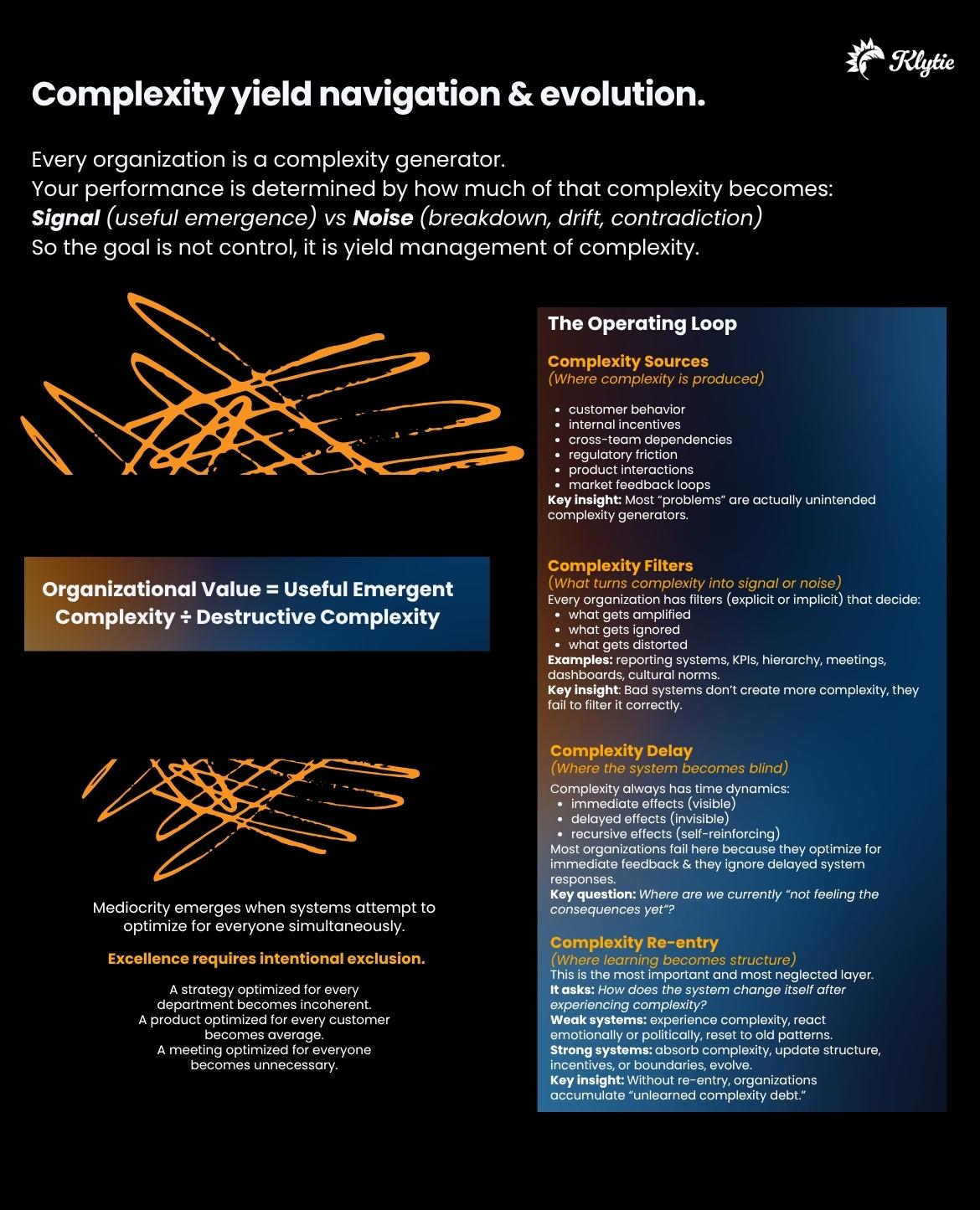
For centuries we mined simplicity from complexity. The next era may belong to those who learn to mine complexity itself.
“Don’t solve the event. Improve the system that generated it” This is the essence of the great inversion. A shift from reducing complexity to increasing its yield.
- From predicting outcomes to navigating emergence.
- From controlling systems to shaping the conditions from which better outcomes naturally arise.
- From fixing recurring problems to redesigning the structures that keep producing them.
- From managing change to enabling evolution.
If these perspectives intrigue you, challenge you, or even provoke you, this could be an invitation for you. Because the future may not belong to those who can see around corners. It may belong to those who can build organizations that thrive when the road disappears altogether.
Until next time, keep it handy!
